Should You Add Subscriptions to Your Shopify Store?
Last updated: · Shopify features, pricing, and platform policies change. Verify with official sources before acting.
Quick answer
Only when three things line up: a SKU repeating above 25%, app spend under 5% of MRR, and a 60-day pilot you ran by hand before installing anything. Most $5K–$50K MRR stores fail at least one of those on the first pass. The three checks and the platform comparison are below.
Who this Shopify subscription guide is for
This guide is for solo Shopify sellers in the $5K–$50K MRR range who are considering adding subscriptions for the first time — or evaluating whether to keep an existing subscription program. It assumes a single-storefront, one-person operation, 20–200 active SKUs, and limited time to manage a second sales motion on top of one-time orders. If you’re running a pure subscription business (subscriptions are your only revenue), the framework here is still useful but you’ll need additional churn-management layers on top. If you’re at $1K–$5K MRR, hold on subscriptions entirely until your one-time order base stabilizes.
The framework is built around one constraint: one-person stores consistently overestimate how much a Shopify subscription program will lift LTV and underestimate the operational overhead. The decision tree below corrects both.
Why subscriptions look great and break small stores
The pitch for subscriptions is consistent across platforms: predictable revenue, higher LTV, lower churn, easier forecasting. All four are true at scale. None of them is automatic at $5K–$50K MRR.
The first failure mode is the catalog mismatch. Subscriptions only work for SKUs that customers actually want to repurchase on a calendar. Consumables work. Replenishables work. One-time-purchase goods (apparel, accessories, gifts) don’t, and dressing them up in a “subscribe and save” wrapper produces a single first month then a cancellation. Most solo stores discover this after 90 days of app fees.
The second failure mode is the tech overhead spiral. A subscription app adds $39–$199/month in baseline fees, plus per-transaction processing on top of standard Shopify Payments fees. For a store doing $15K MRR with ten subscription customers averaging $35/month, the gross subscription revenue is $350, the app cost is $60–$199, and the manual time to manage skips, swaps, and address changes consumes 2–4 hours a month. The economics rarely break even in year one.
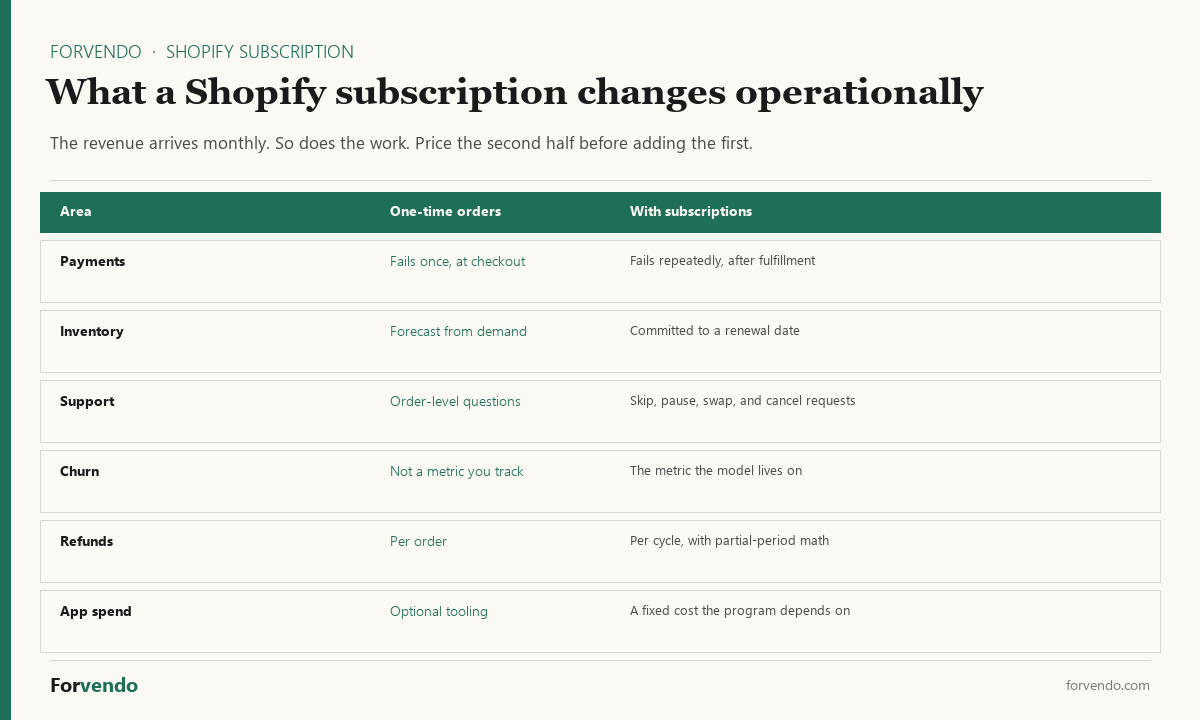
The third failure mode is the one the app fee hides: a subscription changes six operating areas at once, and each of them lands on the same person who was already running the store.
The third failure mode is the expectation gap. Subscription LTV is real, but the multiplier is usually 1.5x–2.5x over the one-time-purchase customer, not the 8x–10x the marketing materials suggest. Worse, the LTV gain only materializes after the customer survives the first three cycles — and first-three-cycle survival rates for new programs run 40–60%.
A Shopify subscription decision tree fixes all three by forcing the readiness check before the install.
The 3 questions before adding subscriptions on Shopify
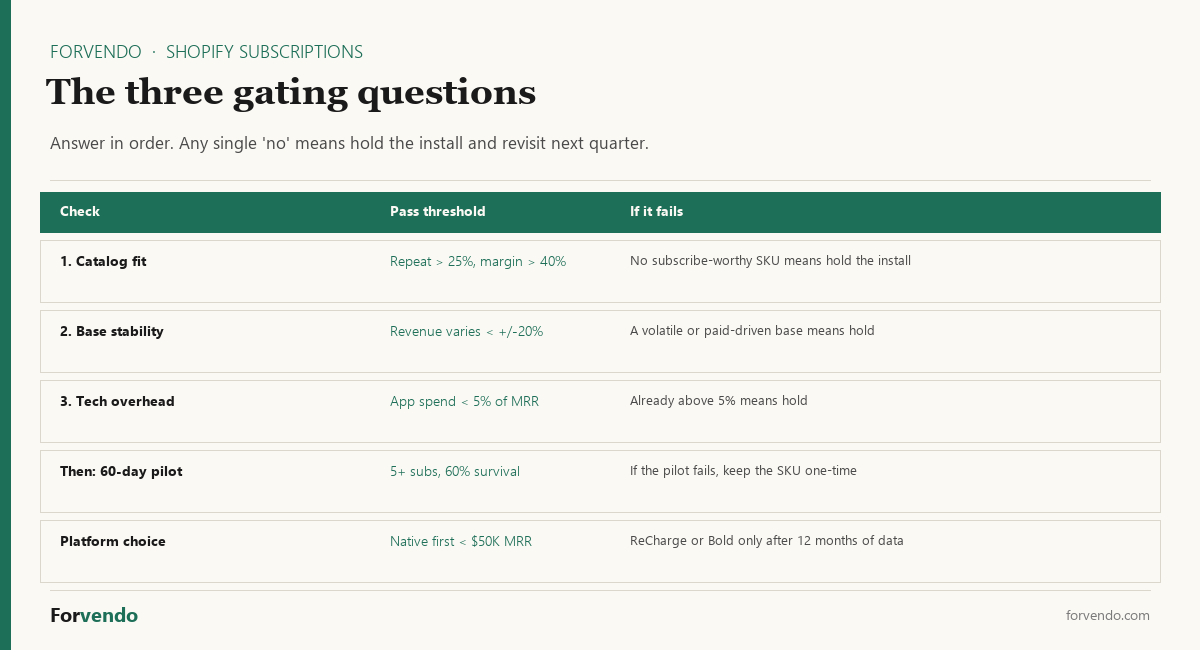
Three questions, in order. If any one of them returns “no,” stop the install and revisit in a quarter.
Question 1 — Does the catalog support subscriptions?
At least one Tier A or Tier B SKU should satisfy three criteria: (a) it’s genuinely replenishable on a 30/60/90 day cycle, (b) it has a verifiable repeat-purchase rate above 25% on the last 12 months of one-time orders, and (c) it carries a margin of at least 40% to absorb subscription processing fees plus a 10–20% subscribe-and-save discount.
If you have no SKU that hits all three, the answer is no.
Question 2 — Is the existing one-time-order base stable?
Subscriptions add operational surface area. The base must be stable enough to absorb it. The check: trailing 6-month monthly revenue should vary by less than ±20% month-over-month, and you shouldn’t be relying on paid acquisition as the primary driver of revenue.
A store growing 40% month-over-month from paid traffic isn’t stable. A store doing $12K, $14K, $11K, $13K, $15K, $14K is stable. The Shopify subscription model overview covers additional readiness considerations beyond the three checks above.
Question 3 — Is current tech overhead below 5% of MRR?
Pull your current monthly Shopify app spend. Divide by MRR. If you’re already above 5%, adding $40–$199/month in subscription app fees will push you past 7–8%, and the math no longer works. The How Many Shopify Apps Is Too Many? covers how to measure and trim that overhead before adding any new tool.
These thresholds are planning assumptions, not universal benchmarks — actual readiness depends on category, margin structure, vendor reliability, and how much manual fulfillment overhead you can absorb. Use them as a starting point and adjust to your own measured numbers.
If all three questions return “yes,” continue to the platform comparison and the 60-day pilot. If any returns “no,” the decision is to wait.
ReCharge vs Bold vs Shopify Subscriptions native — when each one fits
The three serious options on Shopify in 2026 sit on different cost-and-control curves. Pick by store size and operational tolerance, not by feature list.
Free download
The Solo Shopify Weekly Operating Checklist
A one-page PDF plus a copyable Google Sheet — the weekly cadence these guides build on. Free; bring your own store data.
Get the free checklist →For a brand-new Shopify subscription program at $5K–$50K MRR, Shopify Subscriptions native is usually the right starting point. Zero monthly fee, native integration, no migration risk. Move to ReCharge or Bold only after the first 12 months of operating data show that the bottleneck is platform features, not catalog fit.
Forvendo decision rule
Forvendo decision rule
Do not add a Shopify subscription program until repeat-purchase rate on the candidate SKU is above 25% AND current tech overhead is below 5% of MRR AND you have completed a 60-day manual pilot without an app. Treat all three as gating checks, in that order. The first two are gating questions; the third is the cost-free way to test the catalog fit before paying for the platform.
The cost of skipping the pilot is six months of app fees and the operational pull of managing a subscription motion that the catalog cannot sustain. The cost of running the pilot is two evenings to set up a manual reorder calendar in a spreadsheet.
The 3-axis decision: SKU repeat-purchase rate × LTV uplift × tech overhead
The three readiness questions answer “should we?” The 3-axis decision answers “how much will it lift?” Use it to size the program before the install.
Shopify subscription decision — repeat rate gates the test, LTV uplift sizes the prize, tech overhead caps the cost.
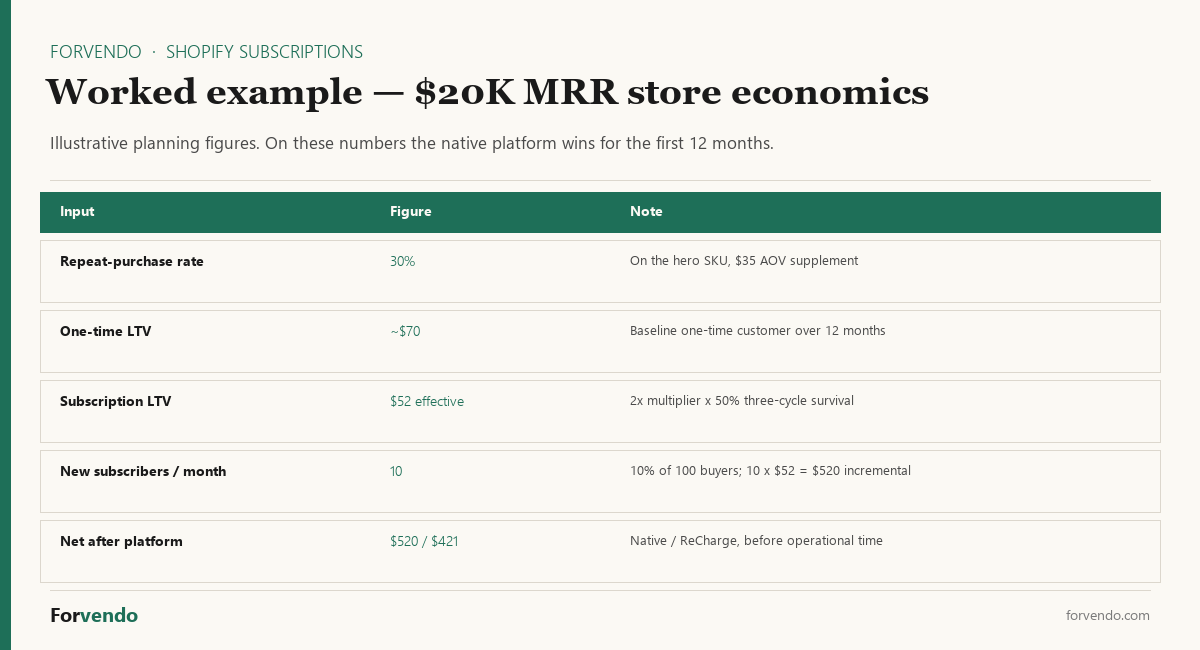
Worked example. A $20K MRR store with a 30% repeat-purchase rate on a hero supplement SKU at $35 AOV. One-time customer LTV is roughly $70 over 12 months. Expected subscription LTV (2x multiplier, 50% three-cycle survival) is $105 × 50% = $52 effective LTV per converted subscriber. Current tech overhead is 3.5% of MRR. If 10% of new buyers convert to subscriptions at 100 new buyers a month, that’s 10 new subscribers a month × $52 = $520 incremental monthly revenue. After a $99 ReCharge plan, net gain is $421 — and that’s before any operational time cost. With Shopify Subscriptions native, net gain is $520 minus operational time. Native wins for the first 12 months on these numbers.
The readiness checklist (do not add subscriptions yet if…)
Use this checklist on the candidate SKU before any platform install. Any single failure means hold.
- ✗ The candidate SKU has a repeat-purchase rate below 25% on the trailing 12 months
- ✗ The SKU margin is below 40% (can’t absorb processing + subscribe-and-save discount)
- ✗ Trailing 6-month monthly revenue varies by more than ±20% month-over-month
- ✗ Current tech overhead is already above 5% of MRR
- ✗ Paid acquisition is the primary driver of revenue (subscription churn dynamics will surprise you)
- ✗ You have fewer than 100 new buyers per month (sample size for any cohort analysis is too small)
- ✗ You have not run a 60-day manual pilot (catalog fit unverified at zero cost)
Six of seven “no”s and one “yes” is still hold. Subscriptions reward focus, not breadth.
The 60-day pilot framework
Before any subscription app or platform decision, run a 60-day manual pilot. Cost: zero in software. Time: 2–3 hours to set up, 30 minutes a week to operate.
Setup (one evening)
Pick one candidate SKU. Create a simple Shopify subscription landing page or note on the product description: “Want this monthly? Email us — first 10 subscribers get the first month at 20% off, no card stored.” Capture customer email and shipping address.
Forvendo newsletter
Operating notes, once a week
One email a week for US-based solo Shopify operators at $5,000–$50,000 MRR: a decision, a checklist, or a teardown. No fluff, unsubscribe anytime.
Join the newsletter →Operation (30 min/week)
Each Monday, ship the orders for that week’s subscription cycle. Use the existing one-time order workflow — you’re creating draft orders manually in Shopify Admin for each subscriber. Charge the card by emailing a Shopify checkout link (or use Shop Pay with stored payment if the customer has it). Log subscriber count, retention, and time spent.
Measure (one evening at day 60)
Compute four numbers: number of paid cycles per subscriber on average, churn rate (subscribers who skipped or canceled), operational time per cycle, and incremental margin after processing fees. If you reach 5+ active subscribers at day 60 with 60%+ three-cycle survival, the catalog fit is real and the platform install is justified. If you reach fewer than 5 subscribers or churn above 50% by day 60, the answer is no — keep the SKU one-time-only.
The pilot is the single highest-leverage check before committing to monthly subscription app fees.
Quarterly review trigger
Even after the program is running, four signals justify a quarterly recalibration.
- Repeat-purchase rate drift — recalculate every quarter. If the SKU rate drops below 25%, pause new subscription signups and figure out why.
- Tech overhead drift — confirm total app spend hasn’t crept past 5% of MRR. If it has, audit and trim before adding any new subscription tooling.
- Three-cycle survival rate — measure each cohort. If survival falls below 50% across two consecutive quarters, the program isn’t retaining and a deeper diagnosis is needed.
- Operational time — track minutes per subscription cycle. If time is climbing without subscriber growth, the manual portion of the workflow is broken and probably justifies platform features (or program shutdown).
If two of the four signals trend wrong in the same quarter, the next quarterly review is a structural one — keep, fix, or shut down — not a tweak.
Free Subscription Readiness Audit
The Forvendo Subscription Readiness Audit is a five-sheet spreadsheet that holds the decision tree in one file. It includes a SKU repeat-purchase calculator (paste your one-time order export, the sheet computes the rate), an LTV uplift projection with adjustable survival assumptions, a tech overhead audit comparing current app spend to MRR thresholds, and a 60-day pilot log. There’s no email gate.
Download the free Subscription Readiness Audit 2026 to score your candidate SKU against repeat rate, LTV uplift, and tech overhead before the platform decision.
Download the Subscription Readiness Audit 2026 · XLSX 14 KB
The audit pairs with the Weekly Shopify Checklist for a One-Person Store, which includes a weekly block for active subscription cycle monitoring alongside the rest of your operating cadence.
Related Forvendo guides
A subscription program is one decision inside the wider operating system. The How Many Shopify Apps Is Too Many? keeps the tech-overhead axis honest by measuring total app spend against MRR before any new tool goes in. The How to Calculate a Reorder Point applies the same measure-then-decide approach to inventory, and the Weekly Shopify Checklist for a One-Person Store sets the quarterly review block where the subscription recalibration trigger lives.
Should you add a subscription program?
A planning guide based on the Forvendo subscription decision tree, not a guarantee.
Common mistakes
The first common mistake is installing a subscription app before verifying catalog fit. Two months of app fees can be saved by running a 60-day manual pilot first.
The second is treating all subscription apps as equivalent on day one. For a store at $5K–$50K MRR with no existing subscription program, Shopify Subscriptions native is usually the right starting point — the more expensive platforms make sense only after platform features are the actual bottleneck.
The third is overestimating LTV uplift. The realistic multiplier is 1.5x–2.5x, not the 8x–10x marketing decks suggest, and it only materializes after three-cycle survival.
The fourth is ignoring tech overhead drift. A subscription app costs the same monthly whether you have 5 subscribers or 50. At small subscriber counts, the platform overhead is the dominant operating cost.
The fifth is failing to recalibrate quarterly. Subscription programs that aren’t measured on repeat-rate, LTV, and tech overhead each quarter end up unprofitable by month nine without anyone noticing.
What this article does not cover
This article doesn’t cover the customer experience design of a Shopify subscription portal (cancellation flow, swap UI, skip mechanics) — those decisions belong to a UX-specific guide after the program is operational. It doesn’t address SMS-based subscription growth tactics, paid acquisition for subscriptions, or B2B / wholesale subscription motions. It doesn’t benchmark every subscription app on Shopify, only the three most-installed at $5K–$50K MRR (ReCharge, Bold, native). It doesn’t provide tax guidance specific to subscription revenue — consult a CPA for recurring-revenue tax treatment in your state.
Frequently asked questions
Should I start with Shopify Subscriptions native or pay for ReCharge?
For a brand-new Shopify subscription program at $5K–$50K MRR, start native. Zero monthly fee, native Shopify integration, no migration risk later. Move to ReCharge or Bold only after the first 12 months of operating data show the bottleneck is platform features (advanced retention flows, bundle management, multi-frequency portals), not catalog fit.
What repeat-purchase rate is high enough to consider subscriptions?
The Forvendo threshold is 25% on the trailing 12 months. Below 25%, the catalog doesn’t support subscriptions even with a discount. Between 25% and 40% the program can work but requires tight three-cycle survival management. Above 40% the catalog fit is strong and the main question becomes platform choice and tech overhead — not whether.
How do I calculate SKU repeat-purchase rate from Shopify?
Export the last 12 months of orders from Shopify Admin → Orders → Export. For the candidate SKU, count distinct customers who placed 2 or more orders containing that SKU. Divide by total distinct customers who bought the SKU at all. The Subscription Readiness Audit above automates this calculation if you paste the export into the SKU calculator sheet.
What LTV multiplier should I assume for subscription customers?
Use 1.5x–2.5x over the one-time-purchase LTV for planning. The marketing decks for subscription platforms suggest 8x–10x; that figure assumes 12+ cycle survival at large subscriber counts and doesn’t match reality at $5K–$50K MRR. Use the conservative multiplier in your projections, then revise upward only after you have 6 months of actual data.
Is the 60-day manual pilot really necessary?
Yes for first-time subscription programs. The pilot costs zero in software and tells you within 60 days whether the catalog actually supports subscriptions. The alternative — installing a $99/month subscription app and discovering churn is 70% in month three — costs $300+ in app fees plus the operational pull. The pilot is the cheapest catalog-fit test available.
How much tech overhead is too much?
5% of MRR is the Forvendo threshold across all apps combined. A subscription app pushes a marginal store past that line — if you’re currently at 3.5–4.5%, adding a $99/month subscription app puts you above 5% on the day of install for any store below ~$40K MRR. Audit the current stack first; remove or downgrade before adding subscription tooling.
What if my candidate SKU has high repeat-purchase rate but low margin?
Subscriptions don’t fix margin. A 30% repeat-purchase rate on a SKU with 25% margin still can’t absorb subscription processing fees plus a 10–20% subscribe-and-save discount. The subscription thesis requires both replenishability and margin — start with margin improvement before subscription consideration.
How do I run the manual 60-day pilot without deliverability problems?
Send the recurring checkout link from your normal store reply-to address (the one customers already get order confirmations from). Keep the messages plain, relevant, and personal — no marketing decoration. The pilot involves a small subscriber group, so replies stay within your normal customer-support flow rather than a marketing pipeline.
Forvendo Editorial note. Forvendo publishes educational operating resources for solo ecommerce operators. Articles may cover tax, sales tax, 1099-K reporting, software pricing, platform policies, and other operating topics that change over time.
This content is for general research and operational planning. It is not legal, tax, accounting, financial, or professional advice. Readers should verify details with official sources or qualified professionals before acting on them. Platform rules, tax thresholds, software pricing, and affiliate program terms can change without notice.
Forvendo articles may be drafted with AI assistance and are reviewed by the operator before publication according to our Editorial Policy, which covers sourcing, AI use, update cadence, and corrections. See also About, Disclosure, and Privacy Policy.