Do You Have to Pay Quarterly Taxes on Shopify Income?
Last updated: · Estimated-tax thresholds, safe-harbor percentages, and due dates are set by the IRS and can change. Confirm current figures against IRS guidance or a qualified US tax professional before scheduling any payment.
A solo Shopify store doesn’t withhold tax from its own profit. Every dollar of net profit lands in your account untaxed, and the IRS expects to be paid as that income is earned — not in one lump at filing time. For a founder whose store clears a few thousand dollars a month, that gap is where the January surprise and the underpayment penalty come from.
This guide covers the operating decision behind quarterly estimated taxes: whether you actually need to pay them, how much to set aside, and the four dates the payments are due. It’s built around a single safe-harbor rule that, once you have one prior-year tax return, can keep you clear of the underpayment penalty and makes the amount largely automatic.
The thresholds and dates here are 2026 planning figures drawn from IRS sources; the exact amount you owe depends on your filing status, other income, deductions, and state rules, so confirm the numbers against current IRS guidance or a CPA before acting.
Quick answer
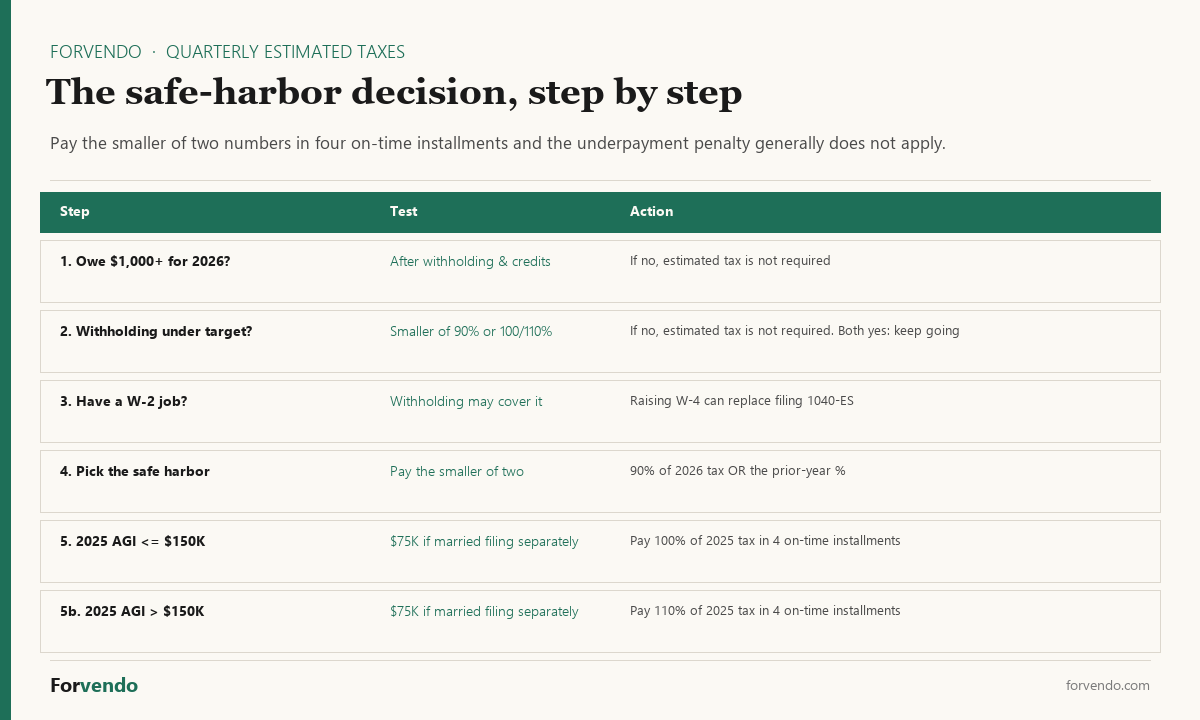
- You generally need to pay quarterly estimated tax only if two things are both true: you expect to owe $1,000 or more in federal tax for 2026 after withholding and refundable credits, and your withholding and refundable credits will come in below the safe-harbor amount described next (IRS, Estimated Taxes; 2026 Form 1040-ES). Sole proprietors, single-member LLC owners, partners, and S-corp shareholders fall under this rule. A first-year founder with no 2025 tax liability may not need 2026 estimates at all (see below).
- The safe harbor is the shortcut. You can generally avoid the underpayment penalty by paying the smaller of 90% of your 2026 tax or 100% of the tax shown on your 2025 return (2026 Form 1040-ES). If your 2025 adjusted gross income was over $150,000 ($75,000 if married filing separately), the prior-year figure rises to 110%.
- Payments use Form 1040-ES and are due in four installments. For the 2026 tax year (calendar-year filers): April 15, 2026 · June 15, 2026 · September 15, 2026 · January 15, 2027. As of October 2026, the first three have passed; the next is January 15, 2027 (catch-up steps are under the four due dates).
- A W-2 day job can absorb the store’s tax. If you also have employment income, raising your W-4 withholding is often simpler than filing 1040-ES — the IRS generally treats withholding as paid evenly across the year, whenever it happens.
- A set-aside percentage keeps the cash ready. Moving a fixed share of every payout (a common planning range is 25–30% of net profit) into a separate account means the quarterly payment is already funded when the date arrives.
For the payment-side reporting that feeds your tax return, see Does Shopify Send You a 1099-K?. For sales tax — a separate obligation from income tax — see Shopify Sales Tax in Multiple States. If you pay contractors, W-9 and TIN Reconciliation covers the other side of the 1099 system.
Table of Contents
Who this is for
This article is written for the same reader as the rest of Forvendo’s tax coverage.
- You sell on Shopify in the United States, typically on the Basic plan.
- Monthly revenue sits between $5,000 and $50,000, and the store turns a net profit.
- You operate as a sole proprietor or single-member LLC (income flows to your personal 1040).
- You may also have a W-2 job, or the store may be your only income.
- You want to know whether quarterly payments apply to you, how much to set aside, and when to pay.
If your business is taxed as an S corporation paying you a salary, part of this changes — payroll withholding covers some of the obligation, and the planning runs differently. If your only concern is sales tax collected from customers, that’s a separate system covered in the multi-state guide above; this article is about income tax on your profit.
Why estimated tax exists
The US income tax is pay-as-you-go. For an employee, that happens automatically: an employer withholds tax from each paycheck and sends it to the IRS. A solo Shopify founder has no employer doing that, so the system asks you to make the payments yourself, four times a year.
The mechanism that enforces it is the underpayment penalty. If you owe $1,000 or more at filing time and didn’t pay enough during the year, the IRS assesses an underpayment penalty on the shortfall, figured for each installment period on Form 2210 using the IRS’s published underpayment interest rate and the number of days the shortfall stayed unpaid (IRS, Underpayment of Estimated Tax by Individuals Penalty). It is usually modest next to the tax itself, but it is avoidable, and avoiding it is almost entirely a matter of paying on a schedule rather than paying the right amount to the dollar.
That distinction is the key to making this simple. You don’t need to predict your exact tax to avoid the penalty. You need to clear a safe-harbor number, and the safe harbor can be set from a figure you already have: last year’s tax.
Do you need to pay? The $1,000 rule
The first decision is whether quarterly estimated taxes apply to you at all. Three situations let many side-business owners skip 1040-ES entirely.
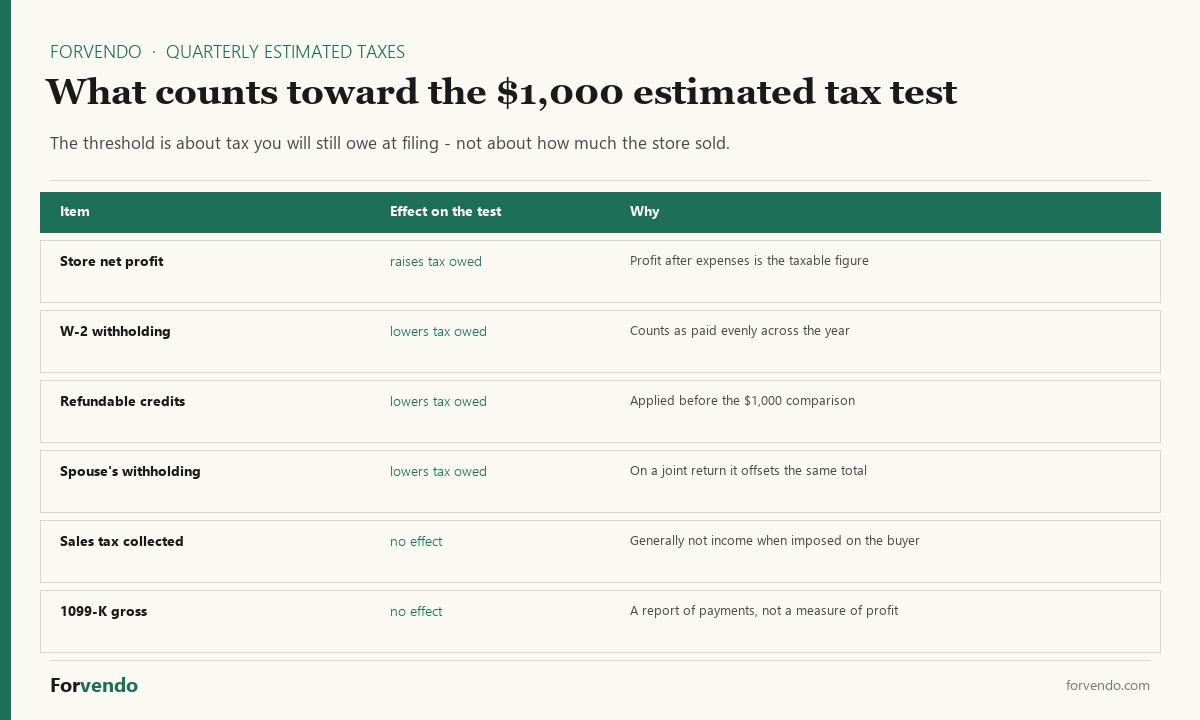
The figure that matters is tax still owed after everything already paid or credited, which is why two stores with identical revenue can land on opposite sides of the line.
Forvendo decision rule
Estimated payments are generally required only if both apply: you expect to owe at least $1,000 for 2026 after withholding and refundable credits, and your withholding and refundable credits will be less than the smaller of 90% of your 2026 tax or 100% of your 2025 tax (110% if 2025 AGI was over $150,000, or $75,000 if married filing separately). If either test fails, the IRS does not require estimated payments (2026 Form 1040-ES).
If you also have a W-2 job, check whether raising your W-4 withholding can cover the store’s tax instead. Withholding is treated as paid evenly across the year, so a single W-4 change late in the year can still satisfy the full-year requirement — something a late estimated payment cannot do.
Don’t file 1040-ES yet if a W-2 job already covers it. Many founders run the store alongside full-time employment. If your employer’s withholding already exceeds your total expected tax (store profit included), you may owe less than $1,000 at filing and need no estimated payments. Raising your W-4 withholding to cover the store’s profit is often simpler than quarterly filings, because it stays automatic and withholding is treated as paid evenly through the year, so a later increase still counts toward the earlier installments (Instructions for Form 2210).
No 2025 tax liability. If you were a US citizen or resident alien for all of 2025 and your 2025 total tax was zero (or you didn’t have to file), you don’t have to pay 2026 estimated tax, provided your 2025 tax year covered a full 12 months (2026 Form 1040-ES; IRS Pub. 505). This can cover a founder whose first profitable year is 2026.
Pay quarterly if the store is your main income, or if withholding falls short. A founder with no W-2 job, or whose day-job withholding doesn’t cover the store’s profit, will generally clear the $1,000 threshold once the store is profitable and should plan on quarterly payments.
The safe harbor: how to avoid the underpayment penalty
Once you know you need to pay, the safe harbor decides how much. This is the rule that removes the guesswork. The IRS generally lets you avoid the underpayment penalty by paying the smaller of two numbers across your four installments, with each installment paid by its due date.
The prior-year method is the one that makes this manageable for a one-person store. Your 2025 tax is a fixed, known number sitting on your filed return. Pay that amount (or 110% of it if your 2025 AGI was over $150,000, or $75,000 if married filing separately) in four equal installments, each by its due date, and you’re generally inside the safe harbor however the store performs this year, provided your 2025 return covered a full 12 months (2026 Form 1040-ES).
Free download
The Solo Shopify Weekly Operating Checklist
A one-page PDF plus a copyable Google Sheet — the weekly cadence these guides build on. Free; bring your own store data.
Get the free checklist →If the store grows and you end up owing more, the extra is due at filing, generally without a penalty. If you are reading this after one or more 2026 dates have passed, see the catch-up steps under the four due dates.
The current-year method (90% of this year’s tax) can mean smaller payments if you expect the store to earn less than last year, but it requires estimating a number you don’t know yet. For most founders, the prior-year safe harbor is the simpler, lower-risk default. The current-year method is worth using only when you have a clear reason to expect lower income.
If you want the four installment amounts without building a sheet, the self-employed estimated tax calculator takes your prior-year tax, AGI, and filing status (including the $75,000 married-filing-separately threshold) and applies the 100% or 110% rule. Enter this year’s expected tax and it uses the 90% route when that is smaller; enter expected withholding and it subtracts that before splitting the rest into four payments. If the expected tax you enter leaves under $1,000 owed after withholding, it notes that estimated payments are generally not required.
One detail worth knowing: the IRS generally expects the installments to be roughly even across the four periods. Paying the full year’s safe-harbor amount in equal quarters satisfies that. If your income is highly seasonal, the annualized income installment method on Form 2210 can match payments to when income is actually earned, but for a steady store the even-installment approach is simpler.
How much to set aside
The safe harbor tells you the floor for penalty protection. A set-aside percentage tells you how to keep that cash available without thinking about it each month.
Your tax on store profit has two layers as a sole proprietor: self-employment tax (Social Security and Medicare on net self-employment earnings) and federal income tax at your marginal rate. State income tax may add a third, depending on where you live. Because those layers stack, the share of profit that needs to go to tax is higher than many founders expect — which is why a flat set-aside percentage, moved the moment a payout lands, prevents the cash from being spent before the quarterly date.
Set-aside worksheet
- Pick a set-aside rate. A common planning range for a profitable solo store is 25–30% of net profit; confirm your own rate with a CPA, since it depends on your bracket, state, and the self-employment tax interaction.
- Each time the store pays out, move that percentage of the period’s net profit into a separate tax savings account.
- On each due date, pay the safe-harbor installment from that account.
- At year-end, true up: if the set-aside account holds more than the tax owed, the surplus is yours; if less, top up before filing.
The set-aside percentage is a cash-flow tool, not a tax calculation. The safe harbor decides whether you owe a penalty; the set-aside decides whether the money is there to pay it.
The two tools work together. The safe harbor sets the minimum you pay each quarter to generally avoid the penalty; the set-aside builds the reserve those payments come from. A founder who does both rarely has a January surprise, because the cash was separated all year and the quarterly payments already cleared the safe-harbor bar.
A worked example
These figures are illustrative planning numbers, not a tax calculation for any real return. They show the mechanics, not a rate you should copy.
Forvendo newsletter
Operating notes, once a week
One email a week for US-based solo Shopify operators at $5,000–$50,000 MRR: a decision, a checklist, or a teardown. No fluff, unsubscribe anytime.
Join the newsletter →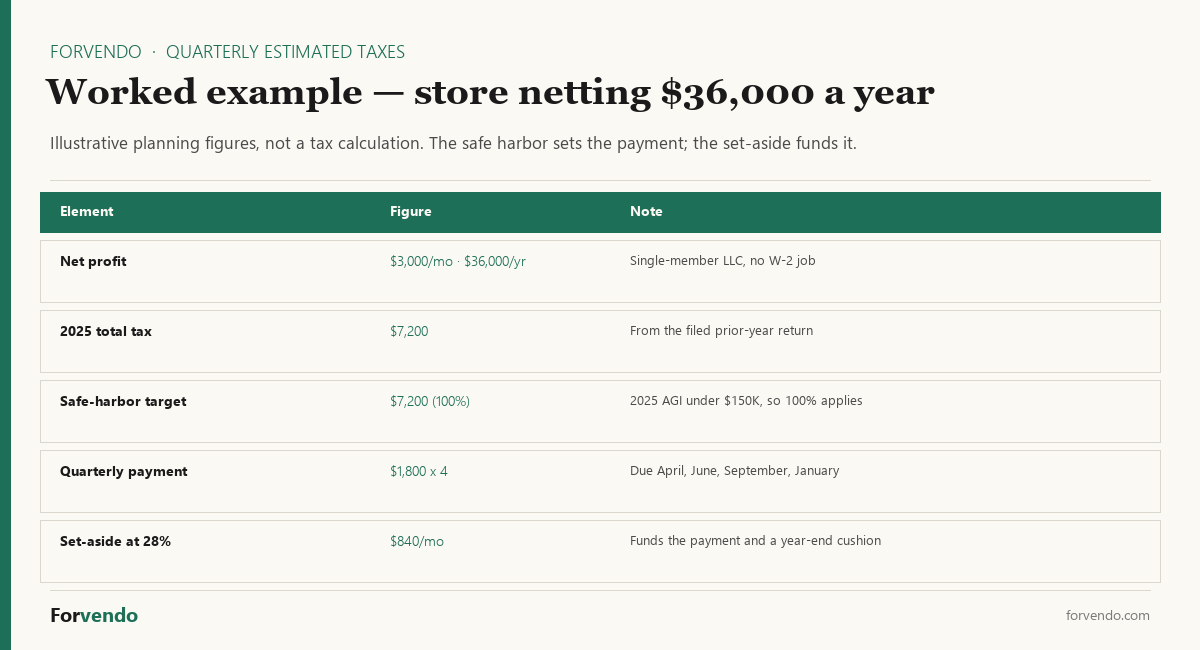
Consider a single-member LLC store that nets $3,000 a month in profit — $36,000 for the year — and has no W-2 job. Say you filed a 2025 return showing $7,200 in total tax and had a 2025 AGI under $150,000.
Safe-harbor target (prior-year method). Paying 100% of the 2025 tax, with each installment on time, generally avoids the penalty: $7,200 for the year, split into four installments of $1,800 due in April, June, September, and January. That target stays fixed however 2026 turns out. A founder starting this plan in October 2026 has already missed three of those dates; the catch-up steps under the due dates apply.
Set-aside (forward-looking). At a 28% set-aside rate on $3,000 of monthly profit, you move $840 a month into a tax account. By April 15 that is $2,520 against an $1,800 payment; the two-month April–May period adds only $1,680, but the $720 left over from the first period covers the June 15 payment. Over the year the account builds a cushion for any true-up at filing.
Year-end true-up. If 2026 profit holds near 2025, the actual tax lands close to the $7,200 already paid through the safe harbor, and the leftover set-aside is yours. If the store grows and the real 2026 tax is higher, the difference is due at filing in April 2027, generally without a penalty, because the prior-year safe harbor was met every quarter.
The point of the example is the order of operations: the safe harbor sets the payment, the set-aside funds it, and the true-up reconciles. None of the three requires predicting the year accurately.
The four 2026 due dates
For a calendar-year filer, the 2026 estimated-tax installments are due on these dates (2026 Form 1040-ES). Each of the four 2026 dates falls on a weekday, so no weekend or holiday shift applies this year.
As of October 2026, the first three 2026 installments have passed; the next is January 15, 2027. If you missed earlier installments, paying the shortfall now stops the penalty from growing on those periods, because the penalty runs for the number of days each underpayment stays unpaid (2026 Form 1040-ES). Raising W-4 withholding for the rest of the year can also help, since withholding is treated as paid evenly through the year. If most of the income arrived late in the year, the annualized income installment method (Form 2210, Schedule AI) can reduce the penalty.
The quarters aren’t even three-month blocks — the first covers three months, the second two, the third three, and the fourth four. That’s a quirk of the system, not a typo. The fourth installment also has an escape hatch: you can skip the January 15, 2027 payment if you file your full 2026 return and pay the entire balance by February 1, 2027 (IRS, When to Pay Estimated Tax).
Payments can be made through IRS Direct Pay, the Electronic Federal Tax Payment System (EFTPS), or by mailing the 1040-ES voucher. Direct Pay from a bank account is free and the cleanest paper trail for a solo store owner.
Common mistakes
- Spending the profit, then scrambling at the due date. Without a set-aside account, the quarterly payment competes with inventory and operating cash. Separate the tax money the moment a payout lands.
- Treating sales tax money as profit. Sales tax imposed on the buyer that you collect and remit generally isn’t your income (IRS Pub. 334); in a state that imposes the tax on the seller, it goes into gross receipts and is deducted when paid. Either way, estimated income tax is calculated on profit, not on the sales tax passing through.
- Assuming a W-2 refund means you’re covered. A day-job refund can disappear once store profit is added. Check the combined picture before deciding to skip estimated payments.
- Forgetting state estimated tax. Many states with an income tax run their own quarterly estimated system with separate vouchers and, sometimes, different dates. Confirm your state’s rules alongside the federal ones.
- Trying to calculate the exact tax each quarter. The safe harbor exists so you don’t have to. Paying the prior-year safe-harbor amount in even installments is simpler and generally avoids the penalty when each installment is paid on time.
- Missing the even-installment expectation. Paying the whole year’s amount in Q4 can still trigger a penalty for the earlier quarters. Spread the safe-harbor amount across all four dates.
What this article does not cover
This guide is scoped to federal quarterly estimated income tax for a one-person Shopify store taxed as a sole proprietor or single-member LLC. It doesn’t cover state estimated-tax mechanics beyond noting that they exist, S-corporation payroll and reasonable-compensation rules, the detailed calculation of self-employment tax, the annualized income installment method in depth, or penalty abatement after a missed payment. It also doesn’t address sales tax, which is a separate obligation covered in the multi-state sales tax guide. Any of those situations benefits from a qualified US tax professional.
Related Forvendo guides
Estimated taxes are one block in the store’s financial operating system. The Does Shopify Send You a 1099-K? explains how the income figure that drives your tax actually arrives from Shopify Payments, and why the 1099-K isn’t your revenue. Shopify Sales Tax in Multiple States covers the separate sales-tax obligation that founders often confuse with income tax. If you pay contractors, W-9 and TIN Reconciliation handles the 1099-NEC side of the same annual cycle. 1099-K vs 1099-NEC sorts out which of the two forms a given payment belongs on. The Weekly Shopify Checklist for a One-Person Store is where the quarterly tax review fits into a recurring cadence.
Download the Estimated Tax Planner
The companion sheet turns the safe harbor and set-aside into a working tool: a prior-year safe-harbor calculator (100% / 110%), a set-aside percentage worksheet, and a 2026 quarterly due-date tracker.
Download the Estimated Tax Planner 2026 · XLSX
Estimated Tax Safe-Harbor Calculator
Planning estimate, not tax advice. Uses the smaller of 90% of this year's tax (if entered) or 100% / 110% of last year's. Confirm with a CPA.
Frequently asked questions
Do I have to pay quarterly estimated taxes if my Shopify store is a side project?
Generally only if both of these apply: you expect to owe $1,000 or more for 2026 after withholding and refundable credits, and your withholding and refundable credits will be less than the smaller of 90% of your 2026 tax or 100% of your 2025 tax (110% if 2025 AGI was over $150,000, or $75,000 if married filing separately). If your W-2 job withholds enough to cover both your salary and the store’s profit, you may owe less than that and need no estimated payments. Raising your W-4 withholding is often the simpler way to cover side-store profit, because withholding is treated as paid evenly through the year.
How do I avoid the underpayment penalty without knowing my exact income?
Use the prior-year safe harbor. Paying 100% of your 2025 tax (110% if 2025 AGI was over $150,000, or $75,000 if married filing separately) in four equal installments, each by its due date, generally avoids the penalty even if the store earns more this year, provided your 2025 return covered a full 12 months. The extra is then due at filing.
What are the 2026 estimated tax due dates?
For calendar-year filers: April 15, 2026; June 15, 2026; September 15, 2026; and January 15, 2027. You can skip the January 15 payment if you file your full 2026 return and pay the balance by February 1, 2027.
How much of my Shopify profit should I set aside for taxes?
A common planning range is 25–30% of net profit for a profitable solo store, because self-employment tax and federal income tax stack on top of each other, and state tax may add more. Your actual rate depends on your bracket, filing status, and state — confirm it with a CPA. The set-aside is a cash-flow habit; the safe harbor is what determines the penalty.
Is estimated income tax the same as the sales tax I collect from customers?
No. Sales tax imposed on the buyer is collected from customers and remitted to the state, and it generally isn’t your income; in a state that imposes the tax on the seller, the amount collected goes into gross receipts and is deducted when paid (IRS Pub. 334). Estimated income tax is paid on your store’s profit. They’re separate systems with separate filings, and treating collected sales tax as profit is a common and costly mistake.
Can I just pay everything once a year instead of quarterly?
If you owe $1,000 or more, your withholding falls short of the safe harbor, and you pay only at filing, you’ll generally owe an underpayment penalty for the quarters you skipped, even if you pay in full in April. The penalty is figured for each installment period based on how long each shortfall stayed unpaid, so spreading the safe-harbor amount across all four due dates is what avoids it.
Forvendo Editorial note. Forvendo publishes educational operating resources for solo ecommerce operators. Articles may cover tax, sales tax, 1099-K reporting, software pricing, platform policies, and other operating topics that change over time.
This content is for general research and operational planning. It is not legal, tax, accounting, financial, or professional advice. Readers should verify details with official sources or qualified professionals before acting on them. Platform rules, tax thresholds, software pricing, and affiliate program terms can change without notice.
Forvendo articles may be drafted with AI assistance and are reviewed by the operator before publication according to our Editorial Policy, which covers sourcing, AI use, update cadence, and corrections. See also About, Disclosure, and Privacy Policy.