Does Etsy Send You a 1099-K? Thresholds, Timing, and the Gross Number
Last updated: · Tax laws and platform policies change. Verify with official sources before acting.
Does Etsy send a 1099-K? Yes, if you meet the federal threshold or your state’s — and when it arrives in January it carries a number that matches nothing else in your shop. Here’s who gets one, what Etsy counts in that figure, and how to reproduce it from your own data.
Quick answer
- Yes, if you meet the federal or a state threshold. Etsy states it issues a 1099-K when you met either one, so a smaller shop in a low-threshold state can get a form in a year the federal rules don’t require it.
- For federal TPSO reporting, the IRS threshold is more than $20,000 in payments and more than 200 transactions. Etsy summarizes its 2025 reporting-season threshold as “$20,000 and 200 sales.”
- It reports gross, not profit. Etsy is explicit that the form “doesn’t calculate your profit” — it’s the total buyers paid through Etsy Payments, before fees, refunds, and shipping costs.
- Etsy Payments only. Sales you took some other way, like in-person Square payments, aren’t in the number.
- Marketplace-collected sales tax isn’t in it. Where Etsy collects and remits sales tax on your behalf, Etsy says those totals aren’t reflected in the 1099-K.
- You can reproduce the figure exactly. Download the Etsy Payments Sales CSV and total the Gross column.
Who this is for
You sell on Etsy in the US, or you’re paid in USD, and you file your own books between visits to a tax professional. If you also run a Shopify store, each platform reports separately and you’ll reconcile them separately.
What Etsy actually reports
The 1099-K reports the total gross sales income processed through Etsy Payments for the calendar year. Etsy’s own definition of gross sales is the total buyers paid you “without subtracting expenses, such as: Fees, Refunds, Shipping costs.”
That phrasing is doing a lot of work. Gross means gross. A refunded order still counts, because the payment was processed. So does a canceled one.
Two things sit outside the number, and both surprise people:
- Payments not processed through Etsy Payments. Etsy gives in-person Square sales as the example. Those are still your income; they’re just not on this form.
- Sales tax Etsy collected and remitted for you. In marketplace facilitator states, Etsy collects and remits on your behalf, and it says those totals “won’t be reflected” in the 1099-K. Sales tax you applied yourself using the sales tax tool is treated differently, so check your own records rather than assuming one rule covers both.
Why it matches nothing else in your shop
This is the part that costs people an evening. Etsy shows you five different money numbers, and the 1099-K matches none of the ones you look at day to day.
The IRS defines the gross amount as the total of reportable transactions “without regard to any adjustments for credits, cash equivalents, discount amounts, fees, refunded amounts, or any other amounts.” Etsy is reporting exactly what the IRS asks for. The mismatch isn’t an error on either side.
How to reproduce the number
You don’t have to trust the form. Etsy publishes the arithmetic, and it’s one column in one file.
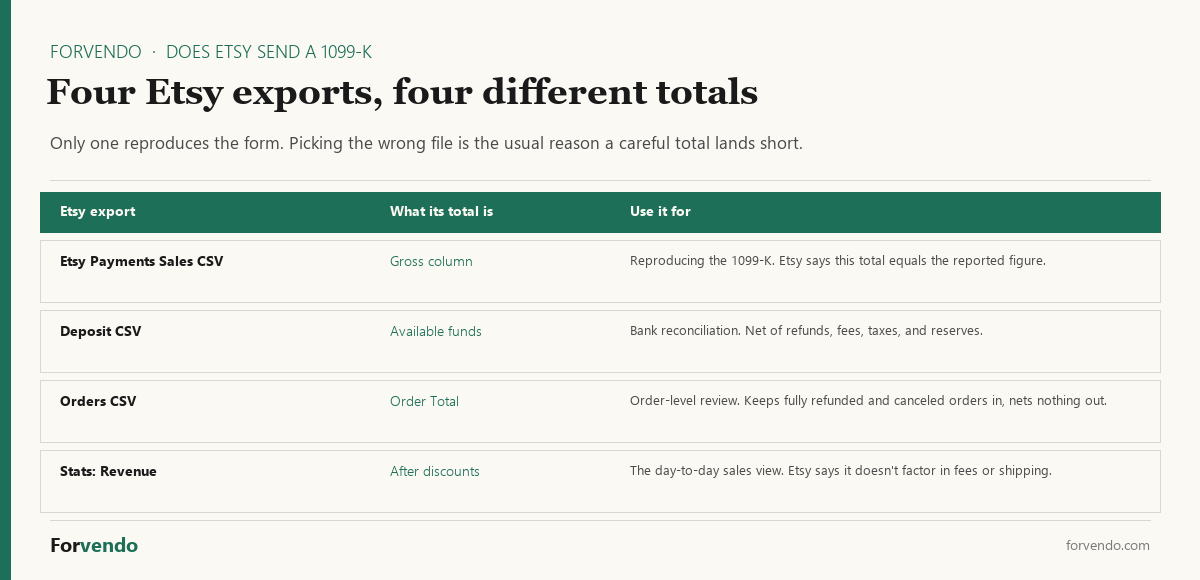
Picking the wrong file is the usual reason a careful reconciliation still lands short. Etsy exports three that look interchangeable and aren’t: the Deposit CSV Amount is available funds after refunds, fees, taxes, and reserves; the Orders CSV Order Total adds all sales but keeps fully refunded and canceled orders in without netting anything out; only the Etsy Payments Sales CSV Gross column reproduces the form. If your total is close but not equal, check which file you opened before you check your arithmetic.
Free download
The Solo Shopify Weekly Operating Checklist
A one-page PDF plus a copyable Google Sheet — the weekly cadence these guides build on. Free; bring your own store data.
Get the free checklist →The same reconciliation, written out with the five line items that explain the gap, is in the Shopify 1099-K guide. The mechanics carry across platforms even though the CSV column names don’t. The marketplace versions differ in what they put inside the gross, which is covered for Amazon and eBay.
From the gross number to your books
Reproducing the figure proves the form is right. It doesn’t tell you what to do with it, and that’s the question that follows immediately: the 1099-K is a gross number, your books are not, and the gap has to be explained line by line.
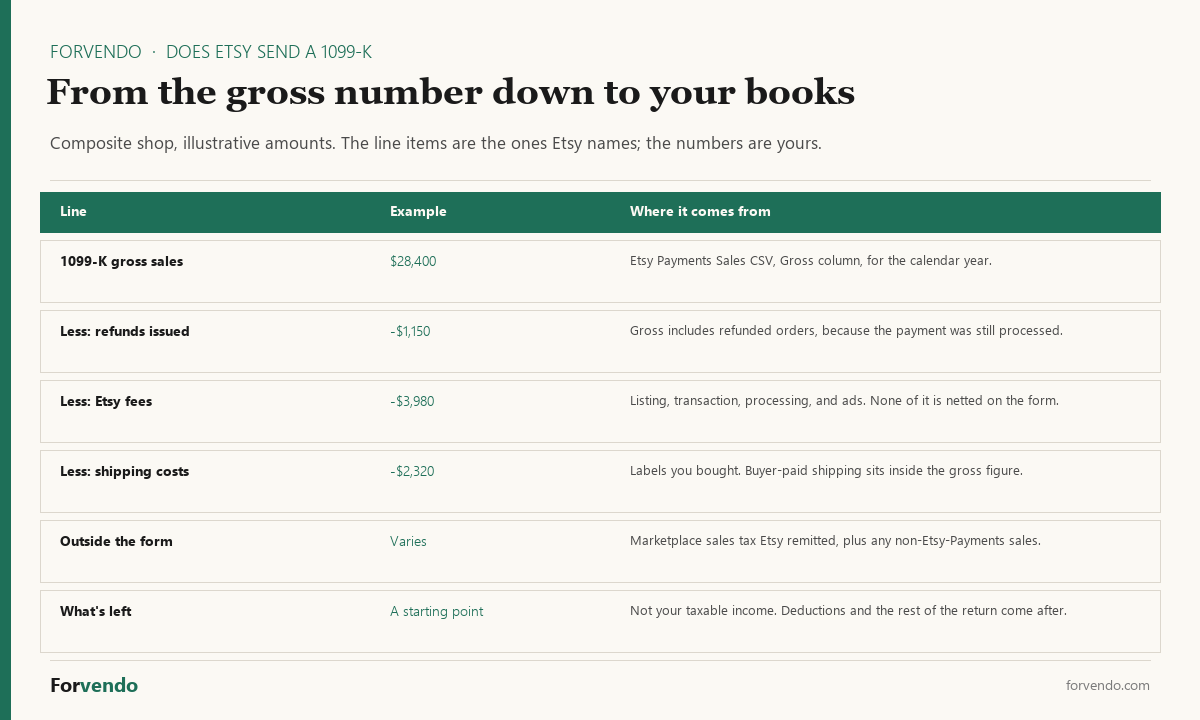
Work top-down, and keep the arithmetic in one file per tax year. Start from the Gross column total. Subtract the refunds you issued, which sit inside the gross figure because Etsy processed those payments. Subtract your Etsy fees — listing, transaction, payment processing, and any ads — none of which the form nets out. The Etsy fee calculator applies those four rates to a single order if you want to see the size of that subtraction before you total a year of them. Subtract what you paid for shipping labels, remembering that the shipping the buyer paid you is part of the gross number on the way in.
Then note the two categories that sit outside the form entirely: marketplace sales tax Etsy collected and remitted for you, and any sales you took outside Etsy Payments. The first is not your income to report; the second is, and it simply isn’t on this form.
What’s left at the bottom is a starting point, not an answer. Deductions, cost of goods sold, inventory treatment, and the rest of your return all sit downstream of it, which is where a CPA or an enrolled agent earns their fee. The value of the bridge is that you arrive at that conversation with a number you can defend and a worksheet that shows how you got there.
Where the form lives, and when
Etsy makes the form available for download rather than mailing it by default. The path is Shop Manager, then Finances, then Legal and tax information, then select the tax year and download. Etsy warns that picking the wrong year from the dropdown produces the wrong numbers, which is an easy mistake to make in a hurry.
Three dates matter, using Etsy’s published 2025-season timeline. These are Etsy’s dates for the 2025 tax year; confirm the current tax year’s dates before filing.
- December 31, 2025 — the last day your taxpayer information can be corrected for that tax year, and the last day to opt out of paperless-only delivery if you want a paper copy mailed.
- By the end of January 2026 — the form is available to download if you crossed a threshold.
- April 15, 2026 — the filing deadline for that tax year’s return.
The $500 trap most guides skip
This one has nothing to do with filing and can stop your shop.
Forvendo newsletter
Operating notes, once a week
One email a week for US-based solo Shopify operators at $5,000–$50,000 MRR: a decision, a checklist, or a teardown. No fluff, unsubscribe anytime.
Join the newsletter →Etsy sends reminders to add a valid SSN or EIN once a shop reaches $250 in sales, and again approaching $500. If valid taxpayer details aren’t on file and sales pass $500 in a calendar year, Etsy states the shop is suspended until the details are added.
So the practical deadline for taxpayer information isn’t tax season. It’s whenever your shop is on its way to its first $500, which for many sellers is months earlier than they expect.
The fix takes a few minutes and the failure mode doesn’t. A suspension lands on the shop, not on the tax filing, so it can arrive in the middle of a good sales week, after Etsy’s reminder emails and Shop Manager alerts. If you opened your shop this year and skipped the taxpayer fields to get listings live, that’s the one piece of admin worth clearing before the next order.
If the number on the form is wrong
Etsy publishes the arithmetic, so a mismatch is usually your file choice rather than an error. Occasionally it is an error — a form that isn’t yours, or an amount that doesn’t reconcile no matter which CSV you open. The IRS is specific about the order of operations there.
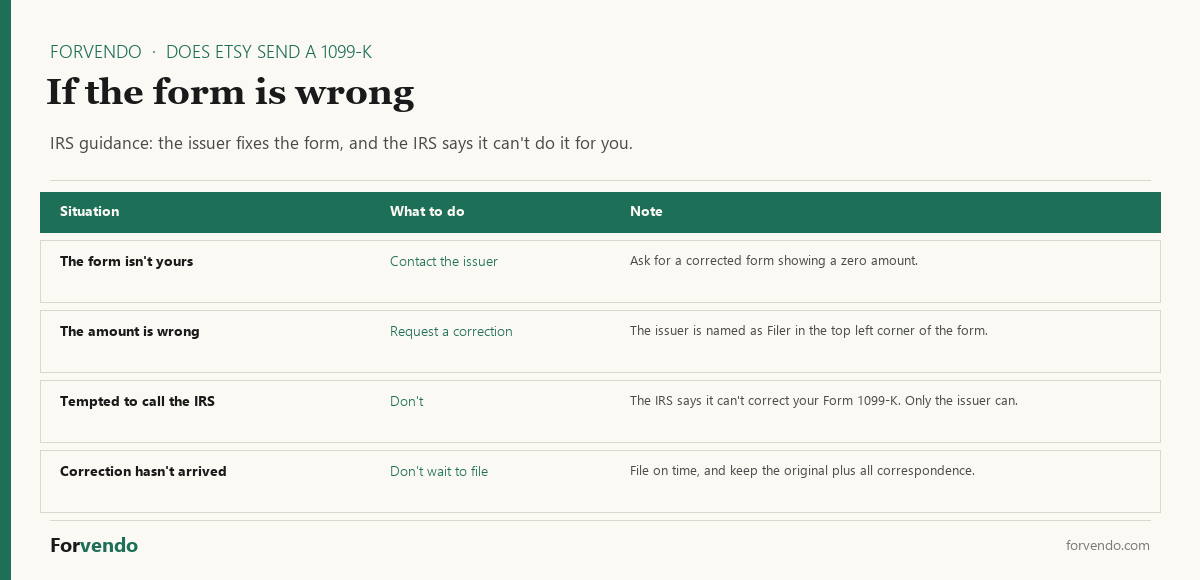
Contact the issuer, not the tax authority. The issuer is named as Filer in the top left corner of the form. If the form isn’t yours at all, the IRS says to ask for a corrected Form 1099-K showing a zero amount; if the amount is wrong, request a corrected form from the same issuer. Keep the original and every message you exchange about it.
The IRS is blunt about the second half: don’t contact the IRS, because it can’t correct your Form 1099-K. Only the party that issued it can.
And don’t let a pending correction push you past the deadline. The IRS guidance is not to wait to file, which means filing on time with your records in order rather than holding the return open while correspondence goes back and forth. What you put on the return in that situation is exactly the kind of question to put to your tax professional rather than to settle from a guide.
If you run more than one Etsy shop
Etsy combines sales across shops that share the same taxpayer ID number, and issues one 1099-K for the combined total, downloadable from each shop.
That cuts both ways. Two shops that each stay under the threshold can still produce a form when added together, and mismatched name, address, or SSN/EIN details across shops can make the combined total wrong. Etsy asks that the same taxpayer information appear on every shop’s Legal and tax information page.
If you’re not a US seller
Etsy says sellers outside the US who aren’t paid in USD won’t be issued a 1099-K. But the trigger is what’s on your Legal and tax information page: a US address on file, or payments received in USD, puts you in scope. Removing that obligation runs through a completed W-8BEN, requested via Etsy support and delivered through Track1099.
Forvendo decision rule
Reproduce Etsy’s gross figure from your own Etsy Payments CSV before you file, rather than accepting the form as the starting point. If your books and the form disagree and fees, refunds, and shipping do not account for the gap, treat that as a reason to pause and reconcile rather than to file and amend later.
Do not wait for January if you have not checked your own state’s threshold. A shop below the federal numbers can still receive a form, and a state rule found in April costs more to handle than the same rule found in December.
What to do before next January
Everything above is easier if four small things are already true when the form arrives. None of them takes long, and all of them are cheaper to do now than in April.
- Get valid taxpayer details on file before the shop reaches $500. This is the one with a hard consequence attached — a suspension, not a filing problem — and it lands months earlier in the year than tax season does.
- Make the taxpayer information identical across every shop you run. Etsy combines shops that share a taxpayer ID onto one form, and mismatched name, address, or SSN/EIN details across them are what makes a combined total come out wrong.
- Save the Etsy Payments Sales CSV monthly, not annually. Download it as you go and keep the running Gross total beside your fee, refund, and shipping totals. Reconciliation in January then takes minutes instead of an evening, and you’ll notice a problem in month three rather than month thirteen.
- Handle delivery preferences before December 31. That’s Etsy’s cutoff for correcting taxpayer information for the tax year and for opting out of paperless-only delivery if you want a paper copy. After it passes, both become next year’s problem.
The pattern behind all four is the same: the work that makes tax season short happens in months that don’t feel like tax season.
What this guide does not cover
- Your specific filing position, which should be reviewed with a CPA or an enrolled agent
- State income tax treatment and state-specific 1099-K thresholds, which vary and which Etsy directs to a tax professional
- Deductions, inventory, and cost of goods sold
- Sales tax registration and marketplace facilitator obligations, covered in the multi-state sales tax guide
- Sellers filing outside the US
FAQ
Does Etsy send a 1099-K if I only made a few sales?
Generally not on federal rules alone, which take more than $20,000 and more than 200 transactions. But Etsy issues a form if you met either the federal threshold or your state’s, and several states set lower ones, so a small shop can still receive one.
Is the amount on the 1099-K my taxable income?
No. A 1099-K reports gross payments, not taxable income. Etsy states the form doesn’t calculate profit or indicate tax liability. Your actual taxable amount depends on your business expenses, your deductions, and the rest of your return, which is a question for your tax professional.
Does a 1099-K mean I owe tax on that whole amount?
No. The form reports gross payments processed, and Etsy states it doesn’t calculate profit or indicate a tax liability. The amount you’re taxed on sits after fees, refunds, shipping costs, deductions, and cost of goods sold — which is why the bridge above ends at a starting point rather than a figure. Take that worksheet to a CPA or an enrolled agent rather than treating the form’s total as the answer.
Why is my 1099-K bigger than my deposits?
Because deposits subtract fees, refunds, taxes, and reserves, and the 1099-K subtracts none of them. Etsy’s Available for deposit and Net profit figures are both net of expenses; the 1099-K isn’t.
Do I still report Etsy income if I don’t get a 1099-K?
The IRS addresses this directly on its Form 1099-K page, which states that income is reported on your tax return whether or not a Form 1099-K is received. A threshold decides whether a form gets issued, not whether income counts. That’s also why the sales you took outside Etsy Payments matter even though they never appear on the form.
What if my 1099-K is wrong?
Check which CSV you used first — the Etsy Payments Sales CSV Gross column is the one that reproduces the figure. If it still doesn’t reconcile, the IRS says to contact the issuer named as Filer on the form and request a corrected version, keep the correspondence, and not to wait on the correction before filing.
Where do I download it?
Shop Manager, then Finances, then Legal and tax information. Select the correct tax year before downloading, and expect an email from Etsy when the form is ready.
Do I get a separate 1099-K from Shopify or PayPal?
Yes, if your volume with that company crosses its threshold. Platforms and processors report separately, which is covered in the Shopify 1099-K guide. PayPal is the one that works differently, because only payments tagged as goods and services enter its reporting pool — see does PayPal send a 1099-K?.
Next step
Reconciling once, properly, makes every following January routine. If you want the worksheet rather than the theory, the free 1099-K reconciliation sheet uses the same gross-to-books framework with the arithmetic already set up.
One note for Etsy sellers using it: the sheet was built around Shopify Payments, so start from the Etsy Payments Sales CSV Gross column rather than a Shopify export, and remember that sales tax Etsy collected and remitted on your behalf is already outside the 1099-K figure. The line items either side of that are the same.
Forvendo Editorial note. Forvendo publishes educational operating resources for solo ecommerce operators. Articles may cover tax, sales tax, 1099-K reporting, software pricing, platform policies, and other operating topics that change over time.
This content is for general research and operational planning. It is not legal, tax, accounting, financial, or professional advice. Readers should verify details with official sources or qualified professionals before acting on them. Platform rules, tax thresholds, software pricing, and affiliate program terms can change without notice.
Forvendo articles may be drafted with AI assistance and are reviewed by the operator before publication according to our Editorial Policy, which covers sourcing, AI use, update cadence, and corrections. See also About, Disclosure, and Privacy Policy.