Does PayPal Send You a 1099-K? Goods and Services, States, and Withholding
Last updated: · Tax laws and platform policies change. Verify with official sources before acting.
Does PayPal send a 1099-K? Every other guide in this series answers for a marketplace. PayPal is not one. It is the rail the money travels on, which means what lands on the form is shaped by something no marketplace has: a button the payer chooses at the moment of payment. Here is what triggers a form, what the gross figure leaves in, and the trap that catches sellers who take PayPal on a Shopify store.
Quick answer
- Only goods and services payments count. PayPal states the reporting “doesn’t include things like paying your family or friends back using PayPal for dinner, gifts, shared trips, etc.”
- The federal threshold is more than $20,000 and more than 200 transactions, and PayPal’s help page states the same pair of numbers.
- Two other triggers exist. A lower state threshold can require a form, and a form also reports 24% backup withholding that was actually applied, even where the year sat below the normal federal threshold.
- The gross leaves your costs in. PayPal names refunded amounts, processing fees, and items sold at a loss as things the reported figure can include.
- A Shopify store taking PayPal can receive separate 1099-Ks from Shopify Payments and from PayPal, where the applicable reporting requirements are met. Neither form on its own equals store revenue.
- The button changes the paperwork, not the tax. The IRS position is that income is reportable whether or not a form arrives.
Who this is for
You take payments through PayPal as a US person, a 1099-K has arrived or may be coming, and you want to know whether it is expected and what it actually counts. Figures below come from PayPal’s own US help article and the IRS. None of it is tax advice for your return, which is a conversation for a CPA or an enrolled agent.
One note on which year these numbers describe, because it changes how you should use them. The federal threshold below is the one currently set in federal law. The state figures are the thresholds PayPal and Shopify currently publish for tax year 2025, and state requirements can change from one year to the next. Treat them as a guide to how the system works rather than as a confirmed figure for the year you are filing, and confirm that year’s rule with your state’s revenue agency.
The switch that decides it
This is the part with no equivalent on Etsy, Amazon, or eBay. On a marketplace, every sale is a sale, and the platform knows it. On PayPal, the sender’s classification affects whether a payment enters PayPal’s 1099-K reporting pool at all. It does not decide the underlying tax character of the payment, and it does not make the transaction disappear — PayPal still has the record either way.
PayPal’s instruction to senders is direct: “Users should select Goods and Services whenever they are sending money to another user to purchase an item, like a couch from a local ad listing or concert tickets, or paying for a service.”
The reporting scope follows that choice. PayPal states the 1099-K “only applies to payments received for goods and services transactions, so this doesn’t include things like paying your family or friends back using PayPal for dinner, gifts, shared trips, etc.”
So the reportable pool is not “money that arrived in your PayPal account.” It is the subset of it that came in tagged as goods and services. If you use one PayPal account for both a side business and splitting dinner, the form covers only one of those, and your account history covers both.
That has a practical consequence worth acting on before next January. If business payments are arriving tagged as friends and family, the form will cover less than your books show. If personal reimbursements are arriving tagged as goods and services, they land in the reportable pool. Part of the fix belongs upstream: tell people paying you which option to use, and if the volume is meaningful, keep the personal account and the business account apart.
If a form has already been issued and you think it includes payments that were not for goods or services, there is a defined route rather than a next-year fix. PayPal offers a Reconciliation Report listing “all of the transactions we included in the calculation of your total gross sales for goods or services reported on your Form 1099-K,” requested from the Tax Documents section alongside the form itself. Its instruction after that is to review the report first, and if differences remain, to contact PayPal with “the specific transaction IDs for each payment you believe we shouldn’t include.” Start there rather than only changing how future payments are tagged.
Why the button is not the same as the tax
Here is where this topic goes wrong in public advice, so it is worth being precise.
The goods-and-services switch decides what gets reported on a form. It does not decide what is taxable. The IRS states plainly that income is reportable on your return whether or not a Form 1099-K arrives for it.
The reverse is also stated by the IRS, and it is the part that protects casual users: “Money you received from friends and family as a gift or repayment for a personal expense should not be reported on a Form 1099-K. These payments aren’t taxable income.”
Read those two together and the picture is consistent. A genuine personal reimbursement is not income, and it should not appear on a form. Business revenue is income, and routing it through the friends-and-family option changes the paperwork trail rather than the character of the money. Which side of that line a given payment sits on is a question for a CPA or an enrolled agent, and it is worth asking with your records in hand rather than settling it from a help page.
The three ways a form gets issued
PayPal’s page names more than the threshold most people quote. Any one of these can produce a form on its own.
The withholding row works differently from the other two, and two rules that sound like one are worth separating.
The first is about reporting what already happened. Where backup withholding was applied to your payments, that withholding and the payments behind it are reported on a Form 1099-K even where the year sat below the normal filing threshold. That is PayPal’s point, and it is why a form can arrive on a small year.
Free download
The Solo Shopify Weekly Operating Checklist
A one-page PDF plus a copyable Google Sheet — the weekly cadence these guides build on. Free; bring your own store data.
Get the free checklist →The second is about when withholding may start at all, and it is narrower than it once was. For payments made in calendar years beginning after December 31, 2024, Treasury regulations generally treat a third-party network payment as a reportable payment for backup withholding purposes only once the year’s transaction count and dollar total pass the same federal figures used for reporting.
The exception is the following year. Where one or more payments to you during the preceding calendar year were reportable payments, that limitation does not apply, and withholding can reach a year that would otherwise sit below the line. The regulation’s own examples run 201 payments totalling $20,000.01 in one year, then 199 payments totalling $18,000.00 in the next.
So a form can arrive on a small year because of withholding, but withholding is not something that begins at the first dollar. It differs from a threshold in one useful way: where the cause is a taxpayer-status or tax ID question, it can often be headed off before it starts. What that takes is covered further down.
If a form has already arrived and you are working backwards from it, the trigger is usually readable from the circumstances.
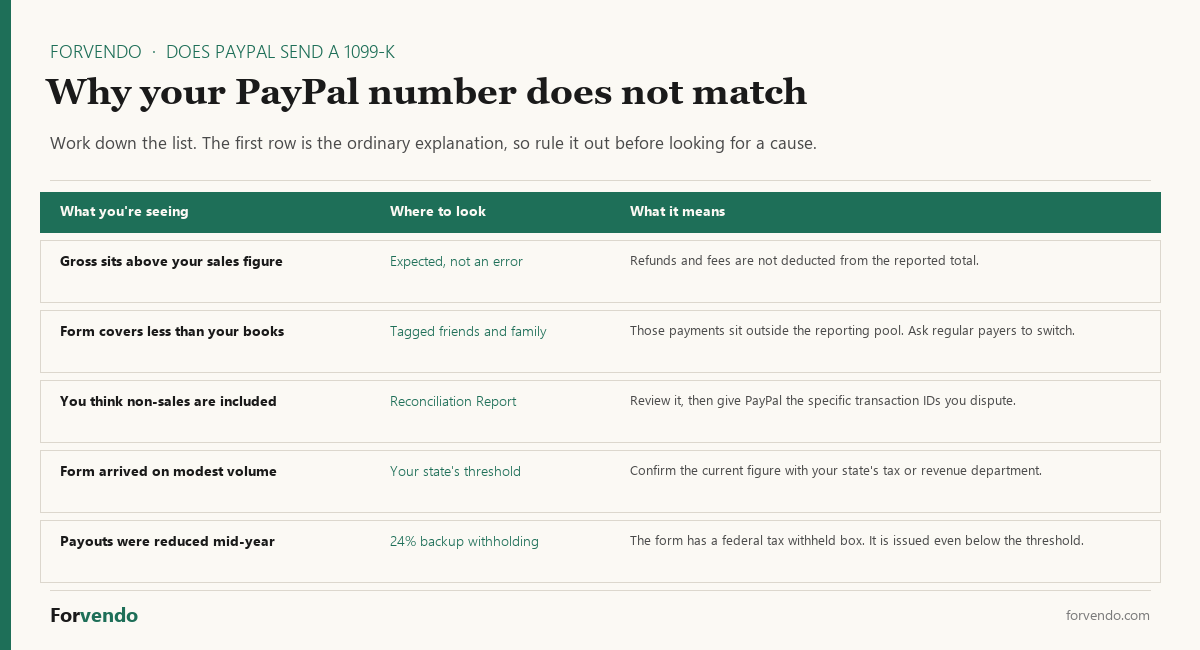
A form arriving on modest volume is worth checking against your state’s threshold. A form issued after your payouts were held or reduced earlier in the year points toward withholding, and the form itself carries a clue: Form 1099-K has a box for federal income tax withheld, and boxes for state information, so a withholding case does not look the same on paper as a plain threshold case.
A gross figure larger than the revenue you have in mind is the case to be slowest about. The reported total does not deduct refunds or processing fees, so running above your own sales figure is the normal outcome rather than evidence of anything. Mis-tagged personal payments are one possible cause among several — refunds, fees, posting dates, currency conversion, and payments split across processors can each open a gap. Reconcile the transactions before concluding that classification is what did it.
Knowing which one fired changes what you do next. A state-threshold form means checking a threshold. A withholding form means resolving a tax ID question. A genuinely mis-tagged form means the Reconciliation Report route above.
PayPal, Shopify, and the two-forms problem
This is the section to read if you sell on your own store rather than a marketplace, because it produces a reconciliation error that looks alarming on a spreadsheet and is completely normal.
Shopify’s Help Center is unusually explicit here, and it names PayPal directly: “The 1099-K includes only transactions processed through Shopify Payments. Transactions through other payment methods, such as PayPal Express, manual payment methods, or cash sales, aren’t included.”
So a Shopify store that offers PayPal at checkout has split its year across two reporting entities. Shopify Payments reports the transactions it processed. PayPal reports the transactions it processed. The split is by processor rather than by card versus not-card, which matters because a PayPal payment can be card-funded on the buyer’s side and still sits outside Shopify’s form. Each form is correct for its own slice, and neither one is your store’s sales figure.
- Shopify Payments form: the transactions it processed
- PayPal form: the goods and services payments it settled
- Manual methods and cash sit on neither form
- Each threshold is measured separately, per entity
- One store can therefore cross zero, one, or both
- Adding the PayPal form to total store sales, which already contain those orders
- Adding both forms together and treating the sum as revenue, before refunds and fees
- Expecting either form to tie to a bank deposit total
- Reading a missing form as a sign the sales were not reportable
The method that survives this is to reconcile from your own order data outward, not from the forms inward. Start with store orders for the year, split them by how they were paid, and check each form against its own slice. That is the same bridge used in the 1099-K reconciliation guide, applied twice instead of once.
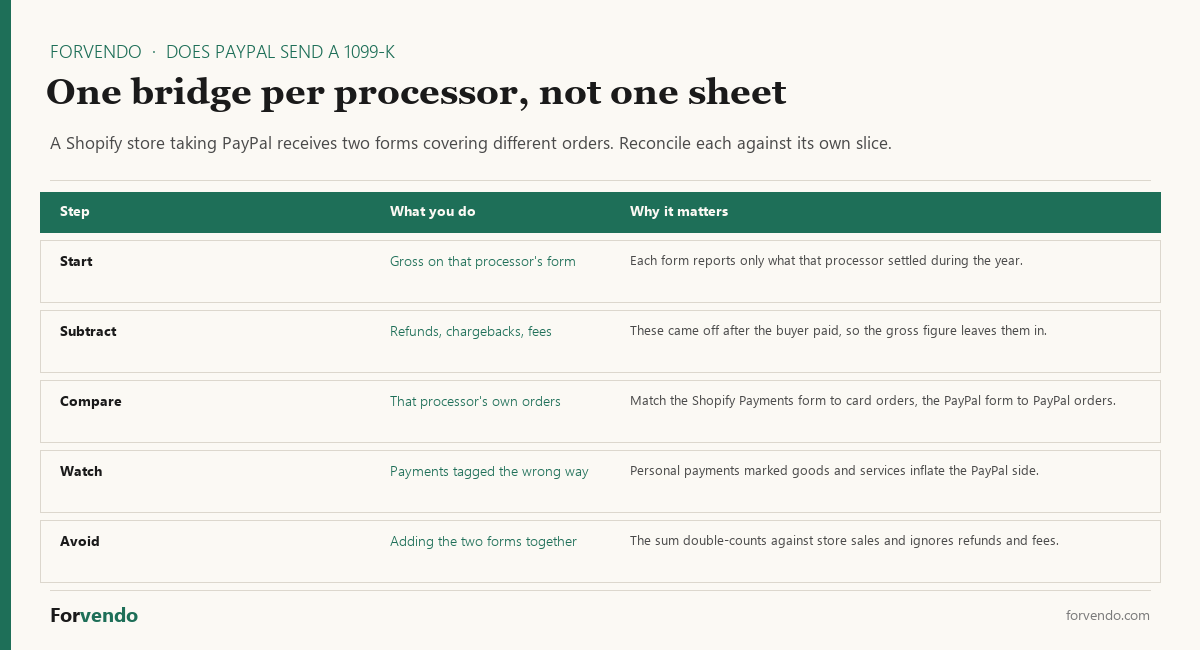
The problem is not that your store has no usable report. It is that two forms built from different transaction populations should not be reconciled against one undifferentiated sales total. Split the store data by payment processor and check each form against its own population.
One more reason the numbers move: Shopify states its form “is based on when transactions posted to your Shopify Payments account in the UTC timezone,” not the order date, so an order placed near the end of December can land on the following year’s form. A date-basis difference of that kind produces a gap that no amount of subtracting fees will close, which is why it is worth ruling in or out early.
One more consequence is worth stating, because it surprises people watching a single number. Splitting checkout across two processors splits the threshold too. A store doing $30,000 across two rails may sit under the federal threshold on both and receive no federal form, while the income remains reportable exactly as before. A missing form is not a signal about whether the sales count.
Forvendo newsletter
Operating notes, once a week
One email a week for US-based solo Shopify operators at $5,000–$50,000 MRR: a decision, a checklist, or a teardown. No fluff, unsubscribe anytime.
Join the newsletter →The published state lists do not match each other
Every company in this cluster publishes a list of states with lower thresholds, and the lists disagree. That is a useful thing to know before you trust any single one of them.
All three lists below describe tax year 2025. PayPal’s page names four states at $600 — Maryland, Massachusetts, Vermont, and Virginia — plus Illinois at over $1,000 with four or more transactions. That is five.
eBay’s Seller Center names ten, adding Arkansas, the District of Columbia, Missouri, Montana, and New Jersey, and its two public pages do not even agree with each other, as covered in the eBay guide. Shopify’s Help Center table, labeled for 2025, names eleven — the same ten plus California.
The shape is closer to nested lists than to three unrelated ones. Five jurisdictions appear on all three pages. Five more appear on the two longer lists but not on PayPal’s. California appears only on Shopify’s, and its entry carries a restriction that is easy to read past: the table qualifies the $600 figure as “App-based drivers only; all others follow federal.” A California merchant on Shopify is not being told they sit at $600.
The numbers themselves also drift where the states overlap. Missouri is $1,200 on Shopify’s table. Illinois is “at least $1,000” with “at least 4” transactions on Shopify’s and “over $1,000” with four or more on PayPal’s — two platform summaries pointing in different directions at exactly $1,000.
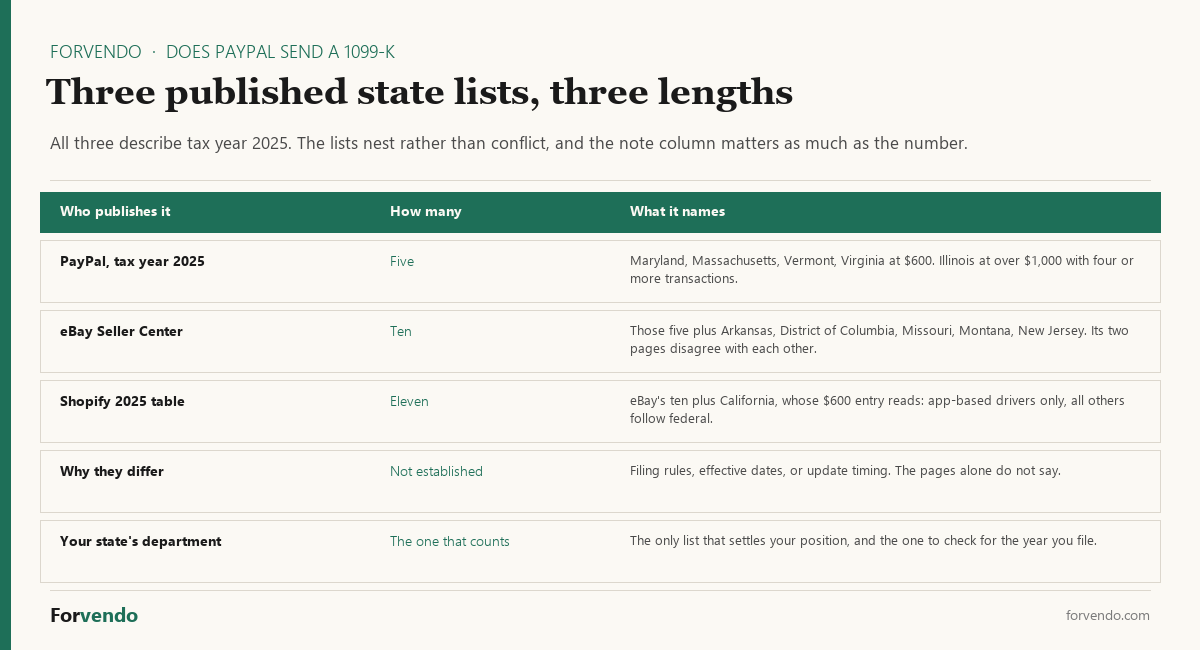
The lists genuinely differ, and the pages alone do not establish why. A difference can reflect state rules that apply to one kind of filer and not another, different effective dates, a platform’s own reading of a rule, or nothing more than when each page was last updated. eBay’s two pages disagreeing with each other is a reminder that update timing alone can produce a mismatch. Guessing at the cause is not something these sources support, and a shorter list is not automatically a wrong list.
What the disagreement does establish is narrower and more useful: a platform page is a starting point rather than an authority for your own position. If your state appears on one company’s list and not another’s, the body that settles it is your state’s tax or revenue department. Thresholds also change between years, which is one more reason to check the current rule rather than a page written for a prior season.
If you are already tracking states for sales tax reasons, keep the two systems separate in your head. Sales tax nexus and 1099-K thresholds are both organized by state and are otherwise unrelated, which is covered in the multi-state sales tax guide.
What PayPal’s gross leaves in
PayPal’s definition lines up with the rest of the cluster. The reported total can include amounts from selling personal items at a loss, refunded amounts, and processing fees.
Take that literally. The figure sits above the fees PayPal charged you, above anything you refunded, and above what the item cost you in the first place. Your bank deposits sit below all of it. A gap between the two is the expected result of a form that reports what was collected rather than what you kept.
The same shape holds on the marketplaces, with one line that varies by platform: Etsy excludes the sales tax it collected and remitted, Amazon includes it, and eBay’s public pages do not say. PayPal’s help article does not settle that line either, and on a self-hosted store the answer depends on how your store collected the tax. Compare the form against your own order report for the year, or raise it with your tax professional, rather than carrying another platform’s answer across.
If PayPal asks for your tax ID
PayPal requests an Employer Identification Number, Individual Taxpayer Identification Number, or Social Security Number as accounts approach the reporting thresholds. That request is the fork in the road for the third trigger.
How much that fixes depends on what caused it. Where withholding was applied only because a tax ID was missing, furnishing a valid one can stop it going forward. Where the name and number do not match IRS records, or a B Notice has already been issued, further certification or documentation may be needed before it stops, and a missing number is not the only reason backup withholding can apply in the first place.
In any of those cases it does not undo a year that already had withholding applied. Amounts sent to the IRS are generally not returned by the processor; they are claimed as withholding on the return, which is one more reason the form and your books will not match line for line. The mechanics of name-and-number mismatches, and what each correction notice asks for, are in the W-9 and TIN reconciliation guide.
Forvendo decision rule
Review how incoming payments are classified during the year rather than in January. Goods and services payments are what the reporting covers, and the classification is decided when the payment is taken.
If a Shopify store also takes PayPal, plan for two separate forms covering two separate payment rails, and reconcile them separately. Treating them as one number is the fastest way to double-count revenue that was only earned once.
When the form arrives
PayPal states that where you meet the IRS or an applicable state reporting threshold in a calendar year, it sends a Form 1099-K in January of the following year and files a copy with the IRS.
Three checks are worth doing before that January, and together they take about fifteen minutes. Confirm PayPal holds a valid EIN, ITIN, or SSN for you and that the name matches. Ask the people who pay you regularly to use the goods and services option so the form matches your books. And note your state’s current threshold from its own revenue department rather than from a company help page.
Those checks do not change a reporting threshold, and they do not change the tax character of a payment. What they do is remove avoidable mismatches and make it far easier to predict whether a form should arrive at all. The pattern across this whole cluster is the same: the work that makes tax season short happens in months that do not feel like tax season.
What this guide does not cover
- Your specific filing position, which should be reviewed with a CPA or an enrolled agent
- Whether a given payment is a gift, a reimbursement, or business income
- Cost basis and which selling expenses are deductible
- State income tax treatment, which varies
- Venmo, Cash App, and other payment apps, which publish their own thresholds
- Sales tax collection and marketplace facilitator rules, covered in the multi-state sales tax guide
FAQ
Does PayPal send a 1099-K for friends and family payments?
No. PayPal states the reporting applies to goods and services payments and does not include paying family or friends back for dinner, gifts, or shared trips.
Does PayPal send a 1099-K if I received under $20,000?
It can. A lower state threshold can require one. So can backup withholding: where it was actually applied, the form reports those payments even though the year sat below the normal federal threshold. Those are two different questions, though — whether withholding gets reported, and whether withholding may begin. For payments made in calendar years after 2024, the second is itself tied to the federal count and dollar figures, unless the preceding calendar year included reportable payments.
I sell on Shopify and take PayPal. Why did I get two forms?
Because they report different orders. Shopify states its form covers only transactions processed through Shopify Payments and excludes PayPal Express, manual methods, and cash. The PayPal form covers the PayPal orders. Adding either form to your total store sales counts those orders twice.
Is the amount on my PayPal 1099-K what I owe tax on?
No. The reported total can include refunded amounts, processing fees, and items sold at a loss. It reports what was collected rather than what you kept, and the taxable figure is worked out on your return.
Nobody sent me a form. Does that mean the income was not reportable?
No. The IRS position is that income is reportable on your return whether or not a Form 1099-K arrives. Splitting checkout across two processors can leave you under both thresholds while the sales remain exactly as reportable as before.
Why does PayPal list fewer states than eBay or Shopify?
The lists genuinely differ — PayPal names five, eBay ten, and Shopify’s 2025 table eleven — but the pages alone do not establish why. Filing rules, effective dates, and update timing can each produce a mismatch, and eBay’s own two pages disagree with each other. A shorter list is not automatically wrong. Your state’s tax or revenue department is what settles the question for you.
Shopify’s table shows California at $600. Does that apply to my store?
Not on the face of the table. Shopify’s 2025 entry for California qualifies the $600 figure as “App-based drivers only; all others follow federal.” Read the note column alongside the number before assuming a lower bar applies to you, and confirm the current position with California’s own tax authority.
My personal and business payments are in one PayPal account. Is that a problem?
It makes reconciliation harder, because the form covers only the goods and services subset while your account history covers everything. Separating the accounts, and asking payers to use the correct option, is what makes the form comparable to your books.
Do I get a separate form from Etsy, Amazon, or eBay?
Yes, where your volume there crosses that platform’s threshold. Each reports separately — see the Etsy, Amazon, and eBay versions of this question.
Next step
Reconciling once, properly, makes every following January routine. If you want the worksheet rather than the theory, the free 1099-K reconciliation sheet uses the same gross-to-books bridge with the arithmetic already set up.
One note for PayPal users working through it: run a separate bridge for each processor rather than one combined sheet. Start each from that processor’s own gross, subtract the refunds and fees that came off after the buyer paid, and only then compare the two against your store’s order data for the year. The combined sheet is where the double-count hides.
Forvendo Editorial note. Forvendo publishes educational operating resources for solo ecommerce operators. Articles may cover tax, sales tax, 1099-K reporting, software pricing, platform policies, and other operating topics that change over time.
This content is for general research and operational planning. It is not legal, tax, accounting, financial, or professional advice. Readers should verify details with official sources or qualified professionals before acting on them. Platform rules, tax thresholds, software pricing, and affiliate program terms can change without notice.
Forvendo articles may be drafted with AI assistance and are reviewed by the operator before publication according to our Editorial Policy, which covers sourcing, AI use, update cadence, and corrections. See also About, Disclosure, and Privacy Policy.