1099-K vs 1099-NEC: Which Form Should Report Your Income?
Last updated: · Tax laws and platform policies change. Verify with official sources before acting.
1099-K vs 1099-NEC is usually framed as a question about what kind of work you do. It is not. The IRS instructions settle most of it with a single rule about how the money moved, and once you know that rule the rest of the differences fall into place. Here is which form belongs where, why some people receive both for the same income, and what each threshold actually is.
Quick answer
- The payment method decides it, not the job. The IRS instructions place card and third-party network payments on Form 1099-K, filed by the payment settlement entity, and exclude those same payments from 1099-MISC and 1099-NEC reporting.
- 1099-NEC comes from a business that hired you. 1099-K comes from the company that processed the payment. Different filers, different vantage points.
- The thresholds run on different clocks. 1099-K sits at more than $20,000 and more than 200 transactions. Nonemployee compensation moved to $2,000 for tax years beginning after 2025, with inflation adjustment from 2027.
- Both forms report gross figures, and neither one is your taxable income.
- Receiving both for the same money is a reporting error, not a signal that you owe tax twice — but it is worth resolving rather than ignoring.
- Income is reportable either way. The IRS position is that income belongs on your return whether or not any form arrives.
Who this is for
You sell online, freelance, or both, and forms have started arriving that seem to describe the same money twice. Or you pay contractors and want to know which form is yours to issue. Figures below come from the IRS instructions and guidance pages named in each section. None of it is tax advice for your return, which is a conversation for a CPA or an enrolled agent.
The one line that settles most of it
Read this before anything else, because it removes the guesswork from the common cases.
The IRS instructions for Forms 1099-MISC and 1099-NEC state that payments made with a credit card or payment card, and certain other payments including third-party network transactions, are reported on Form 1099-K by the payment settlement entity — and that those payments are not subject to reporting on Form 1099-MISC or Form 1099-NEC.
So the question is not “was this freelance work or a product sale?” The question is what carried the money.
A client who pays your invoice by bank transfer or check, for services, is in 1099-NEC territory. That same client paying the same invoice with a company card, or through a payment app as a goods-and-services payment, has moved the transaction into the processor’s reporting lane instead. The work did not change. The rail did.
That single rule explains most of the confusion people have about these two forms, and it is also the rule that gets broken most often — which is where double reporting comes from.
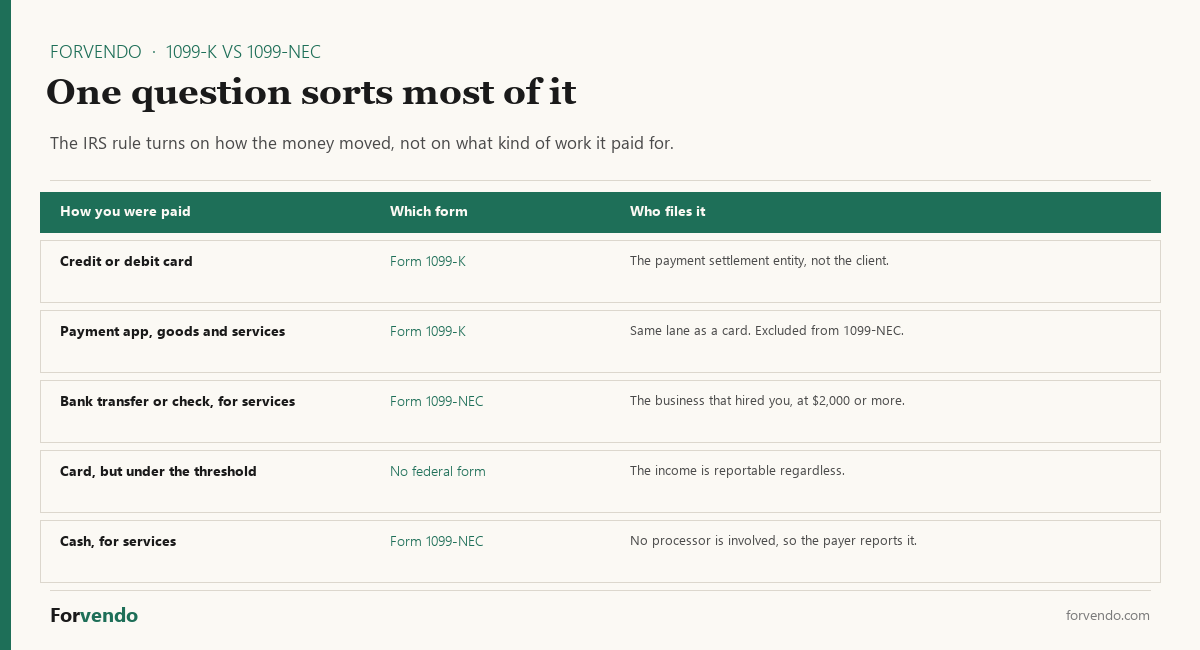
The last row is worth pausing on. Falling under a threshold removes the form, not the income. That distinction is the one most likely to cost someone later.
Which form comes from whom
The two forms answer different questions, which is easier to see side by side than in prose.
The row that does the most work is the one about card payments. Everything else follows from it.
Free download
The Solo Shopify Weekly Operating Checklist
A one-page PDF plus a copyable Google Sheet — the weekly cadence these guides build on. Free; bring your own store data.
Get the free checklist →Notice also what the “who files it” row implies about visibility. A processor sees every transaction it settled and nothing else. A client sees everything it paid you and nothing about your other clients. Neither party has a view of your total income, which is why neither form is designed to be one.
Why some people get both for the same money
This is the case worth understanding, because it looks alarming and is usually mundane.
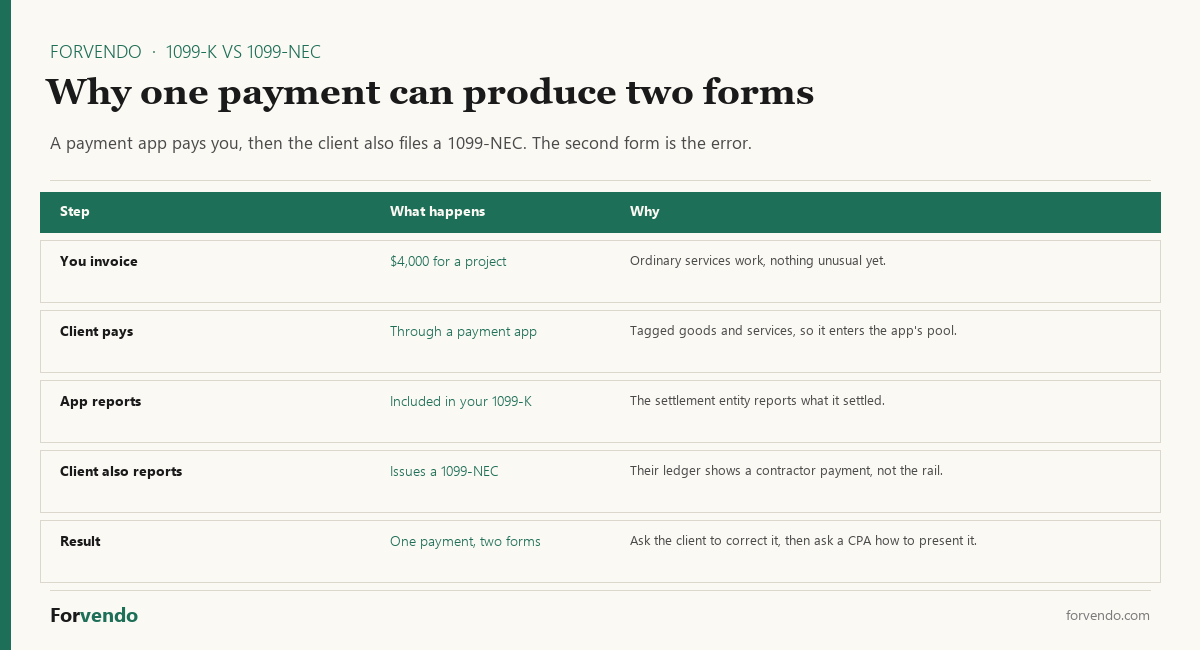
Say you invoice a client $4,000 for a project and they pay it through a payment app as a goods-and-services payment. Two things can happen in January:
- The app crosses its reporting threshold on your account and issues a 1099-K that includes the $4,000.
- The client’s bookkeeper, working from their own ledger, sees $4,000 paid to a contractor and issues a 1099-NEC for it.
Step 2 is the error. The instructions exclude payments made through a third-party network from 1099-NEC reporting precisely so this does not happen. But a bookkeeper reconciling from the accounts-payable side often cannot see how the payment was routed, so the exclusion gets missed.
- The money arrived once and is income once
- Two forms describing one payment is a reporting overlap
- Neither form is itself a tax calculation
- Your books, not the forms, establish what you earned
- IRS matching compares filed forms against your return
- An unexplained gap can generate a notice later
- The issuer can correct a form it should not have filed
- How to present it on the return is a CPA question
The practical move is to ask the client which route the payment took, and if it went through a card or a payment app, to ask them to correct the 1099-NEC they issued. Keep your own record of the request. How the overlap should appear on your return is a question for a CPA or an enrolled agent rather than something to settle from a help page.
The thresholds are on different clocks
People often assume the two forms share a threshold story. They do not, and the gap between them is wide enough to change who receives what.
1099-K. More than $20,000 in gross payments and more than 200 transactions, restored to that pair of figures by the July 2025 tax bill. Some states publish lower figures of their own, and those lists differ between companies — covered in the PayPal guide and the eBay guide.
1099-NEC. At least $2,000 for tax years beginning after 2025, with inflation adjustment from calendar year 2027. For payments made through the end of 2025 the figure was $600, so the two filing seasons on either side of that change do not look alike. The issuer-side workflow for that transition is in the W-9 and TIN reconciliation guide.
The asymmetry has a practical consequence. A freelancer with a handful of clients can cross the 1099-NEC threshold easily and never come close to the 1099-K one. A store owner can do the reverse. Someone doing both may cross neither, on either form, while the income remains exactly as reportable as it would be otherwise.
If you are on both sides of it
Solo operators frequently are: selling through a store, and paying a designer or a virtual assistant. The two roles pull in opposite directions and it helps to keep them separate in your head.
Forvendo newsletter
Operating notes, once a week
One email a week for US-based solo Shopify operators at $5,000–$50,000 MRR: a decision, a checklist, or a teardown. No fluff, unsubscribe anytime.
Join the newsletter →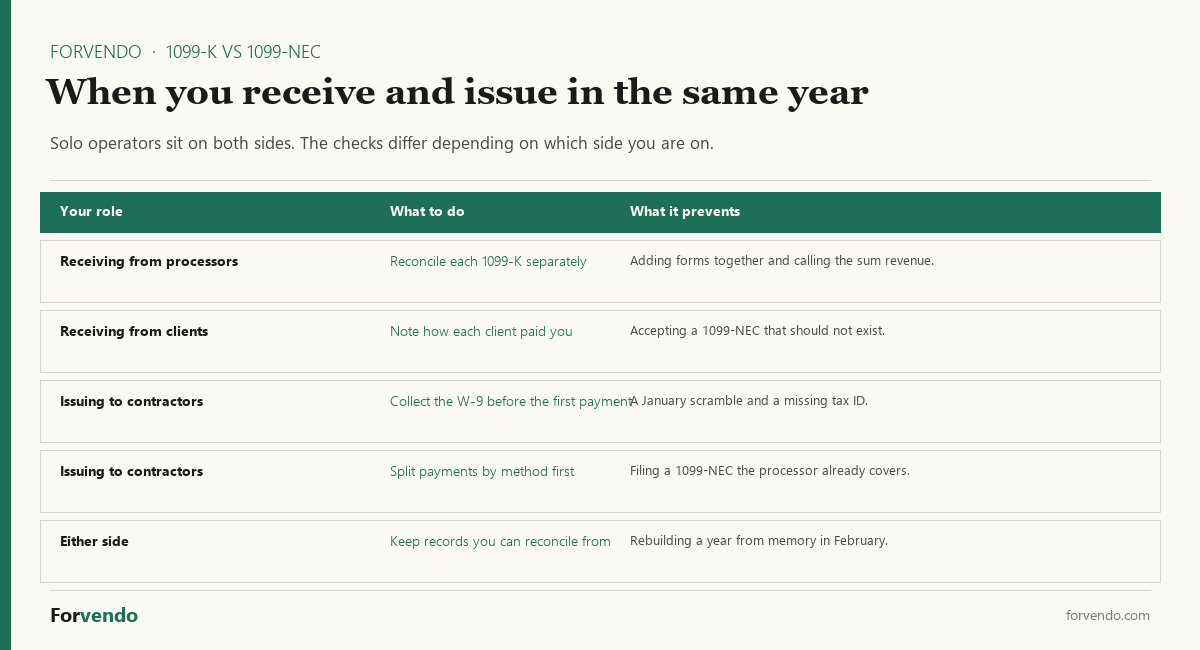
The fourth box is the one that saves work. Before issuing 1099-NEC forms, sort your contractor payments by how they were made. The ones that went out through a card or a payment app are generally not yours to report, and filing them anyway is how you end up creating for someone else the exact double-reporting problem described earlier.
A worked year, with the numbers
Abstractions get slippery here, so take one operator through a full year. The figures are illustrative, not a template for anyone’s return.
She runs a small store and takes on two consulting projects on the side. Over the year:
| Source | Amount | How it was paid | Where it lands |
|---|---|---|---|
| Store, card checkout | $26,400 | Shopify Payments | Shopify Payments 1099-K |
| Store, PayPal checkout | $7,100 | PayPal, goods and services | Counted inside PayPal’s total |
| Consulting client A | $9,000 | Bank transfer | 1099-NEC from client A |
| Consulting client B | $3,500 | PayPal, goods and services | Counted inside PayPal’s total |
Four income streams, two forms. The store’s card volume crosses more than $20,000 and more than 200 transactions, so a 1099-K follows from Shopify Payments. Client A pays by transfer for services and crosses $2,000, so a 1099-NEC follows.
The interesting rows are the two that produce nothing. PayPal settled $10,600 across the store and client B combined, which sits under the federal figures, so no PayPal 1099-K is issued. And client B does not issue a 1099-NEC either, because the payment went through a third-party network and the instructions route it away from 1099-NEC reporting. That $3,500 is ordinary reportable income that generates no form from anyone.
Now add it up. The two forms she receives total $35,400. Her actual income is $46,000. The forms are not wrong — they were never built to sum to her income, because each filer only sees its own slice and two of her slices fell under a threshold.
That gap is the normal state of affairs rather than a problem to solve, and it is the reason the reporting question and the reconciliation question have to be kept apart. The forms tell you what was reported about you. Your records tell you what you earned. Only the second one belongs on a return.
What neither form tells you
Both are gross figures reported by someone with partial visibility, and treating either as an income statement is the underlying mistake in most of these questions.
A 1099-K reports what a processor collected, before its fees came out and before any refunds went back. That is why a store’s 1099-K routinely runs above its actual sales — the mechanics are in the 1099-K reconciliation guide. A 1099-NEC reports what one client paid, with no view of your expenses, your other clients, or whether the work was profitable.
The IRS position sits underneath both: income is reportable on your return whether or not a form arrives for it. Forms are a matching mechanism, not a measurement of what you earned. Your own records are what establish that, which is the argument for keeping them in a form you can reconcile from rather than reconstructing in January.
What to check before January
Four checks, none of which take long, and all of which are far cheaper now than in filing week.
- Sort last year’s income by payment rail, not by client. Card and payment-app receipts sit in 1099-K territory; transfers and checks sit in 1099-NEC territory. That one sort predicts most of what will arrive.
- Confirm each processor holds a valid tax ID for you under the exact name that matches IRS records. A mismatch is what triggers backup withholding, and that produces a form of its own regardless of volume.
- Tell recurring clients how you were paid if they have issued a 1099-NEC for card or app payments before. A note in December costs less than a correction request in February.
- On the issuing side, split contractor payments by method before preparing any 1099-NEC forms. Payments routed through a card or a payment app are generally outside your reporting obligation.
None of these change what you owe. What they change is how much of January is spent reconstructing information that was easy to record at the time.
What this guide does not cover
- Your specific filing position, which should be reviewed with a CPA or an enrolled agent
- How to present an overlapping 1099-K and 1099-NEC on a return
- Form 1099-MISC and the categories that still belong on it
- Worker classification — whether someone is a contractor or an employee
- State-level 1099 filing requirements, which vary and can differ from federal figures
- Sales tax, covered in the multi-state sales tax guide
FAQ
1099-K vs 1099-NEC: which one should I get for freelance work?
It depends on how the client paid. The IRS instructions place card and third-party network payments on Form 1099-K, filed by the processor, and exclude them from 1099-NEC. Paid by check or bank transfer, the same work sits on a 1099-NEC from the client.
I got both forms for the same project. Do I owe tax twice?
No. The money is income once. Two forms describing one payment is a reporting overlap, usually caused by a client issuing a 1099-NEC for a payment that went through a card or payment app. Ask the client to correct it, and ask a CPA how to present it on your return.
Why is my 1099-NEC threshold different from what it was last year?
Nonemployee compensation moved to at least $2,000 for tax years beginning after 2025, with inflation adjustment from 2027. Payments through the end of 2025 used $600, so consecutive filing seasons can look different for the same contractor relationship.
Does a 1099-K mean I run a business?
Not by itself. It means a processor settled enough payments tagged as goods and services on your account to meet a reporting threshold. Whether the underlying activity is a business, and how it should be reported, is a question for a CPA or an enrolled agent.
Nobody sent me either form. Is the income still reportable?
Yes. The IRS position is that income belongs on your return whether or not a Form 1099-K or 1099-NEC arrives for it. Falling below a threshold changes the paperwork, not the reporting obligation.
I pay a contractor through PayPal. Do I issue a 1099-NEC?
Generally not for payments routed that way. The instructions exclude payments made through a payment card or third-party network from 1099-NEC reporting, because the settlement entity reports them on Form 1099-K instead. Sort contractor payments by payment method before filing, and confirm your own situation with a tax professional.
Which form arrives first?
Both land in the same window. Form 1099-NEC is filed on or before January 31 under section 6071(c), and 1099-K forms are sent in January of the following year.
Do the two thresholds interact?
No. They are measured separately by different filers, and crossing one has no bearing on the other. It is possible to cross both, one, or neither in the same year.
Next step
If the forms and your books disagree, the gap is almost always explainable rather than wrong. The free 1099-K reconciliation sheet walks the gross-to-books bridge with the arithmetic already set up.
One note for anyone holding both forms: reconcile them separately before comparing anything to your total income. Run each 1099-K against the transactions that processor actually settled, list 1099-NEC amounts against the clients that issued them, and only then look for a payment that appears in both places. That last step is where an overlap becomes visible, and finding it in February is considerably easier than explaining it later.
Forvendo Editorial note. Forvendo publishes educational operating resources for solo ecommerce operators. Articles may cover tax, sales tax, 1099-K reporting, software pricing, platform policies, and other operating topics that change over time.
This content is for general research and operational planning. It is not legal, tax, accounting, financial, or professional advice. Readers should verify details with official sources or qualified professionals before acting on them. Platform rules, tax thresholds, software pricing, and affiliate program terms can change without notice.
Forvendo articles may be drafted with AI assistance and are reviewed by the operator before publication according to our Editorial Policy, which covers sourcing, AI use, update cadence, and corrections. See also About, Disclosure, and Privacy Policy.