When Do You Need a W-9 From a Contractor? (And What to Do With It)
Last updated: · IRS 1099-NEC reporting thresholds change in 2026 under the One Big Beautiful Bill Act (OBBBA). Confirm current thresholds against IRS guidance or a qualified US tax professional before deciding whether to issue a 1099-NEC for any given vendor.
A one-person Shopify store who pays a virtual assistant, freelance designer, photographer, or any other US-based contractor should have a W-9 form on file before the first payment goes out, and a TIN reconciliation done before the end of January.
The rules around when to collect a W-9 form, when a 1099-NEC is required, and what happens if a Tax Identification Number is missing or incorrect changed meaningfully under OBBBA in 2026. This W-9 and TIN reconciliation guide walks through the operating workflow — when to request a W-9 form, how to verify the TIN before it becomes a problem, how to respond to an IRS B Notice if one arrives, and the new $600 vs $2,000 threshold timeline that affects every one-person store with contractors.
The thresholds, dates, and dollar figures here are planning assumptions; the exact treatment depends on payment type, contractor status, and the tax year, so confirm against current IRS guidance.
Quick answer
- Request a W-9 before the first payment, not after. IRS Form W-9 (current revision 03/2024) is the IRS-blessed way to collect a contractor’s TIN, legal name, and federal tax classification. Without it, you may need to apply 24% backup withholding.
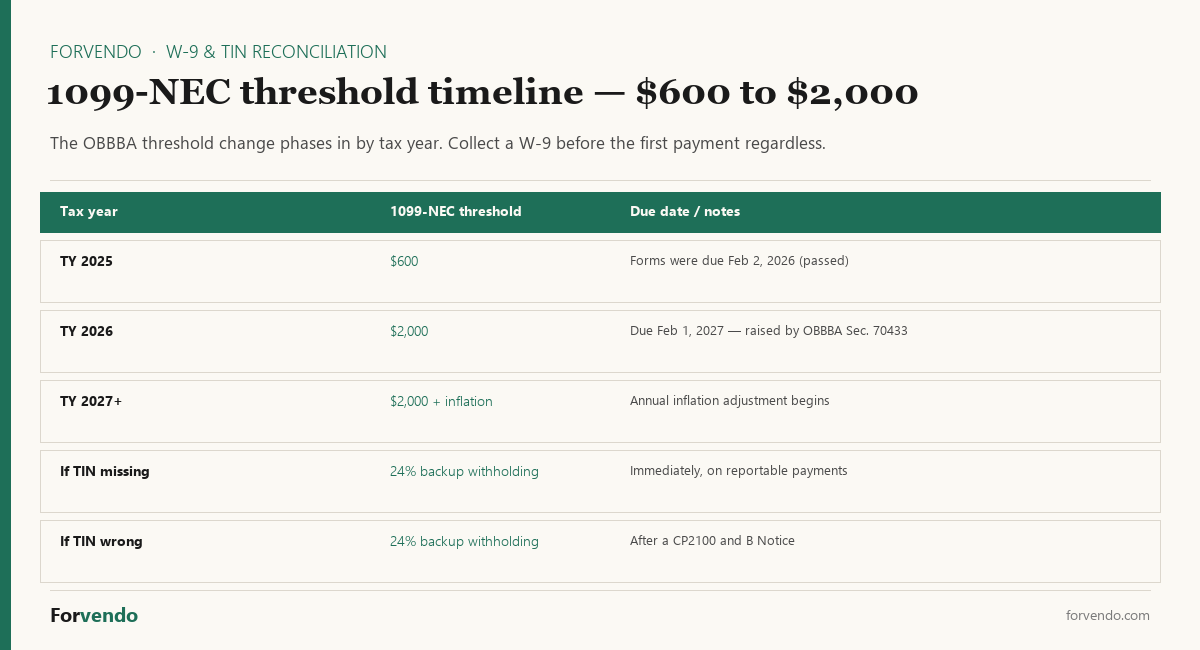
- The 1099-NEC reporting threshold is in transition. For tax year 2025 (payments made through December 31, 2025; forms were due February 2, 2026), the threshold was $600. For tax year 2026 (payments made on or after January 1, 2026; forms due February 1, 2027), the threshold rises to $2,000 under OBBBA Section 70433, with annual inflation adjustment starting 2027.
- TIN Matching is a free, optional IRS pre-filing service that checks TIN-name combinations before you submit 1099-NEC forms. It is open only to payers that filed Forms 1099 in the last 2 years, so a store paying its first contractor usually starts with a carefully checked W-9 and adds TIN Matching once eligible.
- If the IRS sends a CP2100 or CP2100A notice, you have 15 business days from the notice date or the date you received it, whichever is later, to send a B Notice to the affected payee. If no signed W-9 comes back, you are required to begin backup withholding (24%) no later than 30 business days after the notice date or the date you received it, whichever is later.
- E-filing is required for 10 or more information returns (aggregated across every type you file, including 1099s and W-2s), effective for returns filed January 1, 2024 and later.
For the broader payment-side reconciliation, see Does Shopify Send You a 1099-K?. For multi-state sales tax context, see Shopify Sales Tax in Multiple States.
Table of Contents
- Who this is for
- Why W-9 timing matters
- The 1099-NEC threshold timeline ($600 vs $2,000)
- The W-9 and TIN reconciliation workflow
- TIN Matching — the free IRS pre-filing service
- What happens if a B Notice arrives
- State-level 1099 filing — the $2,000 federal threshold complication
- Common mistakes
- What this article does not cover
- Frequently Asked Questions
Who this is for
This article is built for the same reader as the rest of Forvendo’s tax coverage.
- You sell on Shopify in the United States, typically on the Basic plan.
- Monthly revenue sits between $5,000 and $50,000.
- You pay between 1 and 10 US-based contractors in a calendar year — virtual assistants, freelance designers, photographers, copywriters, accountants, or specialists you hire on a project basis.
- You operate the store alone or with a part-time helper.
- You want to know when to collect a W-9, when a 1099-NEC is required, and what changes in 2026.
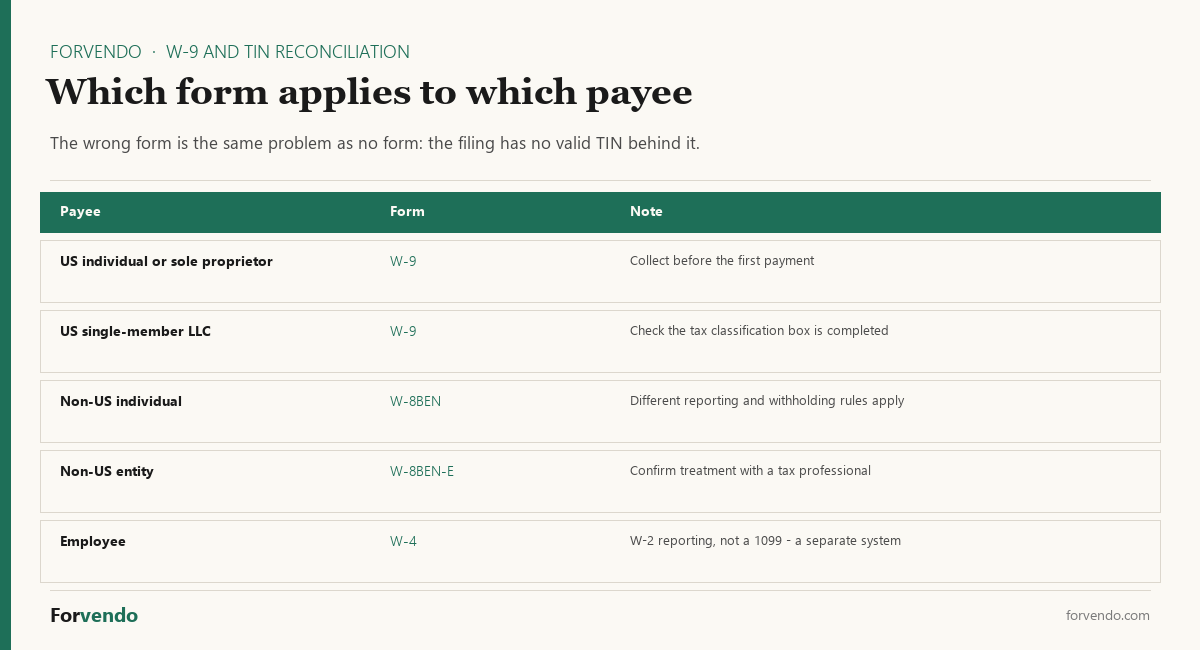
If you have employees on payroll (W-2), the rules differ — W-2 employment uses different reporting. If you pay only non-US contractors, Form W-8BEN or W-8BEN-E applies instead of W-9.
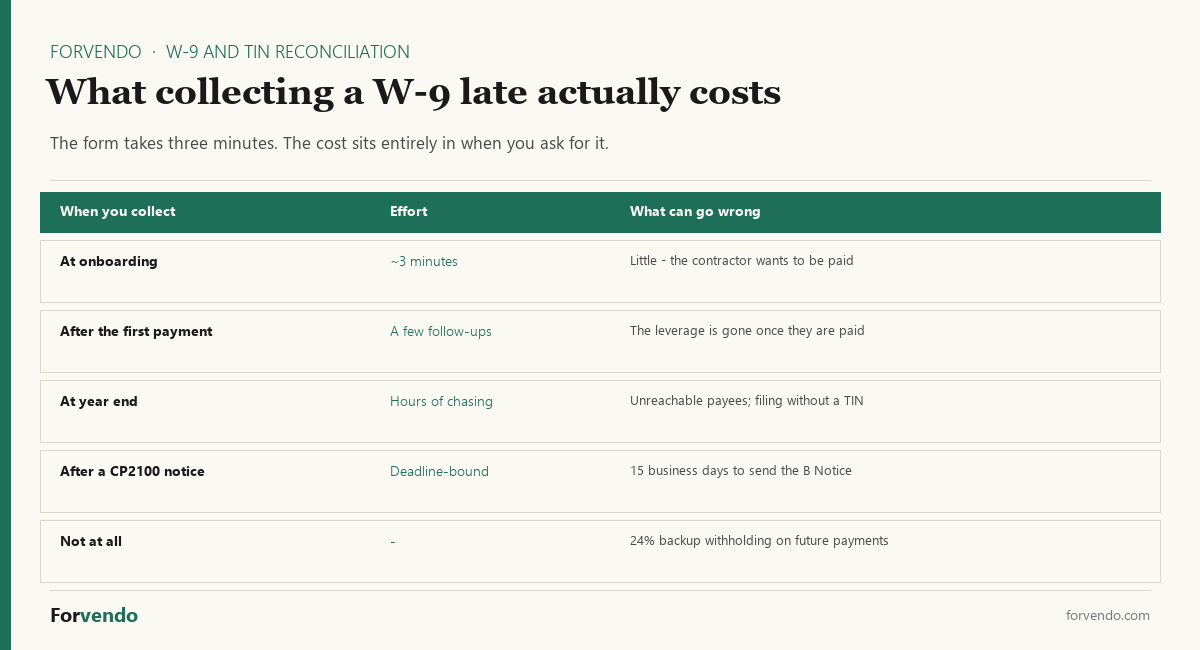
Timing matters as much as the form itself, because the leverage to obtain one disappears the moment a contractor has been paid:
Why W-9 form timing matters
The single most common mistake on the 1099 side is collecting the W-9 late — either after the first payment, or only at the end of the year when 1099-NEC filing approaches. Two structural reasons this is the wrong order. Contractors you pay sit on one side of this; the money your own store receives sits on the other. 1099-K vs 1099-NEC maps both sides against the same rule.
Backup withholding obligations. When a payer makes a reportable payment to a contractor whose correct TIN isn’t on file, IRS guidance states “the payer is required to withhold at the current rate of 24 percent” (Backup Withholding Program, IRS.gov). For a solo store owner paying a virtual assistant $1,500 per month, that’s $360 a month you would have to withhold, deposit with the IRS, and report on Form 945, the annual return for withheld federal income tax on nonpayroll payments. Collecting the W-9 before the first payment avoids immediate backup withholding for a missing TIN, and gives you time to catch a wrong one.
Reconciliation under time pressure. Trying to collect W-9s from five contractors in mid-January, after the calendar year has closed, often takes longer than you have before the January 31 filing deadline (moved to the next business day when it falls on a weekend). Contractors disappear, change addresses, or simply don’t prioritize sending tax forms back. The 1099-NEC filing deadline generally doesn’t move when a W-9 arrives late.
A W-9 collected at contractor onboarding takes about three minutes. A W-9 collected in panic in January takes about three hours of follow-up — when it can be collected at all.
Forvendo decision rule
Collect every W-9 before the first contractor payment, not at year-end. A W-9 collected at onboarding takes three minutes; one collected in January takes three hours of follow-up — when it can be collected at all.
If a contractor refuses to provide a W-9, treat that refusal as a hard stop on payment. Backup withholding at 24% is a worse outcome for both parties than a five-minute conversation at onboarding.
The 1099-NEC threshold timeline ($600 vs $2,000)
OBBBA Section 70433 raised the 1099-NEC reporting threshold but the effective date matters. The transition runs across two tax years.
Two implications for a solo Shopify seller reading this in 2026:
For TY 2025 payments (forms due February 2, 2026): the $600 threshold applied. A contractor paid $750 in 2025 should have received a 1099-NEC. If one was missed, it can still be filed late; ask a tax professional about penalty exposure. The OBBBA $2,000 threshold doesn’t apply retroactively to TY 2025.
Free download
The Solo Shopify Weekly Operating Checklist
A one-page PDF plus a copyable Google Sheet — the weekly cadence these guides build on. Free; bring your own store data.
Get the free checklist →For TY 2026 payments (forms due February 1, 2027): the $2,000 threshold applies. A contractor paid between $600 and $2,000 in 2026 no longer triggers a federal 1099-NEC requirement.
State-level requirements are separate. New Jersey, for example, asks for copies of 1099s when payments reach $1,000 or more in a year, which now sits below the federal $2,000. A New Jersey contractor paid $1,500 in 2026 may not require a federal 1099-NEC but may require a state 1099 filing. Confirm against each state’s information-return rules.
The W-9 form and TIN reconciliation workflow
The pattern below applies to most solo Shopify stores paying US contractors. The same workflow scales from one contractor to ten.
Step 1 — At contractor onboarding, request the W-9 form. Before any payment, send the contractor the current IRS W-9 form (rev. 03/2024). Most one-person stores keep the blank W-9 form in a “Contractor Onboarding” folder and email it as part of the first project agreement. The contractor completes name, business name (if applicable), federal tax classification, address, and TIN, then signs.
Step 2 — Verify the W-9 looks complete. Common gaps to check before filing it away:
– Line 1 holds the name that goes with the TIN: an individual or sole proprietor enters their own name (with their SSN or their EIN). A single-member LLC that is disregarded for tax enters the owner’s name and the owner’s TIN, with the LLC name on line 2. A corporation or partnership enters its entity name and EIN.
– Federal tax classification box is checked (sole proprietor, LLC, S-corp, C-corp, partnership)
– TIN is filled (either SSN or EIN, not both at once)
– Signature and date present
Step 3 — Run TIN Matching once you are eligible. The IRS TIN Matching program is a free pre-filing service through IRS e-Services, open only to payers listed in the IRS Payer Account File, which takes in payers that filed Forms 1099 within the last 2 years. In your first filing year, rely on the signed W-9 and check the name and TIN carefully by eye. From the following year, enroll through IRS e-Services and run each new W-9 through it while the contractor is still in onboarding mode and easy to reach. Details in the next section.
Step 4 — Track payments by contractor across the year. A simple spreadsheet with one row per contractor, columns for each payment, and a running YTD total is sufficient for most solo store owners. The companion W-9 / TIN Reconciliation Tracker automates this with a 1099-NEC trigger flag per row.
Step 5 — In January, file 1099-NEC for contractors above threshold. For TY 2025 (forms were due February 2, 2026): contractors paid $600+ during 2025. For TY 2026 (forms due February 1, 2027): contractors paid $2,000+ during 2026. Filing deadline: January 31 to both the IRS and the recipient, or the next business day when January 31 falls on a weekend or legal holiday. If a contractor’s TIN is still missing at the deadline, file on time anyway with the TIN box left blank, and apply backup withholding to reportable payments.
Forvendo newsletter
Operating notes, once a week
One email a week for US-based solo Shopify operators at $5,000–$50,000 MRR: a decision, a checklist, or a teardown. No fluff, unsubscribe anytime.
Join the newsletter →Step 6 — E-file if 10 or more aggregate information returns. Under T.D. 9972, e-filing is required for returns filed January 1, 2024 and later when the payer files 10 or more information returns in aggregate (across every type you file: 1099-NEC, 1099-MISC, W-2, and others). A store with no employees that files only 1099-NECs can file on paper below 10 forms. Forms 1099-K that Shopify or PayPal file about you are not yours and do not count.
TIN Matching — the free IRS pre-filing service
The IRS TIN Matching service, accessible through IRS e-Services, “lets you validate TIN and name combinations before submitting an information return” (IRS.gov). Interactive matching (up to 25 records per session) and bulk matching (up to 100,000 records, with 24-hour response) are both available (IRS Publication 2108). The service is free.
Eligibility comes first. A payer has to be listed in the IRS Payer Account File (PAF) database, and the IRS says payers “are added to the database if they filed Forms 1099 within the last 2 years to report backup withholding.” A store paying its first contractor usually isn’t in that file yet, so in year one the signed W-9 is the main control. Once eligible, register through IRS e-Services, complete the TIN Matching application, and wait for IRS approval.
For a Shopify store owner working alone with 1-10 contractors, interactive TIN matching is sufficient. Once you are eligible, a workable cadence is:
- After each new W-9 is received — run TIN matching promptly. If a mismatch is returned, contact the contractor while the project memory is fresh, not in January.
- Annually in early December — re-run TIN matching for all active contractors. Names sometimes change (marriage, business restructuring), and verifying before the January 31 filing deadline gives time to correct.
The response comes back as a code: a match, a mismatch, a TIN that is missing or not currently issued, or an invalid request. A mismatch isn’t the same as a confirmed wrong TIN — sometimes the contractor’s IRS record uses a different name spelling, a hyphen, or a maiden name. The mismatch is a signal to follow up with the contractor, not an immediate trigger for backup withholding.
What happens if a B Notice arrives
A B Notice is the second-stage event in the backup withholding chain. The sequence:
1. IRS sends a CP2100 or CP2100A notice to the payer. The IRS issues these notices twice a year, in October and the following April, listing payees whose name/TIN combinations did not match on returns you filed. A CP2100 goes to payers with 50 or more returns with errors (on CD/DVD at 250 or more, on paper at 50 to 249). A CP2100A goes to payers with fewer than 50.
2. The payer has 15 business days to send a B Notice to the affected payee. The 15-business-day window runs from the date on the CP2100/CP2100A or the date you received it, whichever is later. A first B Notice (1st-B) is required if the payee hasn’t been listed on a CP2100/CP2100A in the past three years. The 1st-B requests a fresh Form W-9 from the payee.
3. Backup withholding starts by the 30th business day. If the payee returns a signed W-9, update your records and stop any withholding within 30 calendar days. If not, begin backup withholding (24%) on future reportable payments no later than 30 business days after the CP2100/CP2100A date or the date you received it, whichever is later.
4. If the same payee appears again on a CP2100/CP2100A within three years, a second B Notice (2nd-B) is required — and the requirements escalate. The 2nd-B doesn’t request a new W-9; it requires the payee to obtain TIN validation directly from the Social Security Administration (SSA) for individuals (a copy of the Social Security card) or from the IRS for businesses (Letter 147C for an EIN). The payer still has 15 business days to send the 2nd-B.
5. If no Social Security card copy or Letter 147C arrives within 30 business days of the second B Notice, begin backup withholding and continue until validation arrives.
The operating lesson: a carefully checked W-9 at onboarding, plus TIN Matching once you are eligible, is the cheapest insurance against B Notices. The 15-business-day window is short, and managing B Notice correspondence for multiple contractors during a busy operating season is a clear path to missed deadlines.
State-level 1099 filing — the $2,000 federal threshold complication
The federal threshold rising to $2,000 in TY 2026 creates a new compliance asymmetry that didn’t exist before. Some states set their own 1099 filing thresholds; New Jersey’s $1,000 trigger for copies of 1099s is one example. When the federal threshold rises above a state threshold, contractors paid in those states may require a state 1099 filing without a corresponding federal 1099-NEC.
Examples to confirm against state-specific rules (this table reflects published thresholds as of 2026-10-06 and may shift):
| State | State 1099 threshold | Federal 1099-NEC threshold (TY 2026+) |
|---|---|---|
| Other states | Check the state’s own rules | $2,000 |
| New Jersey | $1,000 | $2,000 — state filing may apply between $1,000 and $2,000 |
The point is structural rather than state-specific: when the federal threshold moves above state thresholds, payers paying contractors in those states now have a federal-vs-state gap to manage. A seller running everything alone paying contractors across multiple states should confirm whether each state’s threshold matches or sits below the new federal $2,000.
Five-record readiness check before issuing a 1099-NEC
- W-9 on file with a valid TIN
- TIN matched against IRS records via TIN Matching, if you are eligible to use it
- Year-to-date payment log totals reaching the applicable threshold ($600 for TY 2025, $2,000 for TY 2026+)
- Contractor classification confirmed (1099 contractor vs W-2 employee — not casual)
- State-specific 1099 threshold check completed for the contractor’s state
If a record is missing, fix what you can before the deadline, but file on time either way. A missing TIN is left blank on the form and backup withholding may apply. Holding the form back does not fix the gap and adds a late-filing problem.
Common mistakes
The patterns below cause most avoidable W-9 and 1099-NEC problems.
- Collecting W-9s after the first payment — by the time the contractor has been paid, the leverage to obtain a clean W-9 has dropped meaningfully. Collect at onboarding.
- Assuming the $2,000 threshold applies to TY 2025 payments — it doesn’t. TY 2025 (forms due February 2, 2026) was $600. The $2,000 applies to TY 2026 payments (forms due February 1, 2027).
- Ignoring TIN Matching once eligible — after your first year of filing Forms 1099, running each new W-9 through the free TIN Matching service catches many name/TIN mismatches before they turn into B Notices.
- Missing the 15-business-day B Notice window — once a CP2100/CP2100A arrives, the clock is short. Calendar the deadline immediately.
- Not aggregating across information return types for the e-file threshold — the 10-return e-file rule aggregates every information return you file yourself (1099-NEC, 1099-MISC, W-2, and others). Five 1099-NECs alone don’t require e-filing, but five 1099-NECs plus six W-2s do. Forms 1099-K filed about you by a platform don’t count toward your total.
- Filing 1099-NEC without state-level review — federal compliance doesn’t equal state compliance when state thresholds differ from federal. Particularly relevant from TY 2026 onward as the gap widens.
- Not preserving W-9 records — a common record-keeping practice is to retain W-9s for at least four years after the last filing using the TIN; confirm the period with a tax professional. Cloud-based contractor folders solve this without ongoing effort.
What this article does not cover
This article is scoped to W-9 collection and 1099-NEC reconciliation for a one-person Shopify store paying US contractors. It doesn’t cover:
- W-2 employment payroll, withholding, or quarterly Form 941 filings
- Non-US contractor payments (W-8BEN, W-8BEN-E, withholding rules)
- 1099-MISC payments for rent, royalties, prizes, or gross proceeds paid to an attorney
- 1099-K reconciliation for payments received through Shopify Payments (covered in Does Shopify Send You a 1099-K?)
- State-by-state filing requirements beyond illustrative examples
- IRS audit response procedures
- Penalty abatement requests after late filing
Any of those scenarios benefits from a qualified US tax professional.
Frequently Asked Questions
Does the new $2,000 1099-NEC threshold mean I do not need to file anything for contractors paid less than $2,000 in 2026?
For federal purposes, payments of less than $2,000 to a single contractor during tax year 2026 (made on or after January 1, 2026) don’t generally trigger a federal 1099-NEC requirement. State requirements may still apply. The new federal threshold doesn’t affect TY 2025 payments, which remain subject to the $600 threshold.
Do I need a W-9 if I am paying a contractor less than the 1099 threshold?
You don’t legally have to issue a 1099-NEC below the federal threshold, but you should still collect a W-9 from any US contractor before payment. Without a W-9 (and the correct TIN), backup withholding can apply as soon as payments to that contractor are reportable, and you will not have the TIN you need if they cross the threshold later in the year.
What if a contractor refuses to provide a W-9?
IRS guidance requires 24% backup withholding on reportable payments to a contractor who has not provided a TIN. For a TIN the IRS later flags as incorrect, withholding follows the CP2100 and B Notice process. Practically, a contractor refusing to provide a W-9 is a major risk signal for the payer — most legitimate US contractors provide one without issue.
How long do I have to file 1099-NEC after the calendar year ends?
January 31 of the following year, to both the IRS and the recipient, or the next business day when January 31 falls on a weekend or legal holiday. TY 2025 forms were due February 2, 2026. TY 2026 forms are due February 1, 2027.
Is paying through PayPal or Venmo subject to 1099-NEC reporting?
Payments through third-party settlement organizations (PayPal, Venmo for business, etc.) are generally reported on Form 1099-K by the platform, not on Form 1099-NEC by you. Direct payments via check, ACH, or wire transfer to a contractor are reportable by you on 1099-NEC if above threshold. Mixing payment methods within a single contractor relationship can complicate the reconciliation — confirm the reporting source for each contractor before filing.
Forvendo Editorial note. Forvendo publishes educational operating resources for solo ecommerce operators. Articles may cover tax, sales tax, 1099-K reporting, software pricing, platform policies, and other operating topics that change over time.
This content is for general research and operational planning. It is not legal, tax, accounting, financial, or professional advice. Readers should verify details with official sources or qualified professionals before acting on them. Platform rules, tax thresholds, software pricing, and affiliate program terms can change without notice.
Forvendo articles may be drafted with AI assistance and are reviewed by the operator before publication according to our Editorial Policy, which covers sourcing, AI use, update cadence, and corrections. See also About, Disclosure, and Privacy Policy.