Does eBay Send You a 1099-K? Thresholds, States, and Withholding
Last updated: · Tax laws and platform policies change. Verify with official sources before acting.
Does eBay send a 1099-K? Most guides answer that with one number. eBay actually lists three separate reasons you might get a 1099-K, and two of them have nothing to do with hitting $20,000. Here’s who receives one, what the gross figure leaves in, and the part that surprises casual sellers.
Quick answer
- The federal threshold is more than $20,000 and more than 200 transactions, restored by the July 2025 tax bill. eBay calls it “permanently restored to its earlier level.”
- Two other triggers exist. Backup withholding on your payments, or living in a lower-threshold state, can produce a form on their own.
- The gross amount excludes nothing. eBay states it “doesn’t exclude credits, discounts, fees, refunds, etc.”
- Gross is not taxable income. eBay’s own wording: “The 1099-K shows your gross receipts, but you are taxable on your net income.”
- Multiple accounts get multiple forms. Thresholds combine across accounts sharing a TIN, then a form is issued for each account.
- Items sold at a loss generally aren’t taxed, which matters more on eBay than on most marketplaces.
Who this is for
You sell on eBay as a US person, a 1099-K has arrived or might be coming, and you want to know whether it’s expected and what it actually says. Figures below come from eBay’s Seller Center and the IRS. None of it is tax advice for your return, which is a conversation for a CPA or an enrolled agent.
The three triggers
This is the part worth reading closely, because the threshold most people quote is only the first of three. eBay says it will provide a Form 1099-K if any of the following apply.
The withholding trigger is the one that catches people off guard, because a form can follow it on a year that never came near $20,000. eBay’s phrasing is explicit that a form goes out even when “your account balance wasn’t enough to cover the tax” and nothing was actually withheld. Worth separating from that, though: reporting withholding that already happened is one rule, and when a processor may begin withholding is another. For payments made in calendar years beginning after December 31, 2024, Treasury regulations generally tie the second to the same federal figures used for reporting, unless the preceding calendar year included reportable payments.
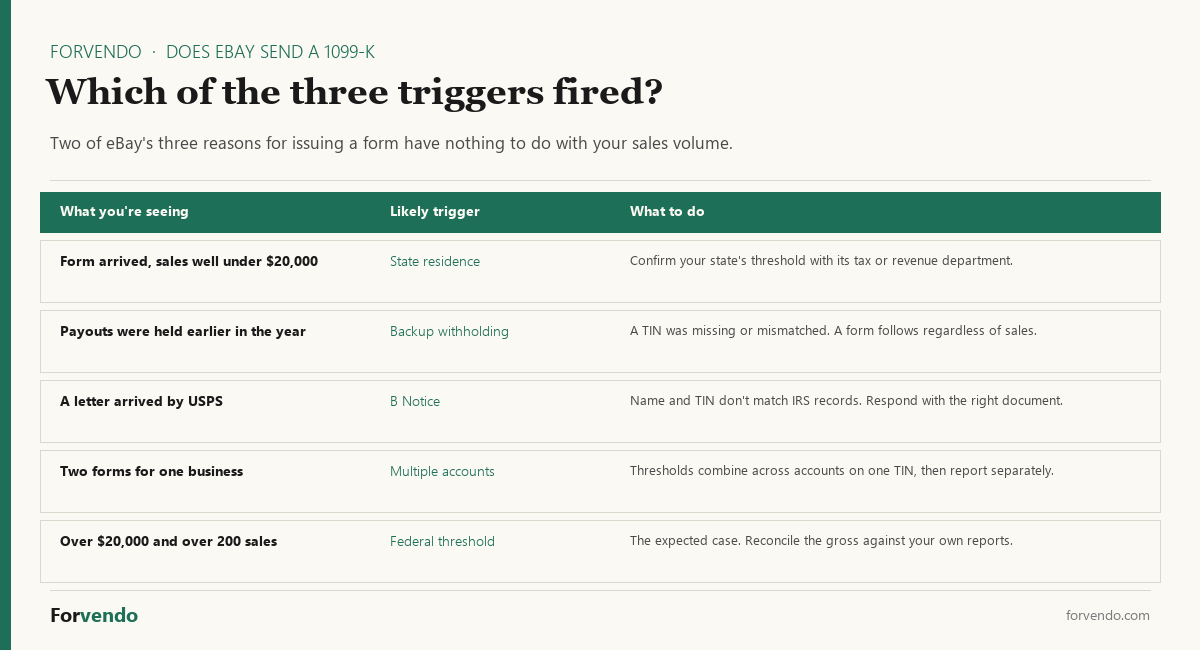
If a form has already arrived and you’re trying to work out why, run it backwards from what you observed. A form on modest sales points at your state’s threshold. Payouts that were held earlier in the year point at withholding, and a form can follow that even on a modest year. Two forms for what feels like one business points at accounts sharing a TIN.
Knowing which trigger fired changes what you do next. A state-threshold form means checking a threshold; a withholding form means fixing a TIN before it happens again next year. They aren’t the same problem, and the form itself looks identical either way.
The state list, and why to verify it yourself
eBay names the lower-threshold states rather than waving at “some states,” which is more than most marketplaces do. There’s a catch worth knowing.
eBay’s two public seller pages don’t list the same states. The Seller Center tax information page names Arkansas, the District of Columbia, Illinois, Maryland, Massachusetts, Missouri, Montana, New Jersey, Vermont, and Virginia. The 1099-K FAQ page lists the same set but swaps Missouri for Rhode Island.
Nine of the ten match. The disagreement sits on Missouri and Rhode Island, and eBay’s own guidance on both pages is the same: confirm the threshold with your state’s tax or revenue department. That’s the right move here regardless of which page you landed on. State thresholds also change between years, which is the usual reason two pages drift apart in the first place.
If you’re registered in several states for sales tax reasons, the broader picture is in the multi-state sales tax guide. Sales tax nexus and 1099-K thresholds are separate systems that happen to both be organized by state.
What the gross number leaves in
eBay’s definition is short and worth taking literally. The form “reports the gross amount of all payments within a calendar year,” and that amount “doesn’t include any adjustments for credits, discounts, fees, refunds or other amounts.”
So the figure sits above your final-value fees, above your refunds, and above any discounts you funded. Your payouts sit below all of them. A gap between the two isn’t an error — it’s the IRS asking for a number that deliberately ignores everything that happened after the buyer paid.
eBay draws the conclusion plainly: “The 1099-K shows your gross receipts, but you are taxable on your net income.”
Free download
The Solo Shopify Weekly Operating Checklist
A one-page PDF plus a copyable Google Sheet — the weekly cadence these guides build on. Free; bring your own store data.
Get the free checklist →One line the marketplaces treat differently. Whether marketplace-collected sales tax sits inside the reported gross varies by platform, and eBay’s public seller pages don’t spell it out. Etsy excludes the tax it collected and remitted; Amazon includes it. Don’t carry either answer over to eBay. Check your form against your own order report, or raise it with your tax professional, before assuming.
The part that matters most for casual sellers
eBay is unusual in this cluster because a large share of its sellers are clearing out personal belongings rather than running a business. That changes the answer to “do I owe tax on this?”
eBay’s example is a bike bought for $1,000 and later sold for $700. The $700 “would generally not be subject to income tax,” because the item sold for less than it cost. Only goods sold at a profit are taxable.
The practical consequence is that a 1099-K can report a five-figure gross on a year where you made no taxable profit at all. That’s not a mistake on the form. It’s why eBay recommends keeping a record of what you paid for items and your selling-related expenses, which is what establishes cost basis when you file.
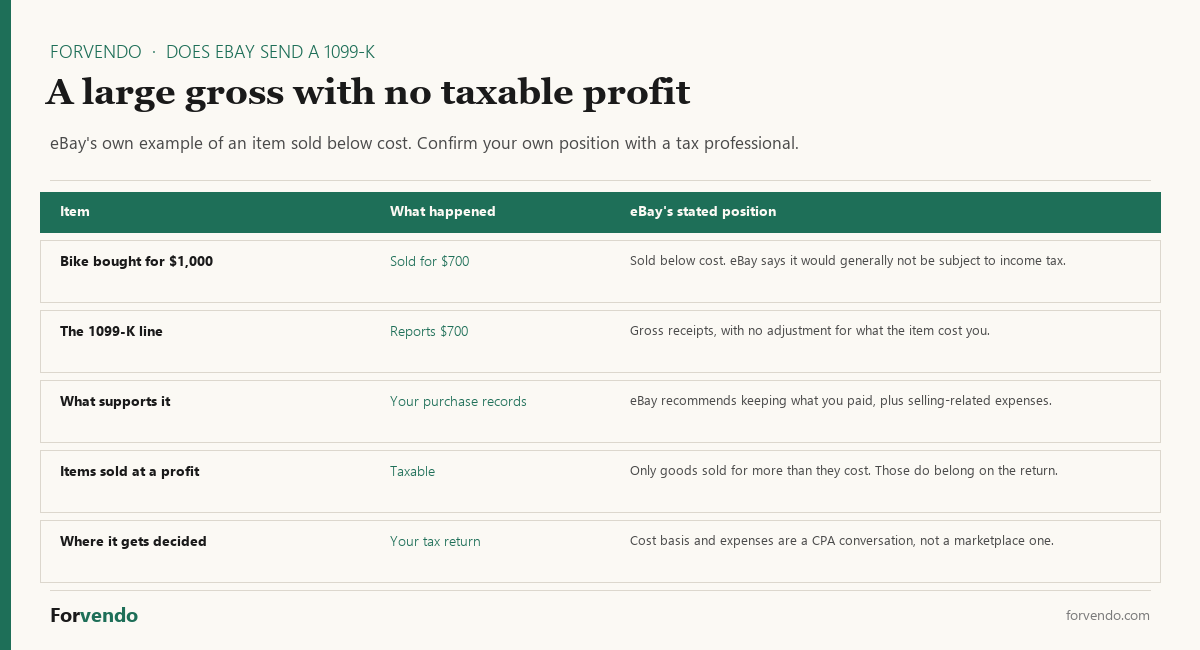
Read the bike example carefully, because the shape of it generalizes. The form reports the $700 that changed hands. It says nothing about the $1,000 that left your pocket years earlier, because the marketplace has no way of knowing it. The record that closes that gap is yours to keep.
That’s the argument for keeping purchase records on anything you might resell, even casually. eBay’s recommendation is to hold on to what you paid for items along with your selling-related expenses, and the reason is straightforward: those records are what establish cost basis when the form arrives showing only one side of the transaction.
Where the line falls between clearing out a closet and running a business is exactly the kind of question to put to a CPA or an enrolled agent rather than settle from a guide. What’s worth doing on your own is arriving at that conversation with the records already in order, because reconstructing what you paid for something three years ago is far harder than noting it at the time.
Etsy, Amazon, eBay: what’s inside the gross
This guide is the third in a set, and putting the three side by side makes the trap visible. The forms are the same form. What each marketplace decided to put inside the number is not.
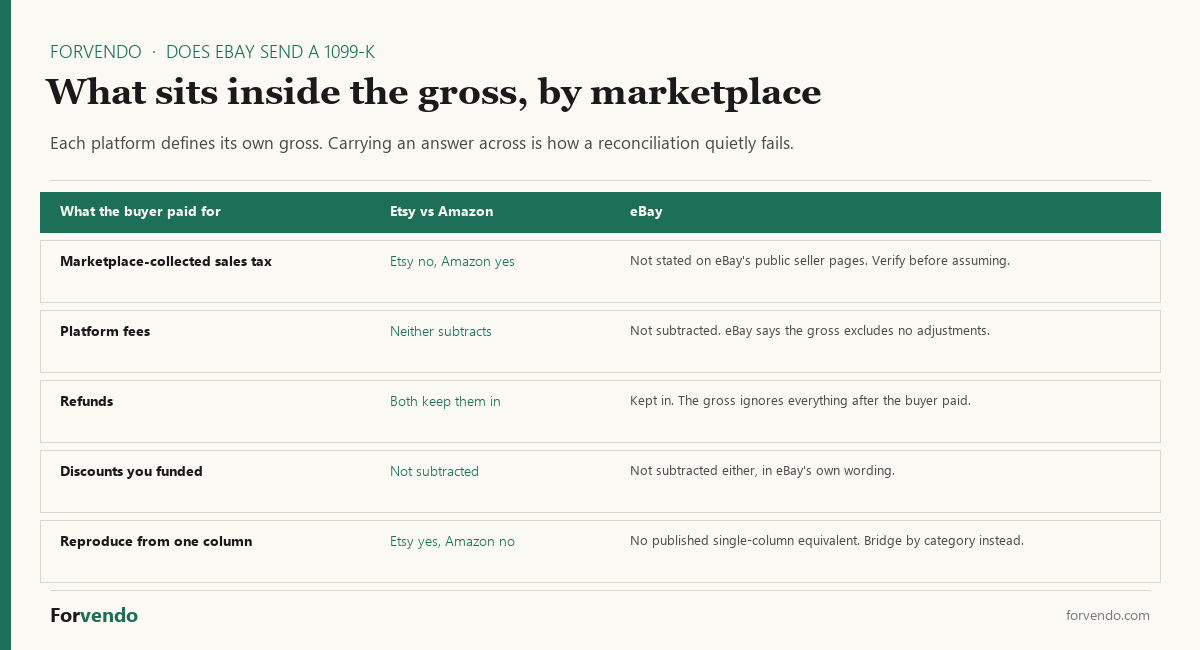
Most rows agree across all three. Fees aren’t subtracted anywhere, refunds stay in everywhere, and no platform nets out a discount you funded. Those are the parts of the definition the IRS drives, so they don’t vary.
The row that does vary is marketplace-collected sales tax, and it varies badly: Etsy excludes it, Amazon includes it, and eBay’s public seller pages don’t say. Three platforms, three different answers, on the line that’s often the largest single adjustment in a reconciliation.
The second difference is practical rather than definitional. Etsy publishes a column whose total equals the form, so you can tie out exactly. eBay gets to the same place by a different route: its 1099-K detail report, generated from the Payments tab in Seller Hub, breaks out the unadjusted gross payment transactions behind the form. Amazon publishes no equivalent, so an Amazon reconciliation stays a category bridge — start at the gross, subtract refunds, fees, and anything else that came off after the buyer paid, and document each step rather than chasing a number that matches to the cent.
If you sell on more than one of these, build a separate bridge per platform. The one habit that reliably produces an unexplainable gap is reusing last platform’s worksheet on this platform’s form.
Forvendo newsletter
Operating notes, once a week
One email a week for US-based solo Shopify operators at $5,000–$50,000 MRR: a decision, a checklist, or a teardown. No fluff, unsubscribe anytime.
Join the newsletter →If you run more than one eBay account
Accounts sharing an SSN, ITIN, or EIN are treated as one for threshold purposes, and then reported separately.
eBay’s wording is that thresholds are “calculated by combining all transactions for all accounts,” and if the combined total crosses the line you’ll receive “a Form 1099-K for each account, even if one or more of the individual accounts does not exceed the IRS reporting thresholds.” The same combine-then-split rule applies to state thresholds.
That’s a different shape from the other marketplaces in this cluster, so it’s worth stating clearly: two small accounts under one TIN can produce two forms, neither of which would have triggered on its own. Both belong in your reconciliation.
Withholding, B Notices, and payout holds
The withholding trigger has a chain of events behind it, and each step has a fix.
If a name-and-TIN mismatch is what put you here, the mechanics of fixing it — TIN matching, what each B Notice asks for, and the paperwork order — are covered in the W-9 and TIN reconciliation guide.
Forvendo decision rule
Check all three triggers rather than the dollar threshold alone. A year below the federal numbers can still produce a form through a lower state threshold or through backup withholding that was actually applied.
If you run more than one eBay account under a single TIN, plan for a form per account and reconcile per account. Gross receipts are the starting figure, not the taxable one — eBay says so in its own wording.
When the form arrives
eBay issues the form by January 31. You get an email when the electronic version is ready to download, and an electronic copy stays available in your account. A physical copy requires opting out of electronic delivery first; opting out doesn’t remove the electronic version.
For tax year 2025, that means a form by January 31, 2026. Confirm the current year’s dates before filing, since the reporting year moves each season.
Non-US sellers submit a Form W-8 series document, and eBay’s instruction is to contact them for how to send it.
One more thing worth doing before next January, and it takes about ten minutes. Confirm that eBay holds a valid SSN, ITIN, or EIN for you, check that the name on file matches IRS records exactly, and note your state’s current threshold from its own revenue department rather than from a marketplace page. Those three checks between them close off two of the three triggers, and the third one you can at least see coming. The pattern across this whole cluster is the same: the work that makes tax season short happens in months that don’t feel like tax season.
What this guide does not cover
- Your specific filing position, which should be reviewed with a CPA or an enrolled agent
- Cost basis calculation and which selling expenses are deductible
- State income tax treatment, which varies
- Sales tax collection and marketplace facilitator rules, covered in the multi-state sales tax guide
- eBay Stores subscription fees and their treatment on your return
FAQ
Does eBay send a 1099-K if I sell under $20,000?
It can. Living in a lower-threshold state can require one, and where backup withholding was actually applied, the form reports those payments even though the year sat below the normal federal threshold.
Is the amount on my eBay 1099-K what I owe tax on?
No. eBay states the form shows gross receipts while you’re taxable on net income. Fees, refunds, and discounts are not subtracted from the reported figure.
Do I owe tax on old personal items I sold?
Generally not on items sold for less than you paid. eBay’s example is a bike bought for $1,000 and sold for $700, which would generally not be subject to income tax. Keeping records of what you paid is what makes that provable.
I have two eBay accounts. Do I get one form or two?
Two. Thresholds are combined across accounts sharing a TIN, then a form is issued for each account, even if one account alone wouldn’t have qualified.
When does eBay send it?
By January 31, with an email when the electronic version is ready. A paper copy requires opting out of electronic delivery.
Does eBay’s 1099-K include sales tax?
eBay’s public seller pages don’t state it either way, so this guide won’t either. What they do say is that the gross amount excludes no adjustments for credits, discounts, fees, or refunds. Marketplace-collected sales tax is a separate question, and the answer differs by platform: Etsy states the tax it collects and remits isn’t reflected in its form, while Amazon counts it inside unadjusted gross sales. Rather than assume eBay follows one of them, compare the form against your own order report for the year, or raise it with your tax professional before you reconcile.
eBay is holding my payouts. What happens next?
That usually means eBay doesn’t have a valid SSN, ITIN, or EIN for you, which is requested at your first sale. Payouts can be held and backup withholding may be deducted until it’s supplied. Supplying it releases the hold going forward, but it doesn’t undo the year: if withholding applied at any point, a 1099-K is issued regardless of whether you hit the sales threshold. If the cause was a name-and-TIN mismatch rather than a missing number, expect a B Notice by mail and respond with the document that notice asks for.
eBay’s two pages list different states. Which one is right?
Neither page settles it, and that’s the honest answer. Nine of the ten low-threshold states match across both; the disagreement is Missouri on one page and Rhode Island on the other. eBay’s own guidance on both pages is the same — confirm the threshold with your state’s tax or revenue department — and that’s the step worth taking whichever page you found first. State thresholds also change between years, which is the likeliest reason two pages drifted apart.
Do I get a separate form from Shopify, Etsy, Amazon, or PayPal?
Yes, if your volume there crosses that company’s threshold. Each reports separately — see the Etsy, Amazon, and Shopify versions of this question. PayPal sits apart from the marketplaces: it reports as a payment processor, so only payments tagged as goods and services enter its pool.
Next step
Reconciling once, properly, makes every following January routine. If you want the worksheet rather than the theory, the free 1099-K reconciliation sheet uses the same gross-to-books bridge with the arithmetic already set up.
One note for eBay sellers using it: generate the 1099-K detail report alongside the form, then work down from the gross, subtracting final-value fees, refunds, and shipping labels you paid. Leave the marketplace-collected sales tax line alone until you’ve confirmed whether it sits inside your reported gross — that treatment differs by platform, and eBay’s public pages don’t settle it.
Forvendo Editorial note. Forvendo publishes educational operating resources for solo ecommerce operators. Articles may cover tax, sales tax, 1099-K reporting, software pricing, platform policies, and other operating topics that change over time.
This content is for general research and operational planning. It is not legal, tax, accounting, financial, or professional advice. Readers should verify details with official sources or qualified professionals before acting on them. Platform rules, tax thresholds, software pricing, and affiliate program terms can change without notice.
Forvendo articles may be drafted with AI assistance and are reviewed by the operator before publication according to our Editorial Policy, which covers sourcing, AI use, update cadence, and corrections. See also About, Disclosure, and Privacy Policy.