Shopify Taxes Explained: The 2026 Guide for Small Sellers
Last updated: · Tax thresholds, rates, and due dates are set by the IRS and individual states and change over time. Confirm current figures against official sources or a qualified US tax professional before acting.
A solo Shopify founder isn’t running one tax obligation. They’re running four, and the four are usually confused with each other: income tax on the store’s profit, sales tax collected from customers, the 1099-K the platform sends, and the 1099-NEC owed to contractors. Each has its own rules, its own deadlines, and its own way of going wrong. The last two are the pair most often mixed up. 1099-K vs 1099-NEC works through which form reports which money, and why the payment method — not the kind of work — decides it.
This guide is the map to solo Shopify taxes. It walks through all four systems the way they actually land on a US store in the $5,000–$50,000 MRR range, gives the one decision rule that matters in each, and links to the deep-dive workflow for each. Read it once to see how the pieces fit; use the linked guides when you need the step-by-step.
The figures here are 2026 planning numbers from IRS and state sources. They’re a starting point for a one-person operation, not a substitute for a CPA on your specific situation.
Quick answer: solo Shopify tax at a glance
- Income / estimated tax — Pay quarterly if you expect to owe $1,000+ for the year. Use the prior-year safe harbor (100% of last year’s tax, 110% over $150K AGI) via Form 1040-ES to stay clear of the underpayment penalty.
- Sales tax — Money you collect for the state, not income. You generally owe it where you have economic nexus (commonly $100,000 in sales). Register before you cross, not after.
- 1099-K — Reports gross card payments, not revenue. To reach the net receipts on your return, take out refunds, lost chargebacks, and sales tax collected from buyers if the form includes it. Fees are an expense, and shipping you charge stays in your sales.
- 1099-NEC — Collect a W-9 before paying any US contractor. The reporting threshold rises from $600 (2025) to $2,000 (2026).
- Deductions — Income tax applies to profit, not sales. Platform fees, apps, processing fees, COGS, shipping, and contractor payments all reduce the taxable number.
- Your Shopify tax documents — The 1099-K, the payout report, and the finance/tax report each answer one question. None of them is your bookkeeping.
- One calendar ties them together — estimated-tax quarters, the January 1099 deadlines, per-state sales-tax filings, and the April annual return.
Who this Shopify tax guide is for
- You run a US-based Shopify store as a sole proprietor or single-member LLC, without a payroll or an in-house finance person.
- Monthly revenue sits roughly between $5,000 and $50,000, so the tax questions are real but a full-time bookkeeper isn’t yet.
- You take card payments through Shopify Payments, possibly alongside PayPal or another processor.
- You know the individual terms — nexus, 1099-K, estimated tax — but not how they connect, or which one to act on first.
If you already know which system you’re dealing with and want the workflow, skip the map and go straight to the linked deep-dive for that system. This page exists to show how the four fit together.
The four solo Shopify tax systems, in one view
The single most common mistake in solo Shopify tax is mixing the first three. Sales tax isn’t your income. The 1099-K isn’t your revenue. And income tax is owed on profit, after both of those are stripped out. Keep them in separate mental buckets and most of the confusion disappears.
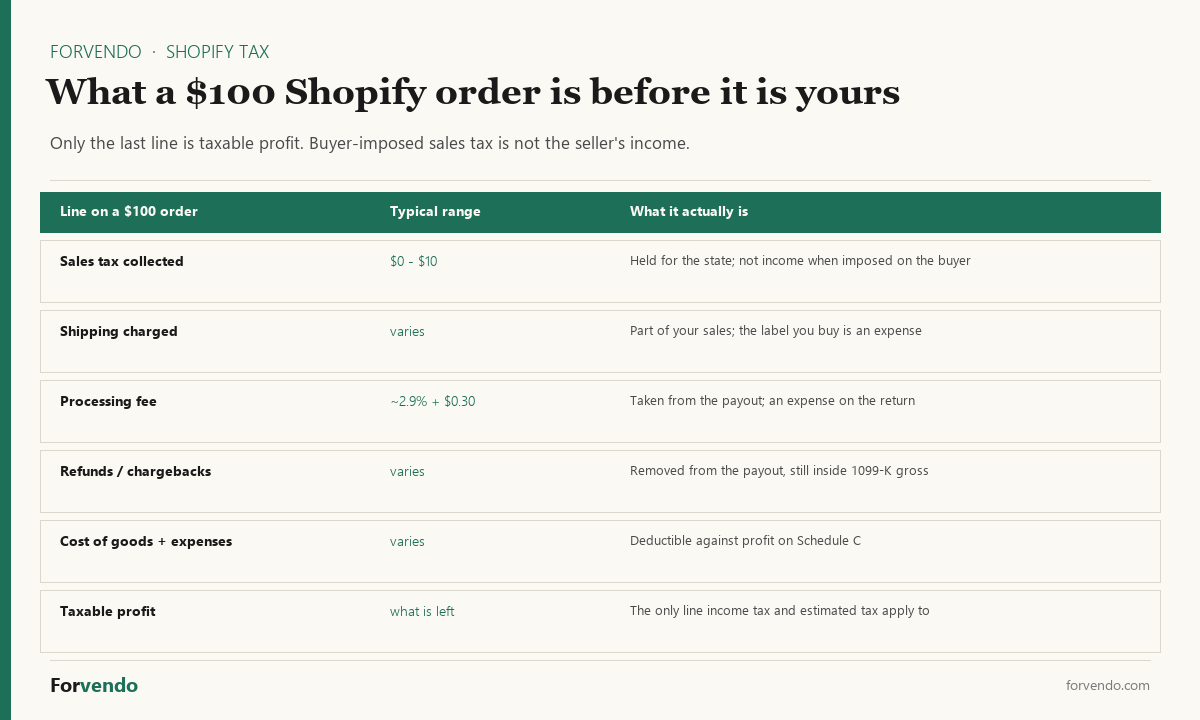
Reading a single order from the top down makes the separation concrete. The gross figure a payment processor reports is the largest number in the chain, and it is the least useful one for tax purposes.
Table of Contents
- 1. Income tax and quarterly estimated payments
- 2. Multi-state sales tax and economic nexus
- 3. The 1099-K: gross, not revenue
- 4. Contractors: W-9 and 1099-NEC
- 5. Closing registrations you no longer need
- 6. Deductions: the Shopify tax write-offs a solo store has
- Where to find your Shopify tax documents
- The unified 2026 tax calendar
- Tools and templates
- Frequently asked questions
1. Income tax and quarterly estimated payments
Your store’s profit is income, and the US tax system is pay-as-you-go. An employee has tax withheld from each paycheck automatically; a solo founder has no employer doing that, so the IRS expects you to pay it yourself, four times a year.
You generally owe quarterly estimated payments if you expect to owe $1,000 or more in federal tax for the year after withholding and credits. The trap is that paying it all in April doesn’t avoid the penalty — the underpayment penalty is calculated quarter by quarter on Form 2210.
The way to make this simple, and to stay clear of the underpayment penalty, is the prior-year safe harbor: pay 100% of last year’s total tax (110% if your prior-year adjusted gross income was over $150,000), split into four equal installments. That number is fixed on your filed return, so you don’t have to forecast this year’s income. If the store grows, the extra is simply due at filing — with no penalty, because you met the safe harbor.
Forvendo decision rule
Pay quarterly estimated tax if you expect to owe $1,000+ for the year. Use the prior-year safe harbor (100% of last year’s tax, 110% over $150K AGI) in four equal installments to stay clear of the underpayment penalty without forecasting.
If you also have a W-2 job whose withholding can cover the store’s tax, raise your W-4 instead of filing 1040-ES — withholding counts as paid evenly across the year, which a late estimated payment does not.
A practical companion to the safe harbor is a set-aside percentage — moving a fixed share of every payout (a common planning range is 25–30% of net profit) into a separate account so the quarterly payment is already funded when the date arrives.
Deep dive: Do You Have to Pay Quarterly Taxes on Shopify Income? — the safe-harbor math, the set-aside worksheet, the four 2026 due dates, and a free planner sheet.
2. Multi-state sales tax and economic nexus
Sales tax is money you collect from customers and remit to the state on their behalf. When the tax is imposed on the buyer, as with typical retail sales tax, it isn’t your income. The hard part isn’t collecting it — Shopify can do that — it’s knowing where you’re required to.
That’s governed by economic nexus: each state sets a threshold, and once your sales into that state cross it, you generally have to register and collect there, even if you’ve never set foot in the state. The common threshold is $100,000 in sales, though some states use $500,000. A meaningful shift by 2026: many states dropped the old “200 transactions” test and now use a revenue-only threshold, which helps small-but-high-volume sellers who used to trip the transaction count on low revenue.
Forvendo decision rule
Track your trailing-12-month sales by state and register before you cross a threshold, not after. Back-liability for sales you should have collected on is the expensive part; registering a little early costs almost nothing.
Deep dive: Shopify Sales Tax in Multiple States — the 2026 state threshold map, the register-or-wait decision, and a free nexus tracker.
Free download
The Solo Shopify Weekly Operating Checklist
A one-page PDF plus a copyable Google Sheet — the weekly cadence these guides build on. Free; bring your own store data.
Get the free checklist →3. The 1099-K: gross, not revenue
By early February (January 31, or the next business day), Shopify Payments sends you a Form 1099-K. The number on it, Box 1a, is gross payments — the total of all card payments processed before any deduction. It includes sales tax you collected and refunded orders, which aren’t your income, along with shipping customers paid and the processing fees taken from your payouts. It’s usually higher than your actual revenue. The IRS gets its copy later in the filing season.
If you file the 1099-K as revenue, you overstate income and overpay. The fix is a reconciliation: start from the 1099-K gross and subtract refunds, lost chargebacks, and any sales tax collected from buyers that the form includes. What remains is your net receipts, which should line up with your books. Shipping you charge customers stays in your sales, and processing fees come off once, as an expense, not out of your sales.
On thresholds: the federal 1099-K reporting threshold reverted to more than $20,000 and more than 200 transactions under the One Big Beautiful Bill Act (OBBBA), but some states set their own lower threshold (Massachusetts at $600, for example). So you can receive a state 1099-K without a federal one. Either way, keep your own records; the form is a report, not a substitute for bookkeeping.
Forvendo decision rule
Do not file the 1099-K figure as revenue. Reconcile it to net receipts (refunds, lost chargebacks, and any sales tax inside the form come out; fees are an expense) every year — ideally a dry run in early December, before the form arrives.
Deep dive: Does Shopify Send You a 1099-K? — the two-bridge model (to your return and to your bank) and a free reconciliation sheet.
Selling on a marketplace too? Each platform issues its own form and defines gross its own way, so the reconciliation has to be repeated per platform rather than reused. The line that varies most is marketplace-collected sales tax: Etsy states it isn’t reflected in the form, Amazon counts it inside unadjusted gross sales, and eBay’s help page says it is excluded. eBay also issues forms for two reasons beyond the sales threshold, either of which can land on a year below $20,000.
Taking PayPal as well? That one splits by payment rail rather than by platform. Shopify states its own form covers only transactions processed through Shopify Payments, so PayPal orders sit outside it and PayPal reports them separately — and only payments tagged as goods and services enter PayPal’s pool. See does PayPal send a 1099-K?.
4. Contractors: W-9 and 1099-NEC
The moment you pay a US contractor — a virtual assistant, a freelance designer, a photographer — a second 1099 system applies, this time with you as the reporter. Two rules carry most of the weight.
First, collect a W-9 before the first payment, not at year-end. Without a correct Taxpayer Identification Number on file, backup withholding (24%) can apply, and chasing W-9s in January from contractors who have already been paid is far harder than collecting one at onboarding.
Second, the 1099-NEC reporting threshold is in transition. For tax year 2025 (due February 2, 2026, because January 31 fell on a Saturday) it’s $600. For tax year 2026 (due February 1, 2027, because January 31 is a Sunday) it rises to $2,000 under OBBBA Section 70433. A contractor paid between $600 and $2,000 in 2026 no longer triggers a federal 1099-NEC — though some states keep lower thresholds, so check your state.
Forvendo decision rule
Collect every W-9 at contractor onboarding and run the free IRS TIN Matching service when you receive it. A W-9 collected up front takes three minutes; one collected in January takes hours of follow-up, if it can be collected at all.
Deep dive: W-9 and TIN reconciliation — the threshold timeline, TIN Matching, B Notices, and a free tracker.
5. Closing registrations you no longer need
Tax registrations aren’t one-way. If your sales into a state fall below its threshold and stay there, continuing to file zero returns is wasted time and a standing compliance surface. Deregistration — formally closing a sales-tax account — is the cleanup step most store owners forget.
It isn’t automatic, and doing it wrong (or at the wrong time) can create problems, so it’s a decision, not a reflex: confirm you genuinely no longer have nexus, file the final return correctly, and follow each state’s closure process.
Deep dive: How to Cancel a Sales Tax Permit — a 7-question decision test, per-state closure forms, and a final-return checklist.
Forvendo newsletter
Operating notes, once a week
One email a week for US-based solo Shopify operators at $5,000–$50,000 MRR: a decision, a checklist, or a teardown. No fluff, unsubscribe anytime.
Join the newsletter →6. Deductions: the Shopify tax write-offs a solo store has
The first five systems are about reporting. This one is about the number being reported. Income tax applies to profit, so every ordinary and necessary cost of running the store lowers the figure the whole calculation sits on — including the quarterly estimated payment.
For a sole proprietor or single-member LLC, that profit is calculated on Schedule C (Form 1040), and the general standard the IRS applies to a business expense is that it is both ordinary (common in your line of work) and necessary (helpful and appropriate for it). Publication 334 is the IRS’s own small-business walkthrough of how that works.
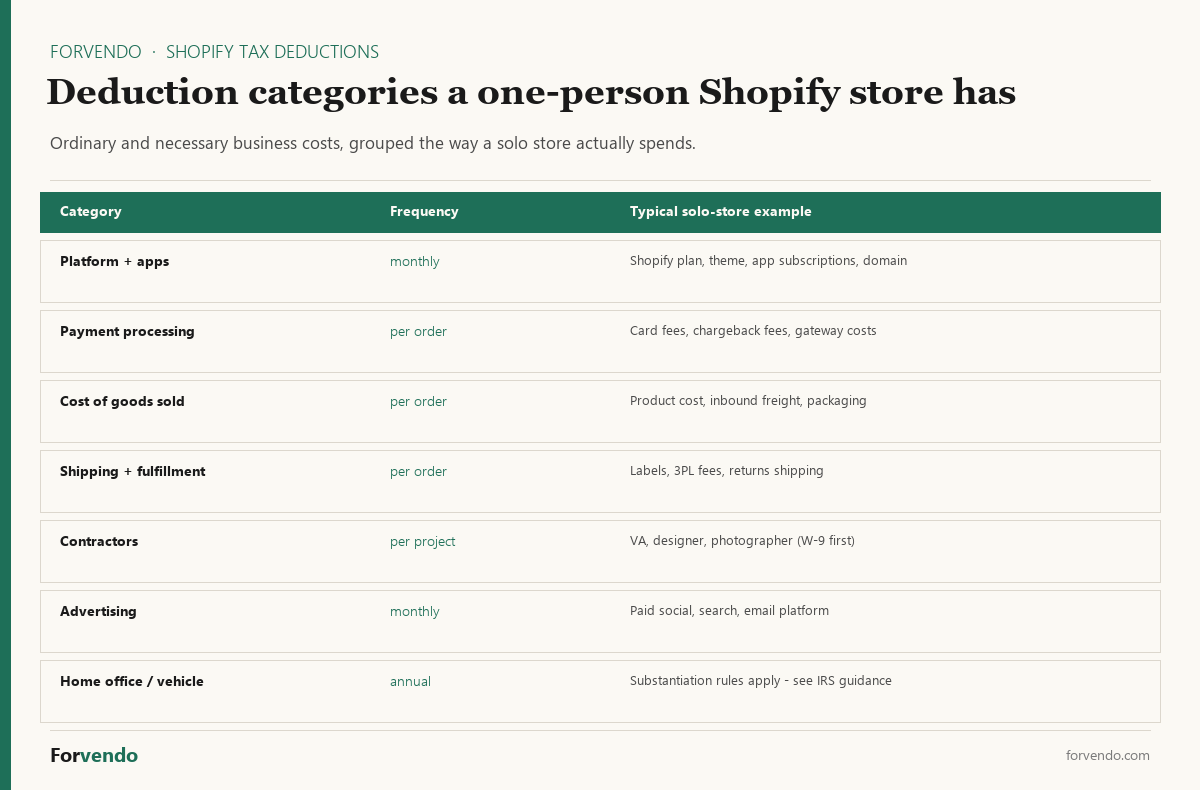
Three categories are worth calling out because solo operators most often miss or mishandle them:
- App and platform subscriptions. The Shopify plan, the theme, and every recurring app charge are business costs. They also tend to be invisible, because they leave the account monthly without an invoice landing in an inbox. Pull an annual app-charge export once a year rather than reconstructing it from memory.
- Payment processing fees. These are deducted from your payout, so they rarely look like a payment you made — but they are still an expense, and they are still reflected in 1099-K gross. This is the same gap the 1099-K reconciliation closes from the other direction.
- Home office and vehicle use. Both are legitimate and both carry substantiation requirements that are stricter than a typical business expense. The IRS home office deduction page sets out the exclusive-and-regular-use test and the simplified option.
Two things that are not deductions, and are commonly mistaken for them: sales tax you collected from customers (it was not your income to begin with, so removing it isn’t a deduction), and a refund you issued (it reduces revenue rather than adding an expense).
There is also a separate deduction rather than a business expense — the qualified business income deduction under Section 199A — that many pass-through owners can claim. Its eligibility rules and years of application have moved with legislation, so treat it as a question for your CPA at filing time rather than a number to plan around.
Forvendo decision rule
Run every store cost through one dedicated business account or card. The deduction you lose is almost never the one you didn’t know about — it’s the one you can’t separate from personal spending twelve months later.
Do not let a deduction drive a purchase. A $500 expense reduces tax by your marginal rate, not by $500; you are still out most of the money.
Where to find your Shopify tax documents
At filing time the question stops being conceptual and becomes “which file do I open?” Shopify produces several records that get called Shopify tax documents interchangeably, and they answer different questions.
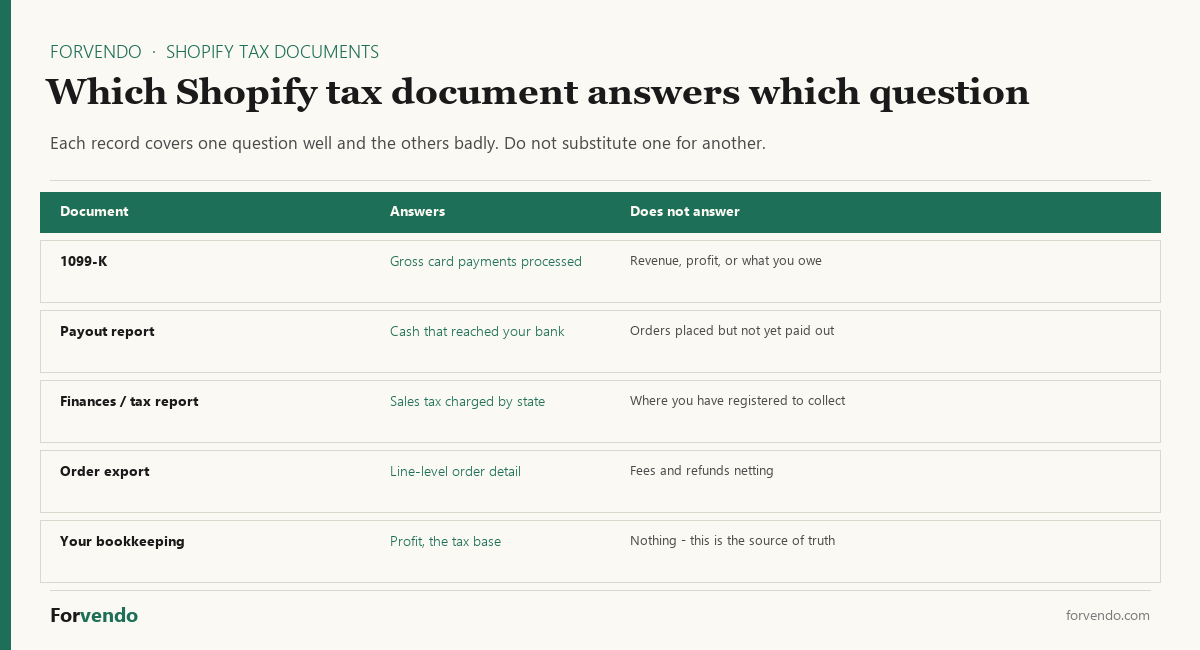
- The 1099-K comes from Shopify Payments, under Finance → Documents → 1099-K in your admin, and appears in January for the prior year. It reports gross card payments and nothing else. It is not a revenue statement.
- The payout report shows what actually reached your bank after fees, refunds, and chargebacks. It’s the closest record to cash, and the reason it rarely equals the 1099-K is the fee and refund gap.
- The finance and tax reports in your admin’s analytics section show sales tax charged, broken out by jurisdiction. This is the input to a sales-tax return — but it reflects what was charged, not where you are registered, so it is not a nexus check.
- The order export gives line-level detail when you need to answer a question the summary reports flatten.
Two cautions. First, Shopify moves admin menus periodically; if a path in your store doesn’t match, search the Help Center for the document name rather than assuming it’s gone. Second, none of these files is bookkeeping. They are inputs. The profit figure your return is built on comes from your own books, with the platform reports used to check them.
The unified 2026 tax calendar
The four solo Shopify tax systems share a calendar. For a calendar-year one-person store, these are the dates that matter most in 2026.
Tools and templates
Each solo Shopify tax system above pairs with a free, no-email-gate sheet on the free resources page: a multi-state nexus tracker, a 1099-K reconciliation sheet, an estimated-tax safe-harbor planner, and a W-9/TIN tracker. They’re enough for most solo stores.
What this guide does not cover
This solo Shopify tax guide is an operating map for a US solo store owner taxed as a sole proprietor or single-member LLC. It doesn’t cover S-corporation payroll and reasonable-compensation rules, the detailed calculation of self-employment or income tax, international sales and customs, state income tax mechanics beyond noting they exist, or audit and penalty-abatement procedures. Each linked deep-dive goes further on its topic, and any judgment call on your specific return benefits from a qualified US tax professional.
If you live outside the United States and own a US LLC, the federal filings change; US LLC for non-residents covers that case.
Estimated Tax Safe-Harbor Calculator
Planning estimate, not tax advice. Uses the smaller of 90% of this year's tax (if entered) or 100% / 110% of last year's. Confirm with a CPA.
Frequently asked questions
Is the sales tax I collect part of my income?
No. Sales tax is collected from customers and remitted to the state on their behalf — it’s held money, not revenue. Income tax is calculated on your profit, after that pass-through is removed. Treating collected sales tax as income is one of the most common and costly mistakes for new sellers.
Why is my Shopify 1099-K higher than my actual sales?
Because it reports gross payments, not revenue. Box 1a includes sales tax you collected and refunded orders, which aren’t your income, plus processing fees, which you deduct as an expense. Shipping customers paid is part of your sales and stays in. Reconcile it to net receipts rather than filing the gross figure.
Do I have to pay quarterly taxes if Shopify is a side project?
Only if you expect to owe $1,000 or more in federal tax after withholding. If a W-2 job’s withholding already covers your total tax, you may owe less than that and need no estimated payments — and raising your W-4 is often simpler than filing 1040-ES.
Can I owe sales tax in a state I’ve never visited?
Yes. Economic nexus is based on your sales into a state, not your physical presence. Once you cross that state’s threshold (commonly $100,000 in sales), you generally have to register and collect there.
Does Shopify pay my sales tax for me?
No. Shopify can calculate and collect sales tax at checkout based on the registrations you configure, but the money sits in your account until you file and remit it to each state. Collection and remittance are two separate steps, and only the first one is automated by default.
Are Shopify fees and app subscriptions deductible?
Generally yes — platform fees, app subscriptions, themes, and payment processing fees are ordinary and necessary costs of running an online store, and they reduce the profit that income tax is calculated on. Processing fees are the ones most often missed, because they’re netted out of your payout instead of billed to you.
Which Shopify tax documents do I need at filing time?
At minimum: the 1099-K (if one was issued), a full-year payout report, and a sales-tax report by state. Bring your own books as the primary record — the platform reports are there to verify them, not to replace them.
Does this guide replace a CPA?
No. It’s a solo Shopify tax operating map and planning tool based on 2026 sources. Tax rules vary by situation and change over time — use it to understand the systems and run the routine work, and bring a CPA in for your specific return and any judgment calls.
Forvendo Editorial note. Forvendo publishes educational operating resources for solo ecommerce operators. Articles may cover tax, sales tax, 1099-K reporting, software pricing, platform policies, and other operating topics that change over time.
This content is for general research and operational planning. It is not legal, tax, accounting, financial, or professional advice. Readers should verify details with official sources or qualified professionals before acting on them. Platform rules, tax thresholds, software pricing, and affiliate program terms can change without notice.
Forvendo articles may be drafted with AI assistance and are reviewed by the operator before publication according to our Editorial Policy, which covers sourcing, AI use, update cadence, and corrections. See also About, Disclosure, and Privacy Policy.