Shopify Discount Strategy: How to Discount Without Killing Margin
Last updated: · Shopify features, pricing, and platform policies change. Verify with official sources before acting.
A discount feels free in the moment and shows up later as a margin hole. For a solo Shopify store, a 20% sitewide sale isn’t “20% off” — on a typical product it can erase more than a third of the profit, and it quietly trains customers to wait for the next one. A discount strategy is what separates a promotion that builds the business from one that slowly starves it.
This guide is the margin-first version of that strategy. It covers when a discount is actually worth running, which type to use, the break-even math that tells you what a sale really costs, and the one guardrail that keeps a promotion from going underwater. The goal isn’t to swear off discounts — it’s to discount on purpose, with the numbers in front of you.
These figures are planning assumptions for a $5,000–$50,000 MRR solo store; your real numbers depend on your margins and product mix.
Quick answer
- Know the break-even before you discount. On a 50% gross-margin product, a 20% discount means you need to sell roughly 67% more units just to make the same profit. Run that number first.
- Discount with a reason, not a calendar. Clearing slow stock, rewarding loyalty, or hitting a specific goal — not “it’s been a while.”
- Prefer threshold and bundle offers over sitewide percentages. They lift average order value instead of just shrinking margin on orders you would have gotten anyway.
- Set a margin floor and hold it. Decide the lowest margin you’ll accept, and let no promotion push a product below it.
- Protect your full-price baseline. Frequent sitewide sales make full price feel like a mistake. Discount the exception, not the norm.
Who this is for
This is for a one-person store on Shopify, $5,000–$50,000 MRR, who runs the store and its promotions personally and feels the margin hit directly. If your margins are thin (under ~35%), the math here matters even more — there’s less room to give away. If you’re a high-margin brand with strong pricing power, you have more flexibility, but the break-even discipline still applies.
Why discounting quietly kills solo stores
The reason a discount costs more than its headline number is that it comes entirely out of margin, not revenue. Drop the price 20% and you don’t lose 20% of profit — you lose a much larger share, because your costs don’t drop with the price.
The thinner the margin, the more brutal the math. A 20%-off sale on a 30%-margin product needs to triple unit sales just to net what full price would have. Few promotions do that — which means many sales lose money you never measure. The break-even unit lift, not the discount percentage, is the number that matters.
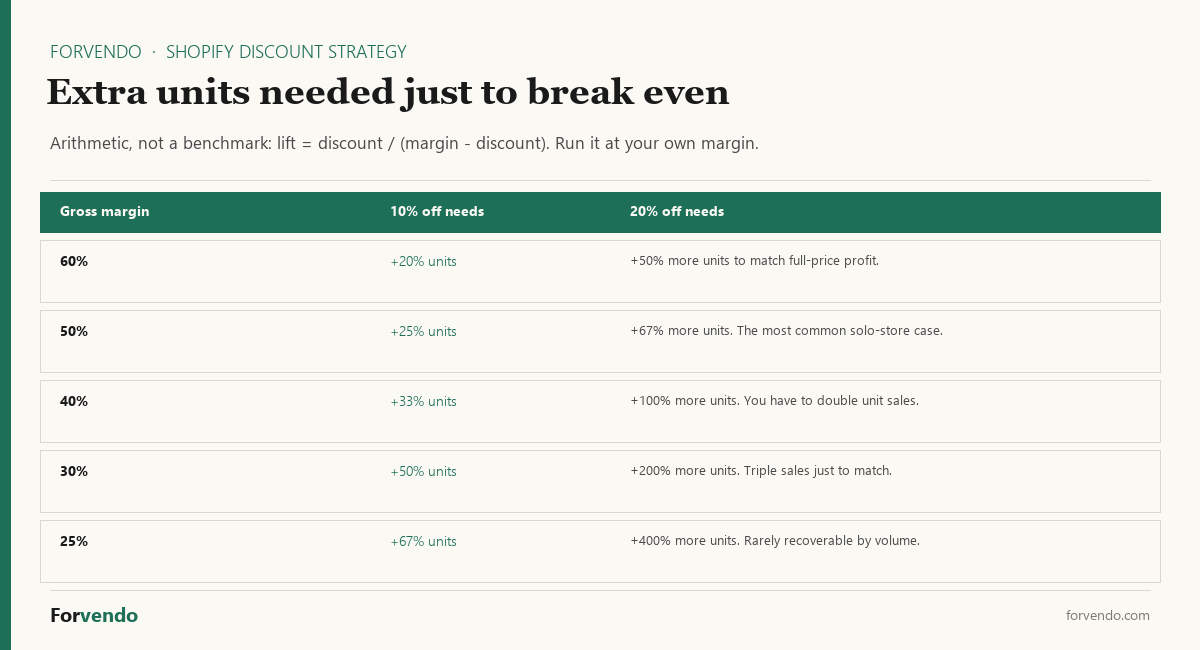
The formula behind that grid is short enough to keep in your head: the extra unit lift you need is the discount divided by what’s left of your margin after it. A 20% discount on a 50% margin leaves 30%, and 20 divided by 30 is roughly 67%. Run it once at your real margin before you set any percentage, and the number usually settles the question on its own.
When a discount is actually worth it
Discount with a job to do. There are a few situations where the math works:
- Clearing slow or seasonal stock — recovering cash from inventory that’s otherwise dead is a real win, even at a low margin.
- Rewarding loyalty or winning back lapsed buyers — a targeted offer to a known segment, not a public sitewide sale.
- Hitting a specific, measured goal — a launch, a first-order incentive tied to email capture, a clear AOV-lift mechanic.
And when it usually isn’t worth it: a sitewide percentage “because it’s been a while,” discounting your best-sellers (which would have sold anyway), or matching a competitor’s sale on instinct.
Which discount type to use
Not all discounts cost the same. Some protect margin or lift order value; a flat sitewide percentage does neither.
Shopify supports all of these natively in discounts and automatic discounts — the tool isn’t the constraint, the decision is.
Free download
The Solo Shopify Weekly Operating Checklist
A one-page PDF plus a copyable Google Sheet — the weekly cadence these guides build on. Free; bring your own store data.
Get the free checklist →Forvendo decision rule
Before any discount, calculate the break-even unit lift at your real margin, and set a margin floor you will not cross. Prefer threshold and bundle offers that lift order value; use a sitewide percentage only with a specific reason and a hard end date.
Do not run a sitewide sale yet if you cannot name what it is for, or if the break-even lift is one you have not actually hit. A discount without a measured goal is a margin gift, not a strategy.
Turning your discount strategy into a Shopify discount
Once you’ve picked the offer, Shopify sorts it into one of three discount classes — product, order, or shipping. Which class you land in isn’t a formality: it decides what the discount can combine with later, which is where margin quietly leaks.
Shopify’s discount types are amount off (a percentage or fixed amount), Buy X get Y, and free shipping. Each can run as a discount code the customer types, or as an automatic discount that applies when the cart qualifies.
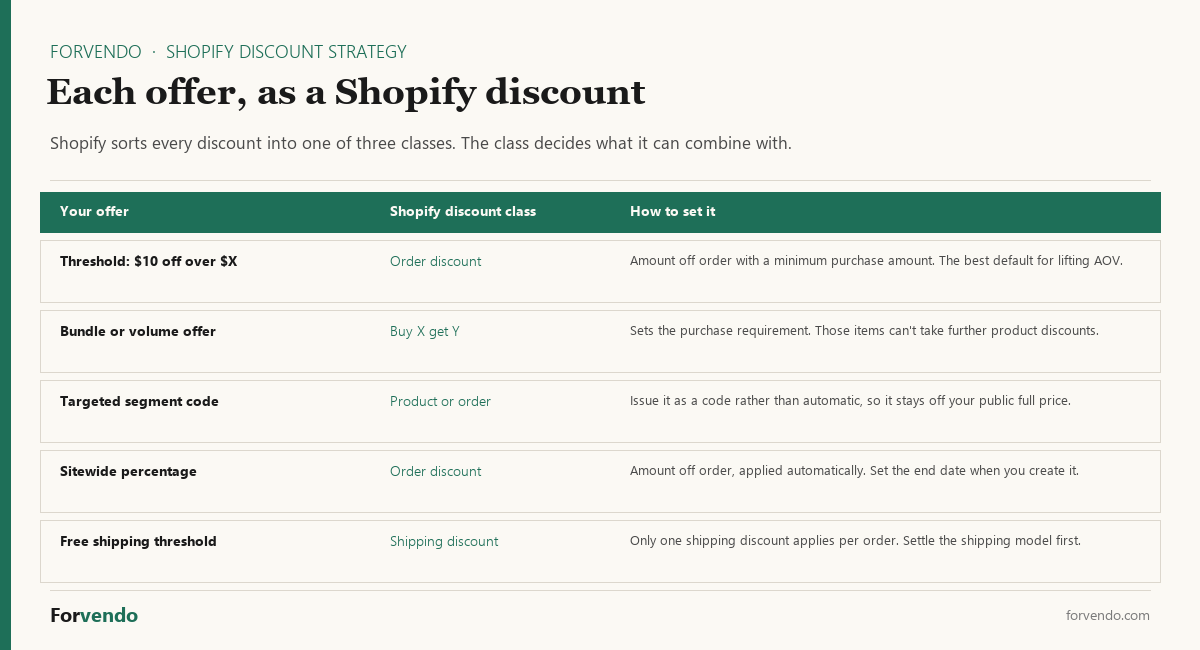
The code-versus-automatic choice matters more than it looks. An automatic discount is visible to everyone who qualifies, so it becomes part of your public pricing — that’s the right mechanism for a threshold offer you want shoppers to chase, and the wrong one for a win-back offer meant for a specific segment. A code keeps the offer private and traceable, which is why targeted discounts belong there.
One practical note on Buy X get Y: Shopify treats the items in that promotion as ineligible for further product discounts. That’s a feature, not a limitation — it stops a bundle from being discounted twice — but it also means a customer holding a code may lose the bundle offer when they apply it.
Stacking: what Shopify actually allows
“Don’t stack discounts” is easy to say and hard to act on unless you know what stacks in the first place. Shopify’s answer: discounts combine only when you allow it, in the Combinations section of the discount you’re creating. Leave that alone and nothing stacks.
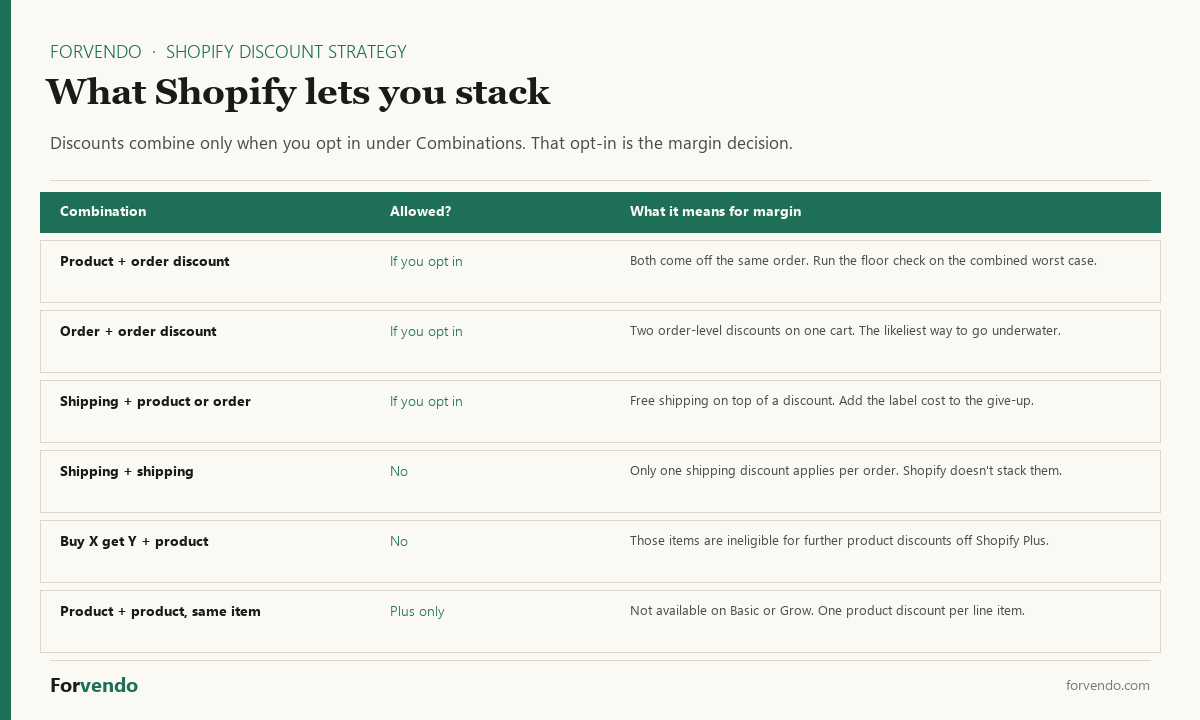
Two of those rows deserve attention. Only one shipping discount can apply per order, so a free-shipping code and a free-shipping threshold won’t double up — Shopify picks one. And combining multiple product discounts on the same line item is a Shopify Plus feature, so on Basic or Grow a single item takes one product discount and that’s it.
The rest is your decision, and it’s the one worth slowing down for. Every box you tick under Combinations widens the worst case. A 15% order discount is a known cost; a 15% order discount that’s combinable with a free-shipping offer and a segment code is a cost you haven’t calculated yet.
Forvendo newsletter
Operating notes, once a week
One email a week for US-based solo Shopify operators at $5,000–$50,000 MRR: a decision, a checklist, or a teardown. No fluff, unsubscribe anytime.
Join the newsletter →The practical rule: before enabling any combination, price the worst case. Take the deepest discount in each class that could legally apply together, add the label cost if free shipping is one of them, and check that number against your margin floor. If the stacked worst case breaches the floor, don’t tick the box — run the offers in separate windows instead.
The one guardrail: a margin floor
The single rule that prevents most discount damage is a margin floor — the lowest gross margin you’ll accept on any sale. Set it once (for example, “no promotion takes a product below 25% margin”), and screen every offer against it. Slow-stock clearance is the only common exception, and even then you’re choosing to recover cash, not to make profit.
A floor turns discounting from a feeling into a check: an offer either clears the floor or it doesn’t run.
Give the floor a review date rather than treating it as permanent. Once a quarter, check three things: whether your actual gross margin still matches the number the floor was set from, whether any promotion breached it in the last three months, and whether the offers that cleared it actually earned their break-even lift.
A floor set at 25% when your margin was 45% is the wrong floor if costs have since pushed the margin to 38%. If nothing breached it and every offer cleared its break-even, the floor is doing its job and you can leave it alone for another quarter. If something did breach it, the useful question isn’t which offer broke the rule — it’s whether the rule got bypassed by a stacked combination nobody priced.
Worked example: a $12K MRR store deciding on a sale
This is a composite store, not a real customer, used to show the checks running together. The numbers are planning assumptions, not a forecast.
The store does $12,000 MRR at an AOV of $52 and a gross margin of 45%. The owner has set a margin floor of 25% and is deciding between a sitewide 20%-off weekend and a threshold offer.
Option A, sitewide 20% off. The discount comes straight out of margin, leaving 25% — exactly on the floor, with no room for anything else. The break-even lift is 20 divided by 25, or +80% more units over the weekend just to match what full price would have earned. That’s the whole decision right there: if past sales haven’t produced an 80% unit lift, this promotion loses money on purpose.
Option B, $10 off orders over $65. On a qualifying $65 order the discount is 15.4%, leaving a 29.6% margin — clear of the floor with roughly five points to spare. It also does something the sitewide sale can’t: it pulls a $52 average order up toward $65, because the customer adds an item to qualify. The give-up buys a bigger basket instead of shrinking one the store had already won.
The stacking check. The owner is tempted to add free shipping to Option B. At a $6.50 average label on a $65 order, that’s another 10 points, taking the combined margin to about 19.6% — under the 25% floor. So the Combinations box stays unticked, and free shipping runs in a separate window if it runs at all.
Option B wins, and it wins on arithmetic that took about five minutes. That’s the entire method: break-even lift first, floor second, combinations last.
Common mistakes
- Discounting best-sellers. They would have sold at full price; the discount is pure give-up.
- Leading with sitewide percentages. They train customers to wait and make full price feel wrong.
- Ignoring the break-even lift. The discount percentage isn’t the cost — the units you must add to break even is.
- No end date. A “sale” with no deadline becomes the new price and resets the baseline.
- Ticking every box under Combinations. Codes plus automatic discounts plus free shipping can quietly push an order below cost. Price the stacked worst case before you allow it.
What this article does not cover
This is a margin-first decision guide for whether and how to discount, not a promotions-calendar template or a paid-ads couponing playbook. It doesn’t cover loyalty-program design in depth, wholesale pricing, or dynamic pricing tools. Those are separate decisions.
Related Forvendo guides
Discounting is a pricing-and-margin decision, like shipping. Shopify Shipping Rates: A Margin-First Decision System applies the same break-even thinking to shipping, and a first-order discount often pairs with Shopify Email Capture. Before discounting to lift sales, it is worth checking whether the problem is price at all — How to Increase Your Shopify Conversion Rate finds where the funnel actually leaks, and a discount applied to the wrong leak costs margin without fixing anything. The whole margin picture sits inside the Solo Shopify Operations guide.
Frequently asked questions
Should I discount my best-sellers?
Usually not. A best-seller is the product most likely to sell at full price, so a discount on it is close to pure give-up — you’re paying for orders you had already won. The exception is a deliberate one: using a best-seller as the qualifying item in a threshold or bundle offer, where the discount buys a larger basket rather than shrinking one. Slow stock is where a straight markdown does real work, because there the alternative is capital sitting in boxes.
Do Shopify discounts stack?
Only when you allow it. Each discount has a Combinations section where you choose which classes it can combine with, and Shopify won’t stack anything you haven’t opted into. Two limits are fixed regardless: only one shipping discount applies per order, and combining multiple product discounts on the same line item is a Shopify Plus feature. Products in a Buy X get Y promotion are also ineligible for further product discounts.
What’s the difference between a discount code and an automatic discount?
A code is typed in at checkout; an automatic discount applies on its own once the cart qualifies. The practical difference is who sees the offer. An automatic discount is effectively part of your public pricing, which suits a threshold offer you want every shopper to chase. A code stays private and traceable, which is what you want for a win-back or first-order offer aimed at one segment — it protects your full-price baseline.
How do I stop a sale from becoming my new price?
Set the end date when you create the discount, not later, and keep sitewide percentages rare enough that full price still reads as normal. The margin floor helps here too: an offer that can’t clear the floor doesn’t run, which naturally limits how often you can discount. If you find yourself scheduling a sale because it’s been a while, that’s the signal the baseline has already slipped.
Is discounting bad for a small Shopify store?
Not inherently — undisciplined discounting is. A discount with a measured goal (clearing stock, lifting AOV, winning back a lapsed buyer) can build the business; a recurring sitewide percentage with no reason mostly gives away margin and trains customers to wait. The difference is whether you ran the break-even math first.
How much can I discount without losing money?
Down to your margin floor — the lowest gross margin you decide to accept. Below that, you’re either clearing stock for cash or losing money. Calculate the break-even unit lift at your margin before setting the percentage; a 20% discount on a 40%-margin product needs roughly double the units to match full-price profit.
What type of discount works best for a solo store?
Threshold offers (“$10 off over $X”) and bundles tend to work best because they lift average order value instead of just shrinking margin. Targeted codes for specific segments protect your full-price baseline. A flat sitewide percentage is the least efficient and should be the exception.
How often should I run sales?
Rarely enough that full price stays the norm. Frequent sitewide sales reset customer expectations and make full price feel like a penalty. Tie promotions to real reasons and clear end dates rather than a fixed monthly cadence.
Forvendo Editorial note. Forvendo publishes educational operating resources for solo ecommerce operators. Articles may cover tax, sales tax, 1099-K reporting, software pricing, platform policies, and other operating topics that change over time.
This content is for general research and operational planning. It is not legal, tax, accounting, financial, or professional advice. Readers should verify details with official sources or qualified professionals before acting on them. Platform rules, tax thresholds, software pricing, and affiliate program terms can change without notice.
Forvendo articles may be drafted with AI assistance and are reviewed by the operator before publication according to our Editorial Policy, which covers sourcing, AI use, update cadence, and corrections. See also About, Disclosure, and Privacy Policy.