When to Hire Help for Your Shopify Store: A 4-Check Test
Last updated: · Contractor classification, tax treatment, and platform policies change. Confirm individual decisions with a qualified professional and current vendor or tax documentation before acting.
“I can’t keep up.” “I lose Sundays to support tickets.” The conclusion — hire someone — feels obvious, and it’s usually wrong. Outsourcing isn’t a time problem. It’s a decision system with three axes: return on investment, operating quality, and dependency risk. When one of them points the wrong way, the contractor budget leaves the store and the output gets worse.
This article walks through the three axes, four readiness checkpoints before any contractor is hired, a “do not outsource yet if” list, a modeled ROI example at $15K MRR (range-based, not a forecast), the two failure modes that consistently waste money, and the small set of work categories where outsourcing actually does pay off for a one-person store.
This article isn’t sponsored. Forvendo doesn’t recommend a specific contractor platform or agency in this guide.
For a solo store owner, the real question isn’t whether outsourcing is available, but when to outsource Shopify tasks without damaging margin, quality, or control. The rest of this guide is a 4-check system for answering that question on a specific store.
Quick answer: when to outsource Shopify tasks
- Outsourcing isn’t a time problem. It’s a decision across three axes — ROI, operating quality, and dependency risk. Time pressure is a signal to re-diagnose, not a decision input.
- Most solo Shopify sellers below $20K MRR should be cautious. The failure modes consume more cash than the channel saves when workflows aren’t yet documented.
- Read the four readiness checkpoints below. Two or more amber readings → defer 60 days. Three or more green → consider a small, scoped test.
- Work that tends to outsource well is documented, repetitive, low-judgment, and reversible — fulfillment, tier-1 customer service, basic graphic editing, bookkeeping data entry. High-judgment work (product strategy, supplier negotiation, finance decisions) usually doesn’t.
- The most common waste pattern is outsourcing the wrong category. The second is outsourcing before the workflow is documented. Both are operational mistakes, not contractor problems.
- Contractor tax and admin obligations may apply. US merchants paying contractors above the applicable IRS reporting threshold may need to issue Form 1099-NEC. The W-9 / TIN reconciliation article covers the records side.
The companion to this guide is the free Weekly Operating Checklist PDF, which includes a Sunday review block where this outsource decision can be reviewed alongside recurring operating leaks.
Table of contents
- Who this outsource decision article is for
- Why “outsource = more time” is the wrong question
- The three axes of an outsource decision
- Do not outsource yet if…
- Four readiness checkpoints before outsourcing
- A composite outsource ROI example for a $15K MRR store
- Two failure modes that make outsourcing waste money
- When outsourcing actually pays off
- What this article does not cover
- Frequently asked questions about outsourcing
Who this outsource decision article is for
This decision system is calibrated to the standard Forvendo reader.
- You sell on Shopify, typically on the Basic plan: $25/month billed monthly, or $19/month billed yearly.
- Monthly store revenue is between $5,000 and $50,000.
- You operate the store alone, possibly around a full-time job.
- Roughly 5–10 hours per week go into the store.
- You’ve started losing Sundays to support tickets, fulfillment slips, or campaigns that didn’t ship.
- You’re considering hiring a virtual assistant, fulfillment partner, freelance designer, or part-time helper.
If your store runs above $50K MRR with established workflows, you’re likely past the readiness checkpoints below and into a different decision — which categories to outsource first. If your store is below $5K MRR, outsourcing typically doesn’t pay off yet; the How Many Shopify Apps Is Too Many? is a more practical place to recover hours.
Why “outsource = more time” is the wrong question
Published guidance on solo operations usually treats outsourcing as a time-recovery tool. Hire someone, save hours. The premise sounds correct. The result, for most solo Shopify stores below $20K MRR, is the opposite.
Three structural reasons outsourcing rarely returns the time it promises.
First, outsourced work needs oversight. A new contractor, even a skilled one, makes mistakes on store-specific context for the first 4–8 weeks. You review output, correct misunderstandings, rewrite workflows. Your own time during onboarding often exceeds the hours the contractor was hired to absorb.
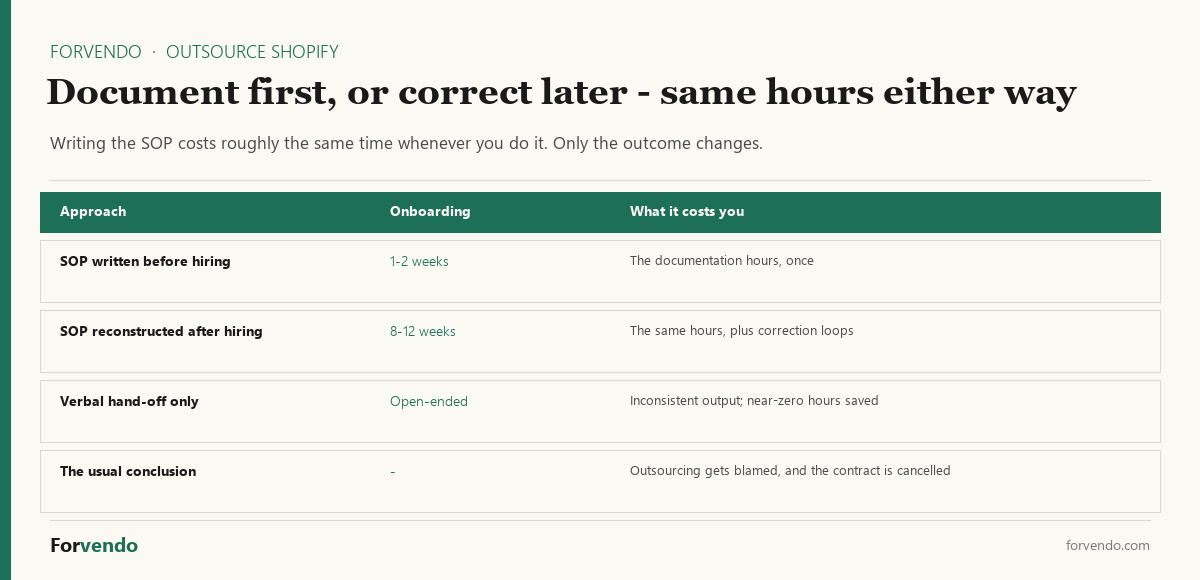
Second, undocumented work can’t be outsourced. If you don’t have a written workflow for the task being handed off, the contractor reverse-engineers it from your behavior, asks repeated clarifying questions, and produces inconsistent output. The cost of documenting the workflow before outsourcing is usually 6–12 hours. Store owners who skip this step trade those hours for 6–12 weeks of correction cycles.
Third, the wrong category gets outsourced. Sellers under time pressure outsource what feels heaviest — usually customer service or fulfillment — instead of what is highest-leverage to remove. The framework below is built around this misalignment.
The more practical framing is: do the three decision axes all point in the same direction, and have the four readiness checkpoints been verified? If yes, outsourcing is a defensible cost. If no, outsourcing is the wrong response to the time problem, and the time problem itself needs to be re-diagnosed. The whole question of when to outsource Shopify tasks tends to resolve once the diagnosis is clean.
The three axes of an outsource decision
Outsourcing pays off when three independent axes all clear simultaneously. Any one axis pointing the wrong way is a strong signal to defer.
Axis 1 — ROI. The hours recovered, multiplied by your effective value per hour on a higher-leverage alternative use, should clear the contractor’s monthly cost by a reasonable multiple. The Forvendo modeling default is a 3x ROI multiple; individual stores will calibrate around it.
Axis 2 — Operating quality. Outsourced output reaches the standard your customers expect, without ongoing review pulling more hours than the contractor saves. This is mostly a function of how well the workflow is documented before the handoff.
Axis 3 — Dependency risk. The contractor can be replaced within two weeks if they disappear, raise rates, or produce inconsistent output. Single-contractor dependencies on critical workflows are a hidden tail risk solo stores rarely budget for until it fires.
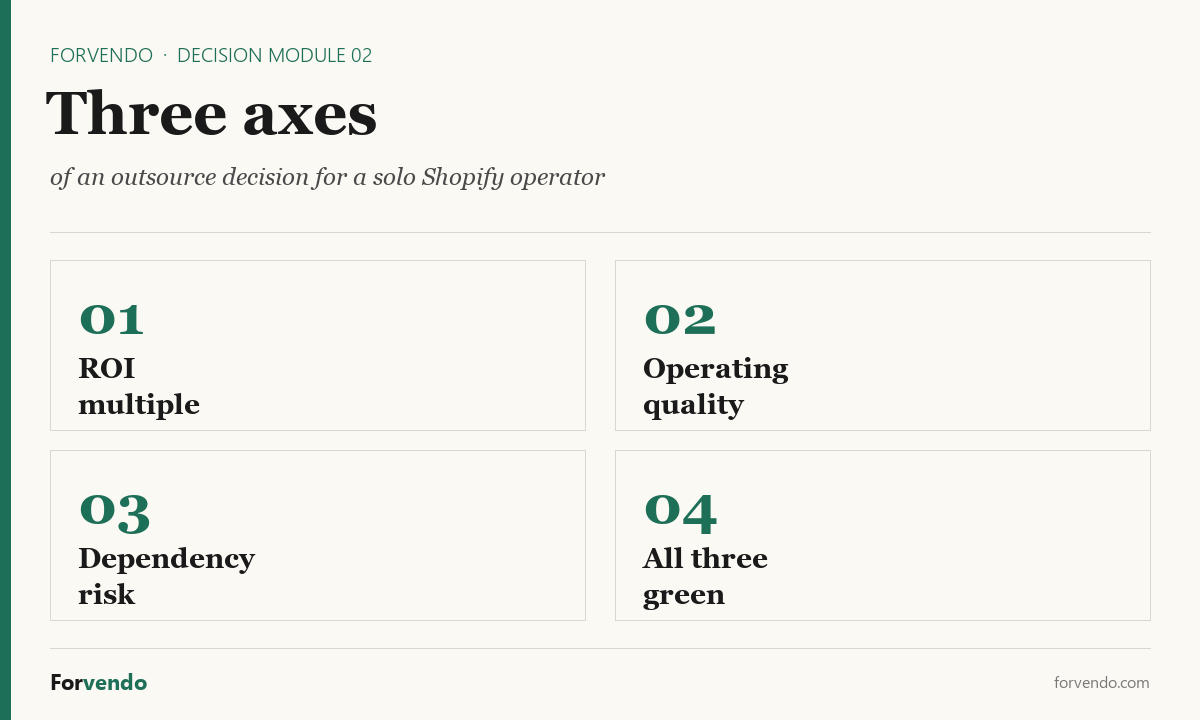
Three-axis outsourcing decision framework — when to outsource Shopify tasks for one-person stores.
Forvendo decision rule
Outsource only when ROI, operating quality, and dependency risk are all green simultaneously. If two of the three axes are amber, defer the decision for 60 days and revisit. If one axis is red, the contractor will not produce a return regardless of how much the other two improve.
Time pressure alone is not an axis. It is a signal to re-diagnose, not a decision input.
Do not outsource yet if…
At a scan, defer outsourcing if any of these hold true.
Free download
The Solo Shopify Weekly Operating Checklist
A one-page PDF plus a copyable Google Sheet — the weekly cadence these guides build on. Free; bring your own store data.
Get the free checklist →- Workflow isn’t documented in a form a stranger could follow.
- Practical gross margin can’t absorb the contractor cost on top of refunds, returns, and processing.
- Success can’t be measured in numbers (response time, error rate, units shipped, etc.).
- No replacement plan exists if the contractor disappears or raises rates.
- You don’t know where the recovered hours will be reinvested.
If any of these five hold, the answer to when to outsource Shopify tasks is "not yet" — defer for 60–90 days and revisit. The detail under each pattern follows.
Don’t outsource yet if practical gross margin is thin. A solo store with 25–30% gross margin (after refunds, shipping, discounts, processing) often can’t absorb the all-in contractor cost without making profitable-looking revenue less profitable. The contractor’s monthly fee is one part; replacement-cost insurance (carrying time when the contractor is unavailable), onboarding cycles for the next contractor, and your oversight hours are the rest.
Don’t outsource yet if the workflow being handed off isn’t documented in a step-by-step format that a stranger could follow. The cost of writing the SOP is usually 6–12 hours up front. The cost of not writing it’s months of correction cycles, inconsistent output, and a workflow that breaks when the contractor leaves. Documenting workflows before outsourcing is a hard prerequisite, not a nice-to-have.
Don’t outsource yet if you can’t describe, in concrete numbers, what a successful outcome looks like. “Handle customer service better” isn’t a measurable outcome. “Respond to all support tickets within 12 business hours with a maximum 8% escalation rate” is. Contractors hired against vague outcomes tend to produce vague results, which you then have to correct.
For a seller running everything alone with any of these conditions, the more practical decision is to defer the outsource conversation by 60–90 days, write the missing SOP, improve contribution margin, and reassess with the four checkpoints below.
Four readiness checkpoints before outsourcing
These four checkpoints turn the abstract question of when to outsource Shopify tasks into a quarterly review that takes about 30 minutes. They can be reviewed before contacting any contractor or platform. They’re practical signals, not hard rules — the more of them that point in the same direction, the more likely outsourcing will produce a positive return.
Checkpoint 1 (documented workflow) is the most predictive in practice. A store owner with a written SOP onboards a contractor in 1–2 weeks. An owner without one tends to spend 6–12 weeks training, correcting, and re-explaining — long enough that the projected ROI rarely materialises.
Checkpoint 2 (margin headroom) determines whether the contractor’s fee is absorbable. At 35% gross margin on a $15K MRR store, $5,250 per month is left after variable costs but before marketing and other operating overhead. A $1,000/month contractor consumes 19% of that headroom. At 25% margin, the same contractor consumes 27%. The 35% line is used here as a practical safety check, not a universal rule.
Checkpoint 3 (ROI multiple) is the explicit math. If the contractor’s monthly cost is $1,000 and they save you 20 hours per month, the implicit value of those hours is $50 per hour. If your hours are better spent on a $50-per-hour activity — product development, supplier negotiation, content — the math works. If the recovered hours would be spent on lower-value activities, the math doesn’t.
Forvendo newsletter
Operating notes, once a week
One email a week for US-based solo Shopify operators at $5,000–$50,000 MRR: a decision, a checklist, or a teardown. No fluff, unsubscribe anytime.
Join the newsletter →Checkpoint 4 (replacement plan) tests for dependency risk. Without a plan, the dependency is a tail risk that tends to fire at the worst time.
A composite outsource ROI example for a $15K MRR store
This is a composite model, not a real customer and not a forecast. The numbers reflect an optimistic-but-not-unrealistic pattern for a store where the four checkpoints above are pointing in the right direction.
Say you run a single-product apparel store at $15,000 MRR with 38% gross margin after COGS, shipping, refunds, discount codes, payment processing, and returns. You’re losing roughly 4–5 hours per week to customer service tickets — order status, sizing questions, exchange requests — and has begun considering a part-time virtual assistant for tier-1 customer service.
Pre-decision diagnosis (week 1):
- Workflow status — customer service responses are template-based, but the templates live in a private Notion page that hasn’t been updated in 4 months. Estimated SOP writing time: 8 hours.
- Margin headroom — 38% gross margin sits above the 35% Forvendo safety check.
- ROI calculation — at $25 per hour effective contractor cost and 16 hours per month, monthly contractor spend is $400. Hours recovered: roughly 16 per month. Higher-value alternative use: product photography and supplier sourcing, estimated $60 per hour.
- Replacement plan — single-contractor dependency. No backup identified.
The first three checkpoints are green or close to green. Checkpoint 4 (replacement plan) is red. You choose to spend two weeks updating SOPs and identifying a backup contractor before hiring.
Decision after the pre-decision phase (week 3): outsource tier-1 customer service to a $25-per-hour part-time VA, 16 hours per month, with a documented backup contractor identified.
Modeled result (weeks 4–12) — range, not a point forecast:
- VA absorbs 12–16 hours per month of your time, depending on ticket volume
- You reinvest 8–14 hours per month into product photography and supplier sourcing
- Estimated incremental revenue from your reinvested hours: roughly $300–$900 per month, varying with execution
- VA cost: $400 per month
- Net cash impact: roughly −$100 to +$500 per month, with your time freed regardless of revenue outcome
- Operating quality: stable in the first 8 weeks (template-based responses), improving as the VA absorbs more product context
The upper end of the range requires you to actually use the recovered hours on higher-value work. The lower end is what happens when the recovered hours are absorbed back into more email and admin. Both are realistic. The ROI math only works when the recovered hours are deliberately reinvested.
Quick outsource ROI test
(Hours recovered per month × value per hour of the alternative use) ÷ Monthly contractor cost = ROI multiple.
| Input | Worked example |
|---|---|
| Hours recovered per month | 16 |
| Value of alternative use | $60/hour |
| Monthly contractor cost | $400 |
| ROI multiple | 2.4x · marginal, defer 60 days |
Interpretation bands:
- ROI multiple ≥ 3x — likely positive, assuming quality and risk axes are also green
- 1.5x to 3x — marginal. Defer 60 days and improve documentation or alternative-use clarity
- Under 1.5x — defer. The contractor cost won’t return enough to justify the dependency risk
The value per hour of the alternative use is the most often misestimated input. Store owners tend to overstate it during time pressure. Test it by writing down what you would do with the recovered hours before hiring. This test is a planning tool, not a forecast or financial advice.
The ROI multiple is one input on when to outsource Shopify tasks; the quality and dependency-risk axes weigh equally in the final decision.
Two failure modes that make outsourcing waste money
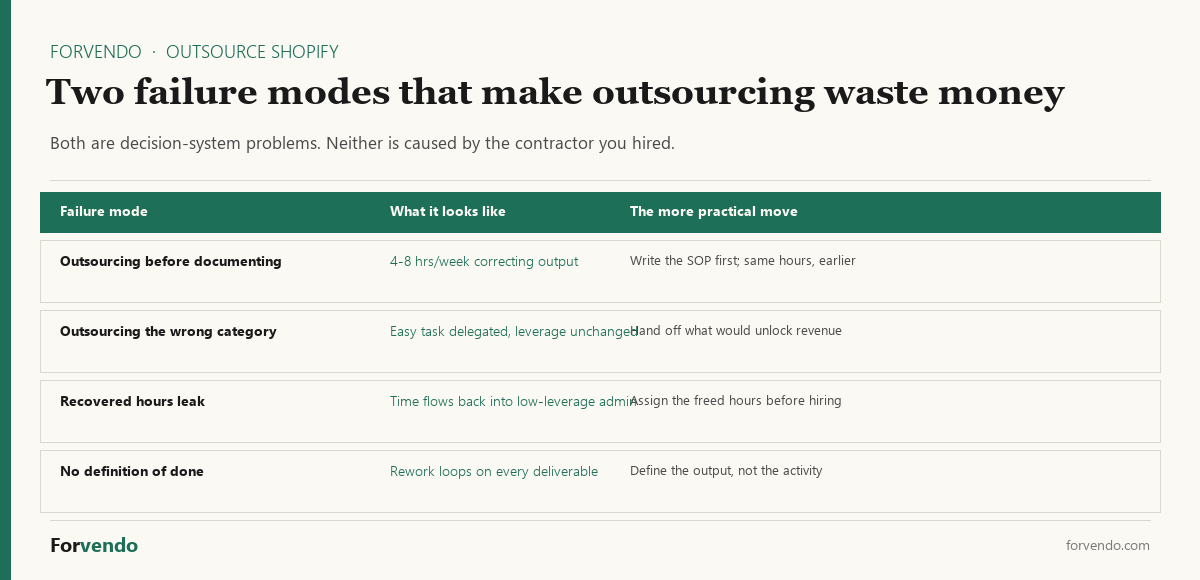
Failure mode 1: outsourcing before documenting. You hire a virtual assistant under time pressure, hand off a task verbally, and ask the VA to “figure it out.” For the first 6–8 weeks, the VA produces inconsistent output, asks clarifying questions in waves, and re-creates partial SOPs that conflict with your mental model. You spend 4–8 hours per week correcting work and explaining context. Net hours saved: near zero. You conclude that outsourcing doesn’t work and cancel the contract.
The more practical move was to spend the same hours writing the SOP first. Documenting the workflow takes roughly the same amount of time either way. Doing it before hiring means the next contractor onboards in 1–2 weeks. Doing it after means 8–12 weeks of correction loops.
Failure mode 2: outsourcing the wrong category. You outsource the most time-consuming task — typically customer service — when the highest-leverage move would be to outsource something else. Customer service is easy to delegate but rarely high-leverage. Product development, supplier negotiation, paid acquisition strategy, and content creation are higher-leverage but harder to define. When you hire for the easy delegation, the recovered hours flow back into more low-leverage admin instead of into the work that would actually move revenue.
The more practical move is to identify the task that, if you could permanently hand it off, would unlock the most revenue. Sometimes that task is customer service. Often it isn’t.
Both failure modes are operational, not contractor problems. Outsourcing doesn’t cause them. They happen with any contractor or platform when the underlying decision system was incomplete.
The first of the two is worth pricing directly, because the documentation hours get spent either way:
When outsourcing actually pays off
When the four readiness checkpoints are all green and the three axes (ROI, quality, risk) all clear, outsourcing typically pays off for one-person Shopify stores in a small number of categories — and rarely pays off in others.
The pattern is consistent: outsourcing tends to work where the task is documented, repetitive, low-judgment, and reversible. It tends not to work where the task requires holding the broader strategic context that you’ve built up over months of running the store.
What to outsource first by store stage
The answer to when to outsource Shopify tasks shifts with store stage. The bands below are practical guidance, not a universal rule.
| MRR band | What tends to outsource first | Why |
|---|---|---|
| Below $5K MRR | Usually nothing | Focus on product, offer, and one-channel acquisition; contractor spend rarely returns at this stage. |
| $5K–$15K MRR | Basic design or editing; tightly scoped admin only | Margin is tight; over-spending on contractors in this band is the most common waste pattern Forvendo sees. |
| $15K–$50K MRR | Tier-1 support, fulfillment, bookkeeping data entry — if the four checkpoints clear | Margin can absorb the channel cost; documented workflows make handoff feasible. |
| $50K+ MRR | 3PL, structured support, bookkeeping, repeatable operations | Your time has higher leverage on strategy than execution; structured handoffs return more than they cost. |
What this article does not cover
- Contractor classification (1099 contractor vs W-2 employee) and the legal tests that determine which applies — these depend on the state, the working relationship, and current IRS or state rules. The Forvendo W-9 / TIN reconciliation article covers the records side; classification questions should be confirmed with a qualified US tax or employment professional.
- Specific contractor platforms or vendor recommendations — Forvendo doesn’t maintain a vendor list for outsourcing.
- International contractor tax treatment, withholding, or treaty considerations.
- Hiring full-time employees — this article assumes contractor or part-time relationships, not W-2 hiring.
- Operations at multi-employee scale — the decision system changes meaningfully past two or three contractors.
The frequently asked questions below cover the parts of the when to outsource Shopify tasks decision that sellers running everything themselves most often need to revisit before hiring.
The free Weekly Operating Checklist PDF includes a Sunday review block where this outsource decision can be reviewed alongside recurring operating leaks. Use the Weekly Operating Checklist PDF to review when to outsource Shopify tasks during your Sunday operating review. If the issue is app cost or operational sprawl rather than labor capacity, start with the How Many Shopify Apps Is Too Many? first. Once outsourcing has begun, the W-9 / TIN reconciliation article covers the contractor records side this guide doesn’t.
Frequently asked questions about outsourcing
How do I know when to outsource Shopify tasks?
You know when to outsource Shopify tasks when the workflow is documented, margin headroom is sufficient, the ROI multiple clears the threshold, and the work can be replaced or re-internalized within roughly two weeks. If any of those is missing, defer for 60–90 days. The four readiness checkpoints above formalize the assessment.
Should a $5,000 MRR Shopify store outsource any work?
Usually no. At $5,000 MRR with typical margin profiles, the contractor cost is too large a fraction of available margin, and your hours are typically better invested in product, content, or one-channel acquisition work that compounds. The four readiness checkpoints below this revenue band rarely all clear.
How much should a solo Shopify operator pay a part-time VA?
There’s no single answer, but a useful starting frame for Shopify store owners working alone in 2026:
- Tier-1 customer service VAs: roughly $10–$25 per hour
- Fulfillment or shipping partners: usually priced per order, with rates depending on volume and complexity
- Bookkeeping data entry: roughly $25–$60 per hour
- Designers and content editors: roughly $30–$80 per hour for project-based work
The hourly rate alone doesn’t determine ROI. The match between the contractor’s effective output and your higher-value alternative use does.
Does paying contractors trigger 1099-NEC obligations?
In many cases, US merchants that directly pay US-based individual contractors above the applicable IRS reporting threshold may need to collect tax information and issue Form 1099-NEC. Treatment can vary based on payee status, payment method, processor reporting, and current IRS rules. The IRS Form 1099-NEC instructions document the current threshold and reporting requirements; confirm the exact requirement for the specific arrangement with a qualified US tax professional. The Forvendo W-9 / TIN reconciliation article covers the contractor-side records that support this reporting.
What is the difference between a contractor and an employee for a solo Shopify store?
The classification is governed by IRS and state-law tests focused on control over how the work is performed, financial control, and the relationship structure — not by what the parties call each other. Misclassifying an employee as a contractor can trigger back-payroll-tax obligations and penalties. Solo Shopify store owners considering ongoing weekly work for a single contractor should confirm classification with a qualified employment or tax professional before structuring the relationship.
How long does it typically take a new contractor to break even on time saved?
For a documented, well-scoped workflow, break-even is usually 6–10 weeks — earlier if the SOP is detailed and your hours are deliberately reinvested. For an undocumented workflow, break-even often doesn’t arrive at all; the correction cycles consume the hours that were supposed to be recovered.
Can outsourcing customer service damage brand voice on a small Shopify store?
It can, when the brand voice hasn’t been documented or templated. A more reliable approach is to pre-write 15–25 response templates covering 80% of routine inquiries, then have the contractor use those templates and escalate the rest. Brand-voice drift tends to happen quickly when contractors are asked to write responses from scratch.
When does outsourcing not pay off even with all checkpoints green?
Two specific cases. First, when your higher-value alternative work is poorly defined — the recovered hours flow into admin instead of into revenue work. Second, when the outsourced category has unusually high context-switching cost — for example, a product line with frequent variant launches that requires the contractor to relearn details every few weeks.
Should outsourcing be tested with a small contract before a longer commitment?
Usually yes. A 4–6 week paid trial with a clear scope and measurable outcomes catches the failure modes early and at lower cost. The trial period should be long enough to include at least one realistic workload cycle, not a sample week.
What is the most common mistake solo Shopify operators make in their first outsource decision?
Hiring for the easiest task to delegate (typically customer service) instead of the task that would unlock the most revenue if you never had to do it again. The easy delegation produces measurable time savings, but the recovered hours rarely move the store forward.
Forvendo Editorial note. Forvendo publishes educational operating resources for solo ecommerce operators. Articles may cover tax, sales tax, 1099-K reporting, software pricing, platform policies, and other operating topics that change over time.
This content is for general research and operational planning. It is not legal, tax, accounting, financial, or professional advice. Readers should verify details with official sources or qualified professionals before acting on them. Platform rules, tax thresholds, software pricing, and affiliate program terms can change without notice.
Forvendo articles may be drafted with AI assistance and are reviewed by the operator before publication according to our Editorial Policy, which covers sourcing, AI use, update cadence, and corrections. See also About, Disclosure, and Privacy Policy.