Does Amazon Send You a 1099-K? What the Gross Number Includes
Last updated: · Tax laws and platform policies change. Verify with official sources before acting.
Does Amazon send a 1099-K? Yes, to US sellers whose unadjusted gross sales meet the reporting threshold. The number on it is almost always larger than what reached your bank, and that gap is by design. Here’s what Amazon counts, what it refuses to subtract, and how to check the figure against your own reports.
Quick answer
- The federal threshold is back to more than $20,000 and more than 200 transactions. Amazon describes the change as reverting “from $600 in unadjusted gross sales and no minimum transactional threshold, back to the previous threshold of $20,000 and more than 200 transactions.”
- Amazon reports unadjusted gross sales, which its seller help defines as “the total sales, unadjusted for fees or refunds.”
- Sales tax and shipping are inside that number. Amazon states unadjusted gross sales include “sales proceeds, sales tax, and gift-wrap and shipping charges.” This is the opposite of how Etsy treats marketplace-collected tax.
- A full refund doesn’t reduce it. Once an order is placed, the order total stays in the year’s gross.
- Some states set a lower threshold than the federal one, so a smaller account can still receive a form.
- Amazon says it doesn’t issue updated forms. Keeping your tax details current is on you.
Who this is for
You sell on Amazon as a US person, a 1099-K has arrived or is about to, and the figure doesn’t line up with your deposits or your bookkeeping. The numbers here come from Amazon’s own seller help pages and the IRS. Nothing below is tax advice for your specific return, which is a conversation for a CPA or an enrolled agent.
What Amazon actually reports
Amazon’s seller help is unusually direct about this. The form reports “the unadjusted gross sales that occurred and not the actual bank transfers.” Unadjusted means what it sounds like: nothing has been taken out.
That single definition explains most of the confusion, because four things people expect to be netted out are not.
If you’ve read the Etsy version of this question, the sales tax row is worth a second look. Etsy excludes the sales tax it collected and remitted on your behalf. Amazon includes it. Carrying an assumption from one marketplace to the other is one of the easier ways to build a reconciliation that never closes.
Why the number is bigger than your deposits
Your bank sees money after Amazon has taken referral fees, fulfillment fees, and refunds out of it. The 1099-K sees the order at the moment the buyer paid. The IRS asks for the gross amount of reportable transactions “without regard to any adjustments for credits, cash equivalents, discount amounts, fees, refunded amounts, or any other amounts,” so Amazon is reporting the figure the regulation calls for.
That means a mismatch between the form and your payouts isn’t evidence of an error. It’s the expected result. What matters at filing time is being able to explain the gap in categories, which is the reconciliation your CPA is likely to ask for.
The refund rule, in Amazon’s own example
Refunds are where sellers most often assume the form is wrong. Amazon publishes a worked example that settles it, and it’s worth walking through because the ordering of each line is the whole point.
- Item price: $100
- Seller promotional discount: −$10, subtracted before the gross amount is calculated
- Shipping charge: +$15
- Order total: $105 — this is the gross sales amount
- Amazon fee: −$20, subtracted after the gross amount is calculated
- The buyer is later refunded in full: −$105, with the $20 fee credited back
Net cash movement: $0. Amount still reported in your annual gross: $105.
Amazon’s explanation is that “when you make a sale, the order total becomes a permanent part of your unadjusted gross sales for the year,” and that IRS regulations require no adjustments to gross transaction amounts. A year with heavy returns can therefore produce a 1099-K that looks nothing like the revenue you actually kept.
How to check it against your own reports
Amazon doesn’t publish a single spreadsheet column that reproduces the 1099-K total the way Etsy does. What it gives you instead is the Date Range reports, which cover the same activity from the transaction side. The useful move is to reconcile categories rather than chase an exact tie-out.
Free download
The Solo Shopify Weekly Operating Checklist
A one-page PDF plus a copyable Google Sheet — the weekly cadence these guides build on. Free; bring your own store data.
Get the free checklist →One detail that trips people up: Date Range reports are separate from the settlement reports on the All Statements page, which show payouts within a settlement cycle rather than activity in a date range. If your totals are close but stubbornly off, check which report you pulled before you check your arithmetic.
Amazon also notes that reports for non-US regions show transactional amounts in local currency while the 1099-K is reported in USD, converted at a daily exchange rate applied on the date each transaction is booked. If you sell across regions, that conversion alone can account for a difference you might otherwise treat as an error.
The same bridge, written out with the line items that explain the gap, is in the Shopify 1099-K guide. The mechanics carry across platforms even when the report names don’t.
The bridge from the gross down to your books
Step four above says to bridge down rather than up. Here’s what that looks like with numbers on it, because the order of the subtractions is what keeps the worksheet defensible.
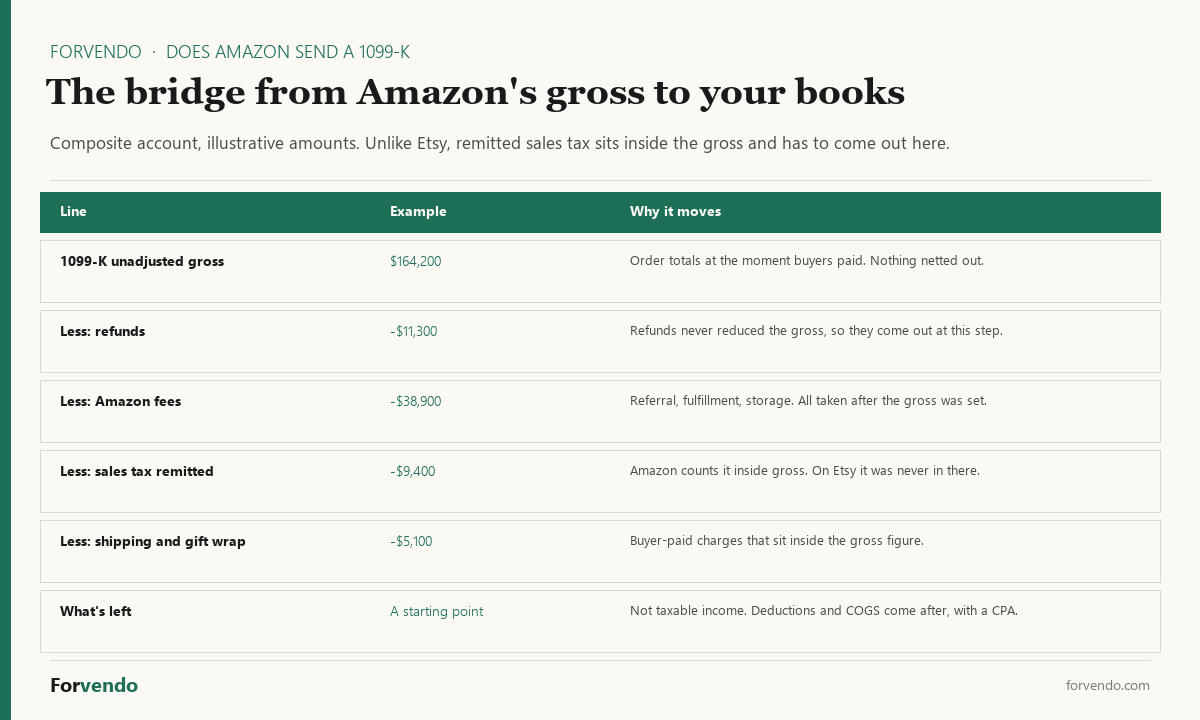
Start at the unadjusted gross figure on the form and take out, in turn, the refunds that didn’t reduce it, the Amazon fees that came off after it was set, the sales tax Amazon collected and remitted, and the shipping and gift-wrap charges the buyer paid. Each of those is a line the form deliberately left in.
The sales tax row is the one to be careful with, and it’s the reason a seller who reconciled an Etsy form last year can get this wrong. On Etsy that money sat outside the number, so subtracting it produces a total that’s short by exactly the tax. On Amazon it is inside the number, so failing to subtract it leaves you reporting money that wasn’t yours.
What’s at the bottom is a starting point for the return, not the answer to it. Cost of goods sold, deductions, and inventory treatment all sit downstream, and that’s the conversation to have with a CPA or an enrolled agent rather than settle from a guide. The value of the bridge is walking into that conversation with a figure you can explain line by line.
Where Amazon and Etsy disagree
Sellers who run on more than one marketplace tend to build one reconciliation habit and apply it everywhere. That’s the habit worth breaking, because the two platforms take opposite positions on the single largest line.
Forvendo newsletter
Operating notes, once a week
One email a week for US-based solo Shopify operators at $5,000–$50,000 MRR: a decision, a checklist, or a teardown. No fluff, unsubscribe anytime.
Join the newsletter →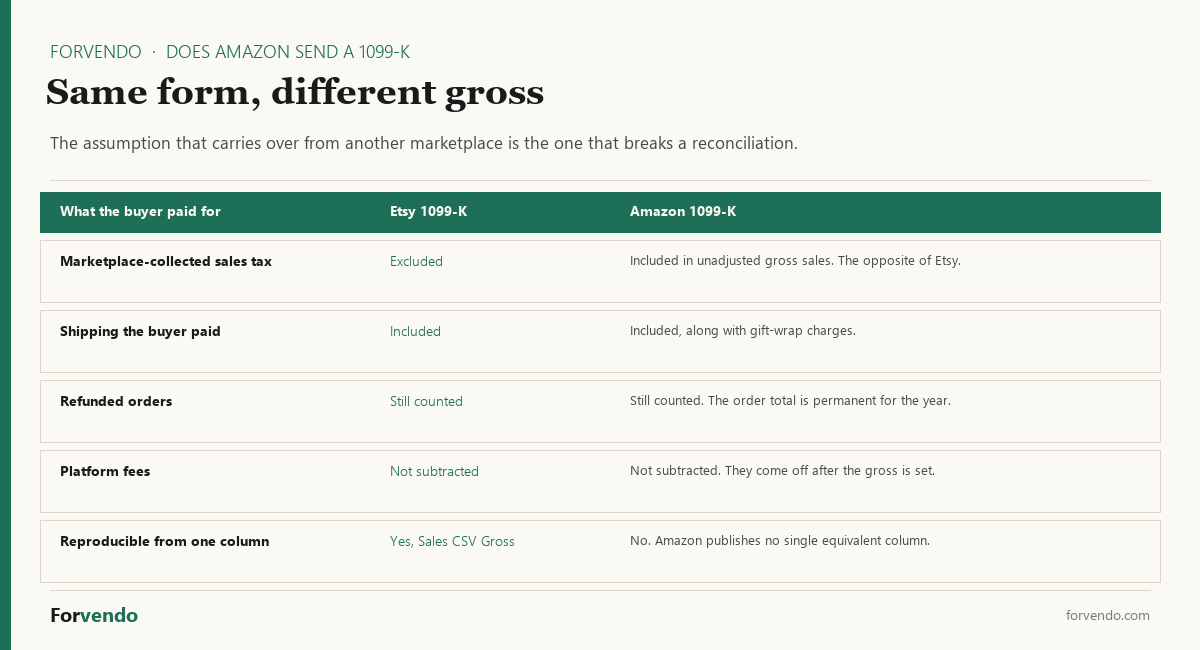
Most rows agree. Both include buyer-paid shipping, both keep refunded orders in, and neither subtracts platform fees. The disagreement is marketplace-collected sales tax, and it’s large enough to matter: on an account doing six figures, it’s the difference between a reconciliation that closes and one that’s off by thousands with no obvious cause.
The other practical gap is reproducibility. Etsy publishes a column whose total equals the form. Amazon doesn’t, which is why the method here is a category bridge rather than an exact tie-out. If you’re expecting to match the figure to the cent from a report, that expectation is the problem rather than your arithmetic.
The general rule this cluster keeps arriving at: check each platform’s own definition of gross before you reconcile it, and don’t carry an assumption across. The forms look identical. What went into them doesn’t. eBay adds a third variation, where two of its three reasons for issuing a form have nothing to do with your sales volume at all.
Where the form lives, and when
Amazon says it provides the form “on or before January 31 of the following year via electronic or physical mail delivery,” depending on your preference. By default it’s postmarked and mailed to the address you gave in the tax interview.
To get it electronically instead, Amazon’s instruction is to retake the self-service tax interview and provide an e-signature at the end. That’s also the route for correcting an address or a tax ID, since both are pulled from the interview rather than from your general account settings.
If you didn’t meet the threshold, no form is issued. Amazon notes you can monitor your own unadjusted gross sales in your account to see where you stand before January.
The correction trap: Amazon says it won’t reissue
This is the part most guides skip, and it’s the one with a deadline attached.
Amazon states plainly that it “will not issue an updated Form 1099-K,” and that it’s the seller’s responsibility to have current information on file across their selling accounts. A wrong address or a stale tax ID is fixed going forward, through the tax interview, not retroactively on a form that’s already been filed with the IRS.
There’s a related wrinkle worth knowing before it surprises you. If you update your tax information partway through the calendar year, Amazon issues a separate 1099-K for each Tax Identification Number that met the reporting threshold that year. Restructuring from a sole proprietorship to an LLC mid-year, for example, can produce two forms for one business. Both are real, and both need to appear in the reconciliation.
The practical takeaway is to treat the tax interview as something you verify each December rather than something you completed once at signup.
Forvendo decision rule
Plan on the form and your deposits disagreeing. Amazon reports unadjusted gross, so sales tax, shipping, and gift-wrap sit inside the number and a refund does not pull it back down. The reconciliation belongs in your books, not on the form.
Amazon states it does not reissue a corrected form, so the practical deadline for catching a problem is before the reporting season, not during it. If you also sell on Etsy, reconcile each platform separately — the two put different things inside the gross.
What to verify before January
Because Amazon says it won’t reissue a form, the useful deadlines all fall before the form is generated rather than after it arrives.
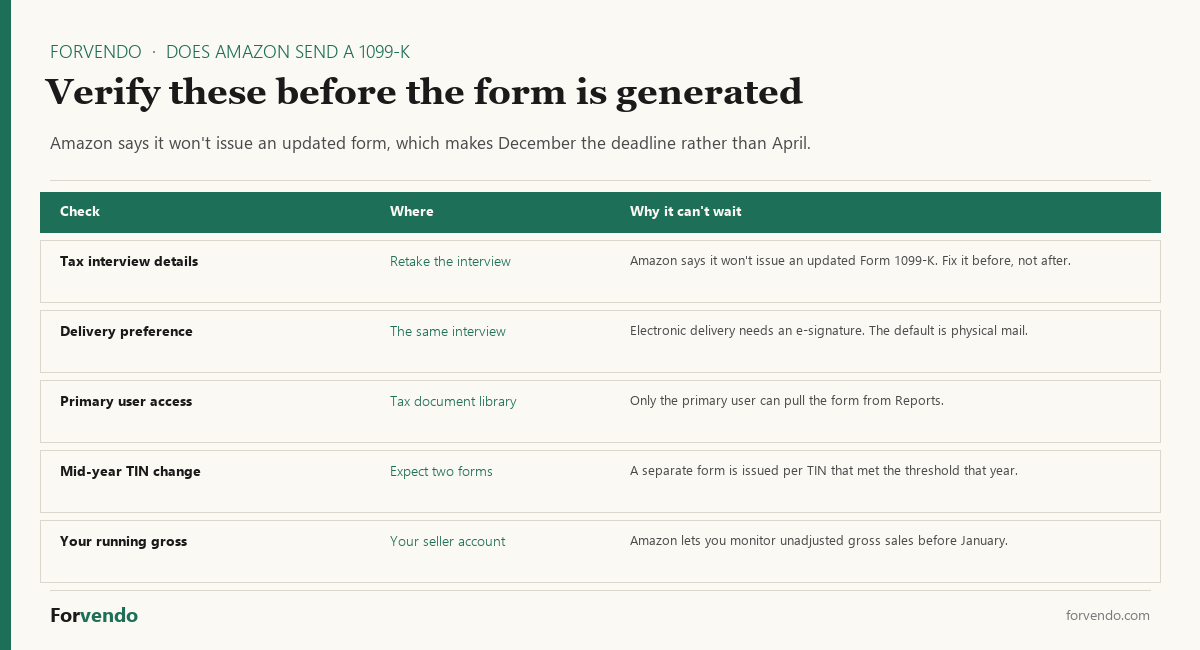
Put a December reminder against the tax interview. It’s where your address and tax ID come from, it’s the only route to correcting either, and it’s also where you switch from mailed delivery to electronic with an e-signature. Ten minutes there in December is worth more than any amount of effort in February.
Check who can actually retrieve the form while you’re at it. The Tax Document Library sits behind primary-user access, which is a problem people discover at the worst possible moment if the account was set up by someone else or the primary user has changed.
And if your business structure changed during the year, expect the paperwork to reflect it. A separate form is issued for each Tax Identification Number that met the threshold, so a mid-year move from sole proprietorship to an LLC can produce two, both of which belong in the reconciliation.
If you run more than one seller account
Amazon consolidates unadjusted gross sales across all accounts sharing the same TIN, and issues a form as applicable for each jurisdiction you sell in. Two consequences follow.
First, accounts that individually sit under the threshold can cross it once combined. Second, selling across different regions may produce more than one 1099-K. Amazon’s guidance is to provide your TIN in every account regardless of whether that account is near a threshold, so the reporting lands together the way the regulations expect.
If you’re not a US seller
Amazon’s page states that IRS regulations require non-US taxpayers to provide a Form W-8 in order to be exempt from US tax reporting requirements. The form is submitted through the same tax interview. If you’re outside the US and a 1099-K appears anyway, that’s usually a signal the interview information needs revisiting rather than something to ignore.
What this guide does not cover
- Your specific filing position, which should be reviewed with a CPA or an enrolled agent
- State income tax treatment and state-specific 1099-K thresholds, which vary
- Deductions, inventory, and cost of goods sold
- Sales tax registration and marketplace facilitator obligations, covered in the multi-state sales tax guide
- Amazon’s FBA fee structure and its treatment on your return
FAQ
Does Amazon send a 1099-K if I only made a few sales?
Generally not on federal rules alone, which take more than $20,000 and more than 200 transactions. But some states set a lower threshold than the federal one, so a smaller account can still receive a form.
Why is my Amazon 1099-K higher than my deposits?
Because it reports unadjusted gross sales rather than bank transfers. Fees and refunds are not subtracted, and sales tax, shipping, and gift-wrap charges are included.
Do refunds reduce the amount on the form?
No. Amazon states that once a sale is made, the order total becomes a permanent part of that year’s unadjusted gross sales, even if the buyer is later refunded in full.
Why is my Amazon 1099-K higher than my Etsy one on similar sales?
Most often because of sales tax. Amazon counts marketplace-collected sales tax inside unadjusted gross sales; Etsy states the tax it collects and remits on your behalf isn’t reflected in its form. On comparable revenue, the Amazon figure carries that tax and the Etsy figure doesn’t. Shipping and gift-wrap charges add to the same effect. Neither form is wrong — they’re reporting different things, which is why each platform’s reconciliation needs its own bridge rather than a shared assumption.
Where do I download it?
Reports, then Tax document library, then the tax year, then Form 1099-K. Only the primary user on the account can access forms there.
Can I get a corrected 1099-K from Amazon?
Amazon says it doesn’t issue an updated form. Corrections to your address or tax ID are made by retaking the self-service tax interview and apply going forward.
Do I get a separate form from Shopify, Etsy, or PayPal?
Yes, if your volume there crosses that company’s threshold. Platforms and processors report separately, which is covered in the Shopify 1099-K guide and, for Etsy, in its own guide. PayPal is the exception worth reading separately: it reports as a payment processor, and only goods and services payments enter its pool.
Next step
Reconciling once, properly, makes every following January routine. If you want the worksheet rather than the theory, the free 1099-K reconciliation sheet uses the same gross-to-books bridge with the arithmetic already set up.
One note for Amazon sellers using it: the sheet was built around Shopify Payments, so start from the 1099-K gross and work down using your Date Range Summary report. Unlike the Etsy path, do not deduct marketplace-collected sales tax as though it sat outside the form — on Amazon it’s already inside the gross figure, so it belongs in the subtraction, not outside it.
Forvendo Editorial note. Forvendo publishes educational operating resources for solo ecommerce operators. Articles may cover tax, sales tax, 1099-K reporting, software pricing, platform policies, and other operating topics that change over time.
This content is for general research and operational planning. It is not legal, tax, accounting, financial, or professional advice. Readers should verify details with official sources or qualified professionals before acting on them. Platform rules, tax thresholds, software pricing, and affiliate program terms can change without notice.
Forvendo articles may be drafted with AI assistance and are reviewed by the operator before publication according to our Editorial Policy, which covers sourcing, AI use, update cadence, and corrections. See also About, Disclosure, and Privacy Policy.