Kit vs Klaviyo: Which Email App a Small Shopify Store Should Use
Last updated: · Email platform pricing and feature limits change. Confirm current Kit and Klaviyo pricing against their published pricing pages before committing to a tool.
Below roughly 1,500 subscribers, Kit is usually enough and Klaviyo is usually early. That’s the short answer. The longer one turns on whether your revenue comes from broadcasts or from behavior-triggered flows — the real split between the two tools, and the reason this isn’t the binary it gets framed as.
This article is operational. Pricing is current as of 2026-05-22 from published vendor pages; both Kit and Klaviyo have shifted tiers in the past 24 months and may again. Confirm exact current pricing on the vendor pricing page before committing.
Quick answer
- Kit vs Klaviyo isn’t a two-option decision for a Shopify store owner working alone. Shopify Email is the often-ignored third option, and below a certain scale it’s the rational choice. Kit and Klaviyo aren’t interchangeable products — Kit is built for newsletter-first creators, Klaviyo is built for ecommerce segmentation.
- Shopify Email gives the first 10,000 emails per month free. Beyond that, $1 per 1,000 emails. For a solo store at ~1,500 subscribers sending one campaign per week, that’s well within the free tier indefinitely.
- Kit Creator is $33/month flat for 1,000 subscribers, with unlimited sequences and visual automations. Kit’s free Newsletter plan caps at 1,000 subscribers but has no sequence builder, only one basic automation.
- Klaviyo’s free tier is 250 profiles and 500 sends per month. Paid Email plan starts at $20/month for 251–500 profiles and scales roughly $10–15 per +500 profiles. At ~1,500 subscribers, Klaviyo runs $40–50/month.
- The three-tier decision pattern — under 250 subscribers and not running sequences → Shopify Email. 250–1,500 subscribers running a welcome flow → Kit Creator. 1,500+ subscribers with serious Shopify segmentation needs → Klaviyo.
For the underlying weekly operating cadence that includes an email check, see The Weekly Shopify Checklist for a One-Person Store.
Table of Contents
- Who this is for
- Why Kit vs Klaviyo is the wrong framing
- The three-tier decision framework
- What a welcome email flow actually does
- Tier 1: Shopify Email (the often-ignored option)
- Tier 2: Kit Creator (newsletter-first sequences)
- Tier 3: Klaviyo (ecommerce segmentation)
- Migration considerations
- Common mistakes
- What this article does not cover
- Frequently Asked Questions
Who this is for
This article is built for the same reader as the rest of Forvendo.
- You sell on Shopify, typically on the Basic plan.
- Monthly revenue sits between $5,000 and $50,000.
- Your email list sits somewhere between 50 and 5,000 subscribers, or you’re about to start one.
- You operate the store alone or with a part-time helper.
- You want to know whether to start on Shopify Email, move to Kit, or go straight to Klaviyo — and what the actual costs look like at your subscriber count.
If you run a multi-product brand with 50,000+ profiles and complex segmentation, Klaviyo is almost certainly the answer and the rest of this article is mostly background.
Why Kit vs Klaviyo is the wrong framing
“Kit vs Klaviyo” is the search term most solo Shopify sellers type because they have seen both names in vendor marketing. But the two tools aren’t direct substitutes — they’re built for different store owners with different needs.
Kit (formerly ConvertKit) is built around the assumption that you publish a newsletter and an audience subscribes to it. The product’s center of gravity is the sequence builder and the broadcast composer. Tagging is light. Ecommerce integration exists but isn’t the primary use case.
Klaviyo is built around the assumption that you run an ecommerce store and the email tool needs to know everything about customer behavior — products viewed, products purchased, time since last order, lifetime value, segmentation by RFM. The product’s center of gravity is the segment builder and the Shopify event stream. Newsletters work, but the platform is designed for transactional and behavioral flows.
A one-person store at $10K MRR with 800 subscribers running one welcome flow and one weekly newsletter doesn’t need Klaviyo’s segmentation depth. The cost is real ($30–40/month) and the complexity overhead is real (Klaviyo’s UI is dense). Going with Kit Creator at $33/month gives all the functionality that store needs and a friendlier interface.
A solo store owner at $35K MRR with 3,500 subscribers running abandoned-cart flows, post-purchase upsell flows, and 6 segmented broadcast streams per month — that store will outgrow Kit and find Klaviyo’s segmentation worth the migration.
The decision isn’t Kit vs Klaviyo. It’s “which of three tiers fits where I am right now.”
The three-tier decision framework
The matrix below maps a one-person Shopify store’s stage to the rational tool choice. Pricing reflects 2026-05-22 vendor pages.
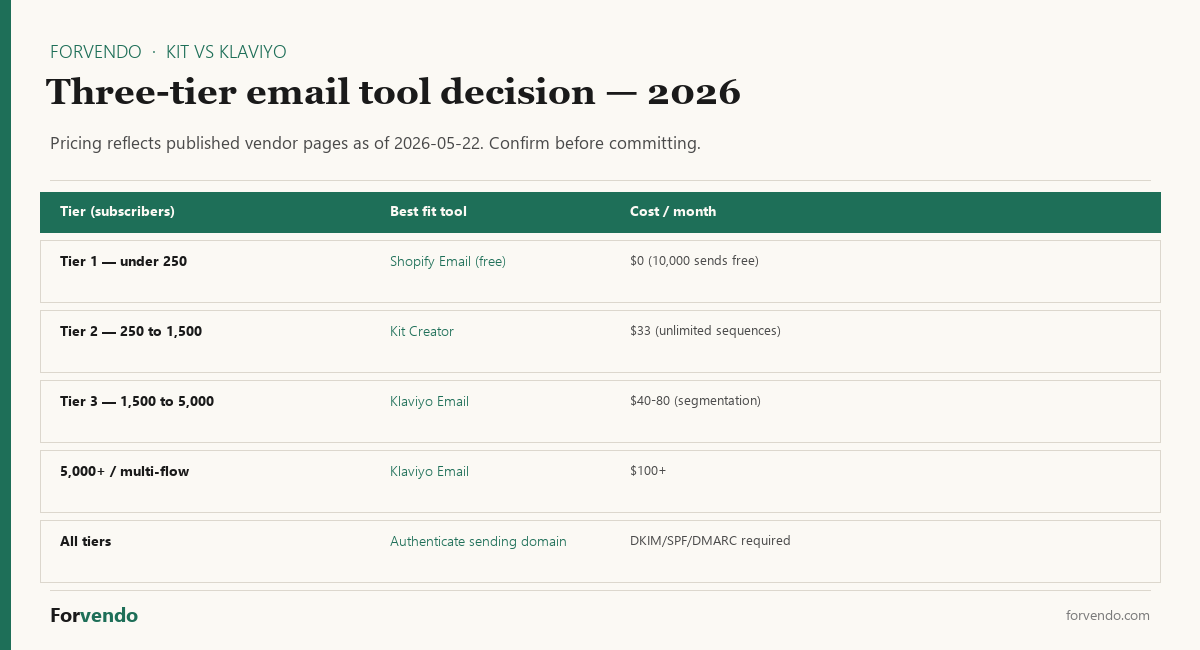
The cleanest signal that you’ve outgrown Tier 1 is when you want a welcome sequence that fires automatically over multiple days. Shopify Email supports basic automations (abandoned cart) but doesn’t have a multi-step welcome sequence builder. That alone is usually the trigger to move to Tier 2.
The cleanest signal that you’ve outgrown Tier 2 is when you can’t segment by purchase behavior — “everyone who bought Product X in the last 30 days but not Product Y” — without exporting CSVs. That’s when Klaviyo’s segment engine starts paying for itself.
Free download
The Solo Shopify Weekly Operating Checklist
A one-page PDF plus a copyable Google Sheet — the weekly cadence these guides build on. Free; bring your own store data.
Get the free checklist →Forvendo decision rule
Do not migrate to a paid email tool until a paid feature is blocking a real revenue task. The cost of switching tools later is small. The cost of subscribing too early is one of the most common ways small Shopify stores leak margin month after month.
If the list has not crossed 250 active subscribers, or if no multi-step welcome flow is being sent, stay on Shopify Email — even at 800 subscribers, even at 1,200, as long as the limiting feature has not blocked a specific revenue task.
The free Welcome Email Flow Template packages the 5-email sequence below (with bracketed placeholders) in two formats — a PDF for planning and a .txt source to paste straight into your tool of choice.
What a welcome email flow actually does
Before comparing tools, it helps to specify what a “welcome email flow” is in the context of a solo Shopify store. The structure that holds up across most stores in this MRR range:
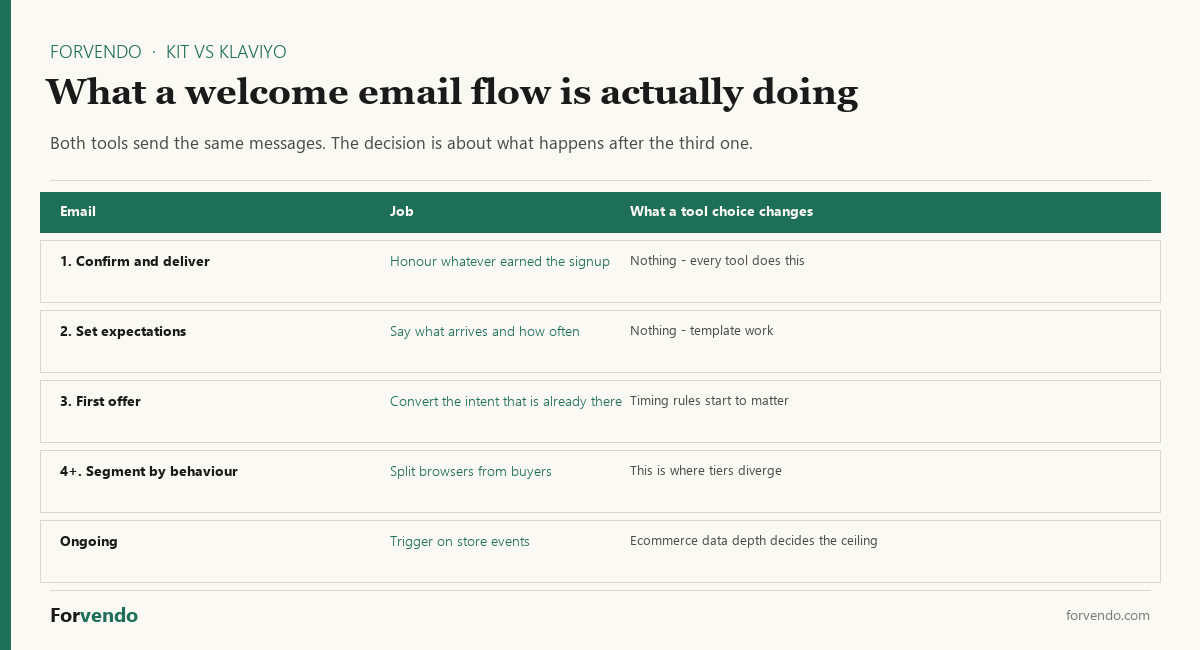
- Email 1 — Immediate — Confirm what the subscriber will receive, set expectations, deliver any promised lead magnet (free guide, discount code, sample chapter).
- Email 2 — Day 1 or 2 — Introduce yourself and the brand voice. Not a sales pitch; this is the relationship-establishing email.
- Email 3 — Day 3 or 4 — A product or category recommendation tailored to the subscription source if known, or to the store’s top sellers.
- Email 4 — Day 7 — A genuine question prompt to convert one-way subscription into two-way conversation, or social proof from existing customers.
- Email 5 — Day 10 — The first stand-alone offer or invitation to a community/next step.
Five emails over ten days is the version most one-person stores can write once and let run for a year. Longer flows (10–14 emails) are common in agency-built Klaviyo setups but rarely outperform a tighter five-email flow at the seller running everything alone scale.
All three platforms support this structure. The difference is in how they let you build it and what additional behavior they can layer on.
Tier 1: Shopify Email (the often-ignored option)
Shopify Email is the built-in email tool that ships with every Shopify plan. It’s often overlooked because vendor marketing for Kit and Klaviyo dominates the comparison searches.
Forvendo newsletter
Operating notes, once a week
One email a week for US-based solo Shopify operators at $5,000–$50,000 MRR: a decision, a checklist, or a teardown. No fluff, unsubscribe anytime.
Join the newsletter →Pricing (Shopify Help Center): First 10,000 emails per month free. Beyond that, $1 per 1,000 additional emails. For a one-person store at 1,500 subscribers sending one campaign per week, that’s 6,000 emails/month — well within the free tier.
What it does well:
– Native Shopify integration. No data sync delays, no app installation, no separate login. Product data, prices, branding pull directly from the store.
– Drag-and-drop editor with pre-built templates for newsletters, abandoned cart, and product launches.
– Sender authentication tied to the store domain (combined with your DNS setup).
What it doesn’t do:
– Multi-step welcome sequence builder with delays between emails. Abandoned cart automation works, but a 5-email welcome flow over 10 days requires manual workarounds.
– Sophisticated tagging or segmentation beyond basic customer attributes (purchased, not purchased, location).
– Visual automation builder.
Best for: A store under 250 subscribers, or a store between 250–500 subscribers that hasn’t yet decided whether to invest in a welcome flow. Shopify Email is a free way to start the list without paying for capacity you haven’t used.
When to move on: As soon as you want a 5-email welcome flow that fires automatically over 10 days.
Tier 2: Kit Creator (newsletter-first sequences)
Kit (rebranded from ConvertKit) is the most common Tier 2 choice for solo store owners because of its sequence builder and the editorial-style newsletter format that suits founder-led brands.
Pricing (2026-05-22, Kit pricing page):
– Newsletter (free): Up to 1,000 subscribers, 1 basic automation, no sequence builder.
– Creator: $33/month (or $390/year) for 1,000 subscribers, with unlimited sequences and visual automations. Adds users (up to 2), apps & integrations, custom branding.
– Pro: $66/month, adds unlimited users, advanced A/B testing, deliverability reporting.
The Newsletter (free) tier is not enough for the welcome flow structure described above — the sequence builder is gated behind Creator. One-person stores starting on Kit typically commit to Creator from the first paid month.
What it does well:
– Visual sequence builder with day-based delays. A 5-email welcome flow takes about 60 minutes to set up the first time.
– Clean newsletter composer with link tracking, click reports, and an editorial layout that doesn’t look like a sales blast.
– Subscriber tagging and form-based segmentation. Good enough for most one-person stores.
– API and Shopify integration available, but the integration is lighter than Klaviyo’s.
What it doesn’t do:
– Native real-time Shopify event triggering. You can subscribe customers via Shopify integration, but advanced behavioral flows (“subscriber viewed product X three times without buying”) aren’t native.
– Deep segmentation by purchase history beyond what tags capture.
– Send-time optimization based on per-subscriber engagement patterns.
Best for: A store at 250–1,500 subscribers running a welcome flow and a weekly or bi-weekly newsletter, where the brand voice is editorial and founder-led.
When to move on: When segmentation needs outgrow tagging — typically at 1,500+ subscribers with multiple product categories and meaningful repeat-customer signals.
Tier 3: Klaviyo (ecommerce segmentation)
Klaviyo is the ecommerce-native option. Its pricing scales with active profiles (subscribers + non-subscriber identified visitors), which means costs rise faster than Kit at the same list size.
Pricing (2026-05-22, Klaviyo pricing page):
– Free: 250 active profiles, 500 emails per month, 150 SMS credits. Email support for the first 60 days; community-only support after that.
– Email: Starts at $20/month for 251–500 profiles, scaling roughly $10–15 per +500 profiles. At ~1,500 profiles, expect $40–50/month. At 5,000 profiles, $100+/month.
– Email + SMS: Adds SMS credits at additional per-profile cost.
Each paid email plan includes roughly 10× the active profile count in monthly email sends.
What it does well:
– Real-time Shopify event integration: viewed product, added to cart, started checkout, placed order, refunded, etc. Each event can trigger a flow.
– RFM segmentation built in. “VIPs who haven’t ordered in 60 days” is a one-click segment.
– Predictive analytics (expected next order date, customer lifetime value forecasts) on paid tiers.
– Deep email templates oriented toward ecommerce (product blocks, dynamic price + inventory pulls).
What it doesn’t do well:
– Editorial-style newsletters require fighting the template defaults. The product is built for transactional and promotional emails, not for founder-voice writing.
– The learning curve is steep. Setting up a clean welcome flow from scratch typically takes 4–8 hours the first time.
– Pricing escalates faster than Kit at the same subscriber count.
Best for: A store at 1,500+ profiles where segmentation by purchase behavior moves real revenue, or where you’re willing to invest 8–12 hours up front to build flows that compound for two years.
When it’s overkill: Below $20K MRR or under 1,000 active profiles, the segmentation engine sits mostly unused while the bill arrives every month.
Migration considerations
The migration cost between tiers is asymmetric.
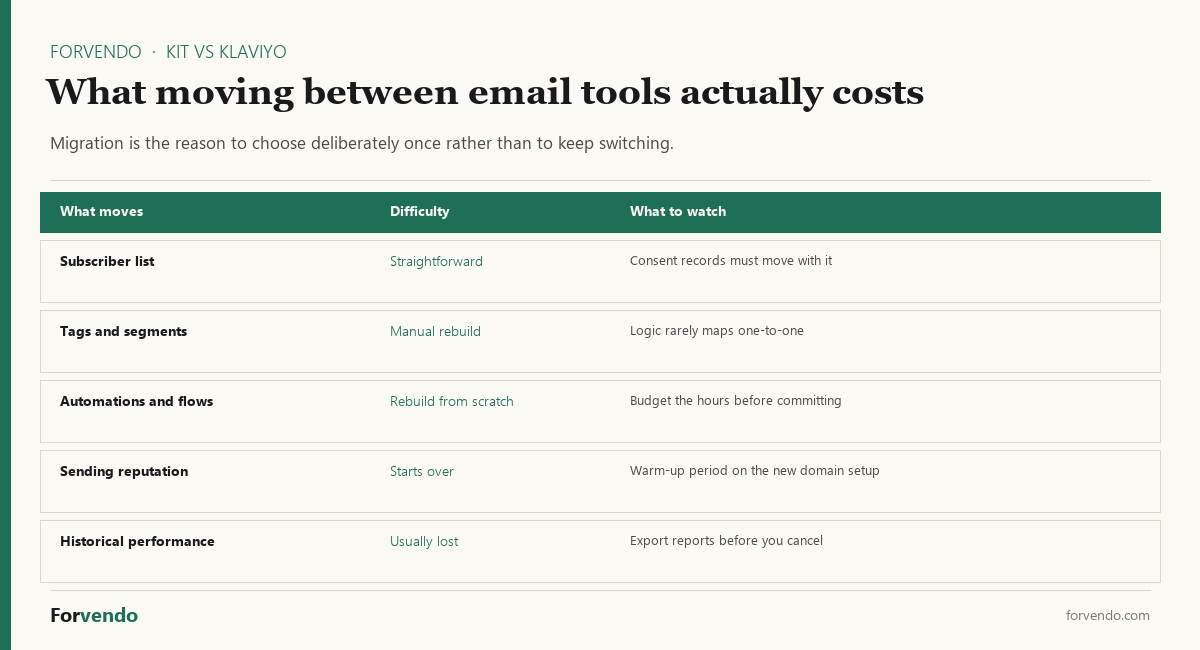
- Shopify Email → Kit: Export subscriber list from Shopify, import to Kit, redirect the signup form. Typical effort: 2–4 hours. No transactional flows to migrate.
- Kit → Klaviyo: Export subscribers + tags, import to Klaviyo, rebuild flows in Klaviyo’s visual builder. Typical effort: 8–16 hours, mostly because Klaviyo flows aren’t a 1:1 port of Kit sequences. Plan a weekend for the migration.
- Klaviyo → Kit (downgrade): Rare but possible. The complexity is mostly in deciding which Klaviyo flows to preserve vs. drop. Most sellers running everything themselves who downgrade keep only the welcome flow and abandoned cart.
The two practical lessons: (1) start on Tier 1 or Tier 2 if you’re unsure — the migration up is cheaper than the migration down, (2) don’t change platforms more than once per 18 months. The migration time + relearning cost is usually larger than the platform-fee delta over that period.
Common mistakes
A handful of patterns generate most of the avoidable cost.
- Going to Klaviyo first because “everyone uses it”. Store owners below 1,000 subscribers pay for capacity they don’t use. The complexity overhead distracts from writing.
- Staying on Shopify Email past the point where automation matters. The free tier is generous, but a missing 5-email welcome flow costs more in lost conversion than the $33/month Kit Creator subscription.
- Building elaborate flows before sending the first broadcast. The biggest predictor of email-driven revenue is consistent broadcast cadence (weekly or bi-weekly). Spending six weeks designing the welcome flow before sending a single newsletter is a common mis-allocation.
- Migrating platforms during high-volume months. Black Friday is the wrong week to switch email platforms. Migrate in February or July.
- Forgetting to authenticate the sending domain. All three platforms require DKIM/SPF/DMARC for reliable deliverability. The setup is one evening; the alternative is steady delivery rate decay.
What this article does not cover
This article is scoped to the welcome flow decision for a solo Shopify seller. It doesn’t cover:
- SMS marketing strategy (Postscript, Klaviyo SMS, Attentive)
- Full Klaviyo flow library (post-purchase, win-back, browse abandon, replenishment)
- Email deliverability infrastructure beyond domain authentication (warmup, IP reputation, sender score)
- Affiliate program email integration (Goaffpro, UpPromote, Refersion)
- B2B email tooling (HubSpot, Marketing Hub)
- Lead magnet asset design (the 1099-K Reconciliation Sheet and Sales Tax Nexus Tracker are examples of the asset side)
Any of those topics benefits from dedicated treatment.
Frequently Asked Questions
Can I run a welcome flow on Shopify Email at all?
Not as a multi-step time-delayed sequence. Shopify Email supports abandoned cart automation and basic single-email triggers, but a 5-email flow with day-based delays requires either Shopify Flow (the workflow automation app, with limits) or a third-party email tool. For one-person stores who want a real welcome sequence, Kit Creator or Klaviyo is the rational step.
Is Kit’s free tier enough to run Forvendo’s actual welcome flow?
No. Kit’s Newsletter (free) tier doesn’t include the sequence builder. Forvendo’s own 5-email welcome sequence (delays of 0d / 2d / 2d / 3d / 3d) requires the Creator plan or higher. The free tier is suitable for a broadcast-only newsletter without automation.
How does Klaviyo’s free tier compare to Kit’s?
Klaviyo’s free tier caps at 250 profiles and 500 sends per month, with sequence/flow access included. Kit’s Newsletter (free) tier allows up to 1,000 subscribers but blocks the sequence builder. For a brand-new list under 250 subscribers, Klaviyo’s free tier is more capable for automation; for newsletter-only sending at higher list sizes, Kit’s free tier sends more emails.
Does the email tool affect Shopify checkout conversion?
Indirectly. The tool that connects to Shopify can affect post-purchase flows (thank-you sequences, review requests, replenishment reminders), which influence repeat-purchase rate but not the initial checkout. For initial checkout conversion, store design, product page quality, and shipping policy matter more than the email tool.
Should I run Shopify Email and Kit in parallel during migration?
Briefly, yes. The cleanest migration pattern is to set up Kit, redirect the signup form to Kit, then let Shopify Email send the final couple of weeks of broadcasts while you build the welcome flow in Kit. After Kit is live, archive (do not delete) Shopify Email broadcasts for audit history.
Forvendo Editorial note. Forvendo publishes educational operating resources for solo ecommerce operators. Articles may cover tax, sales tax, 1099-K reporting, software pricing, platform policies, and other operating topics that change over time.
This content is for general research and operational planning. It is not legal, tax, accounting, financial, or professional advice. Readers should verify details with official sources or qualified professionals before acting on them. Platform rules, tax thresholds, software pricing, and affiliate program terms can change without notice.
Forvendo articles may be drafted with AI assistance and are reviewed by the operator before publication according to our Editorial Policy, which covers sourcing, AI use, update cadence, and corrections. See also About, Disclosure, and Privacy Policy.