UpPromote Pricing and Review: Is It Worth It for a Small Store?
Last updated: · App pricing, plan limits, and program terms can change. Confirm current UpPromote pricing and program terms against the official pricing page before committing to a plan.
This UpPromote review isn’t written to decide whether UpPromote is a good Shopify affiliate app in general. The harder question is whether a one-person Shopify store running between $5,000 and $50,000 in monthly store revenue should run an affiliate program at all. Many shouldn’t, not yet. The decision isn’t “which affiliate app is best?” It’s “can I run an affiliate program without turning it into another recurring Sunday task?”
The rest of this review walks through UpPromote pricing on the 2026 plan structure, four practical checkpoints to apply before installing the app, a “do not install yet if” list, a modeled ROI example at $15K MRR (a range, not a forecast), two failure modes that quietly waste money, and a brief comparison against Refersion and ReferralCandy as the other commonly-considered Shopify affiliate program apps.
Forvendo doesn’t currently participate in the UpPromote partner program and earns no commission from this review. If that changes, the relationship will be disclosed here and on the Disclosure page. Editorial standards are unchanged regardless of any commission relationship.
Quick answer: is UpPromote worth it?
This UpPromote review starts with the cost picture, not the feature list.
- UpPromote pricing runs from $0 on the Free plan to $199.99 on Enterprise (monthly billing). The two tiers most solo Shopify sellers evaluate are Free and Growth at $29.99/month. Growth adds a 2% performance fee on successful referral sales; Professional at $89.99 drops the fee to 1.5%; Enterprise at $199.99 drops it to 1%.
- The real cost of a Shopify affiliate program isn’t the app fee alone. It’s the combination of app fee, affiliate commission paid out, the platform’s performance fee, your monthly time for vetting and payouts, and occasional fraud review on suspicious referrals.
- The Free plan is usually enough for a 6–8 week pilot. It supports 1 program, 200 referral reviews per month, link and coupon tracking, and a basic registration form. That covers a first pilot for almost every store below $20K MRR.
- The paid plan should wait until there’s real attributed revenue. Subscribing to Growth before any inbound affiliate demand has been confirmed is the most common way one-person stores waste $30–$90/month on the channel.
- App pricing and program terms can change. Before subscribing, confirm current pricing, plan limits, performance fees, and partner program terms on the official UpPromote pricing page.
The companion to this article is the free Shopify App Stack Audit Sheet 2026, which includes a 5-question test that the affiliate-app row maps directly into.
Table of contents
- Who this UpPromote review is for
- Why the “best affiliate app” question is incomplete
- UpPromote pricing 2026
- Do not install UpPromote yet if…
- Four checkpoints before installing UpPromote
- UpPromote ROI example for a $15K MRR Shopify store
- Two failure modes that make UpPromote a bad investment
- UpPromote vs Refersion vs ReferralCandy
- What this UpPromote review does not cover
- Frequently asked questions about UpPromote
Who this UpPromote review is for
This UpPromote review is calibrated to the standard Forvendo reader.
- You sell on Shopify, typically on the Basic plan: $25/month billed monthly, or $19/month billed yearly.
- Monthly store revenue is between $5,000 and $50,000.
- You operate the store alone, possibly around a full-time job.
- Roughly 5–10 hours per week go into the store.
- You’ve started seeing the phrase “do you do affiliates?” in customer DMs, or you’re spending $200+/month on paid ads and looking for a cheaper acquisition channel.
If you run a multi-employee brand with 100+ active affiliates and dedicated channel marketing, UpPromote may still be a fit, but the calculus in this review assumes solo operation.
Why the “best affiliate app” question is incomplete
Most published reviews of UpPromote, Refersion, and ReferralCandy compare features as if every Shopify store owner should run an affiliate program. Most solo store owners between $5K and $20K MRR shouldn’t — yet. The cost of running an affiliate program is rarely the app cost. It’s the operational overhead that lands the day after the app is installed.
A working affiliate program on a solo store involves vetting incoming applications (sometimes only a few per month, sometimes 5–15 once a signup page is public and visible), writing baseline payment terms, handling cases where a code is used in ways you didn’t anticipate, processing payouts monthly, and updating the affiliate base when promotions or product lines change. That work compresses into roughly 90–120 minutes per month once the program is steady, but the first three months can easily run 4–6 hours per month while you build the workflow.
The more practical framing is: do the four checkpoints below point in the same direction — that an affiliate program is likely to produce more revenue than it costs in your time and gross margin? If they do, the app choice matters. UpPromote is one defensible choice. If two or more checkpoints point the wrong way, the app choice is the smaller question, because the program itself is unlikely to pay off.
UpPromote pricing 2026
For this UpPromote review, pricing was reviewed on 2026-05-28 against UpPromote’s published pricing page. App pricing, plan limits, and performance fees can change, so confirm current terms on UpPromote’s official pricing page before choosing a plan.
| Plan | Monthly (annual rate) | Performance fee | Programs | Notable feature gates |
|---|---|---|---|---|
| Free | $0 (no annual rate) | 0% | 1 program | 200 referral reviews/month, link & coupon tracking, basic registration form |
| Growth | $29.99 · $24.99/mo billed yearly | 2% of successful referral sales | Unlimited | Unlimited reviews, premium registration form, store credit payment, marketplace listing |
| Professional | $89.99 · $74.99/mo billed yearly | 1.5% of successful referral sales | Unlimited | Auto-pay with PayPal, anti-leak discount, custom affiliate links, multi-level marketing |
| Enterprise | $199.99 · $166.66/mo billed yearly | 1% of successful referral sales | Unlimited | Multi-store sync, unlimited staff, coupon code commission, custom development |
The Free plan is usable for a real pilot. The 200 referral reviews per month limit is the binding constraint — a “referral review” is a tracked referral event that needs your approval before commission posts. A pilot with 8 active affiliates and roughly 25 conversions per month doesn’t come close to that ceiling.
The Growth plan’s 2% performance fee is the line that catches most sellers running everything themselves by surprise. On $5,000 of monthly affiliate-attributed revenue, the platform fee is $100 plus the $29.99 subscription, for a total of about $130/month before any commission paid to the affiliate. Using 10% as a default modeling commission rate for a typical physical-product DTC store, total channel cost on that $5,000 lands at roughly $630, or about 12.6% of channel revenue. 15% is treated as an upside scenario that needs supporting margin, not a default. Commission-rate ranges are discussed in the FAQ.
Two values that materially affect channel economics are app-specific and configurable inside UpPromote — the cookie window (how long after a click an attributed sale can occur), the minimum payout threshold for the merchant’s own affiliates, and the payout schedule. Public marketing pages don’t always quote current defaults. Confirm the cookie window, payout threshold, and payout schedule inside the app or in the official UpPromote documentation before launching a program. These shape the math more than the subscription tier does.
Do not install UpPromote yet if…
Don’t install UpPromote yet if there’s no real referrer signal. A public affiliate signup page doesn’t create demand by itself. If no customers, creators, or small partners have asked for an affiliate program in the last 90 days, the better move is to collect referral signals first — for example by adding a simple “tell us if you’d like to share our product” line to the order confirmation email — before adding another Shopify app.
If practical gross margin is thin, an affiliate program can make profitable-looking revenue less profitable. The app fee is only one part of the channel cost. You also pay affiliate commission, absorb the platform’s performance fee, review suspicious referrals, and handle payout administration. Low-margin physical resale, dropshipping mixes that pay shipping subsidies, and product lines with heavy refund or return rates often don’t have the headroom for affiliate commissions on top of those costs.
If you can’t reliably commit roughly 90 minutes per month to vetting, payouts, and affiliate communication, the program will degrade quickly. The same applies to product categories with high fraud, return, or chargeback risk. For a one-person store with any of these conditions, the more practical decision is to defer UpPromote for 60–90 days, tighten the app stack, improve contribution margin, and revisit the affiliate channel when the four checkpoints below point in the same direction.
Four checkpoints before installing UpPromote
These four checkpoints can be reviewed before installing any Shopify affiliate program app. They’re practical signals, not hard rules — the more of them that point in the same direction, the more likely a program will pay off. A single checkpoint failing is rarely a hard stop on its own; two or more pointing the wrong way is the more meaningful pattern.
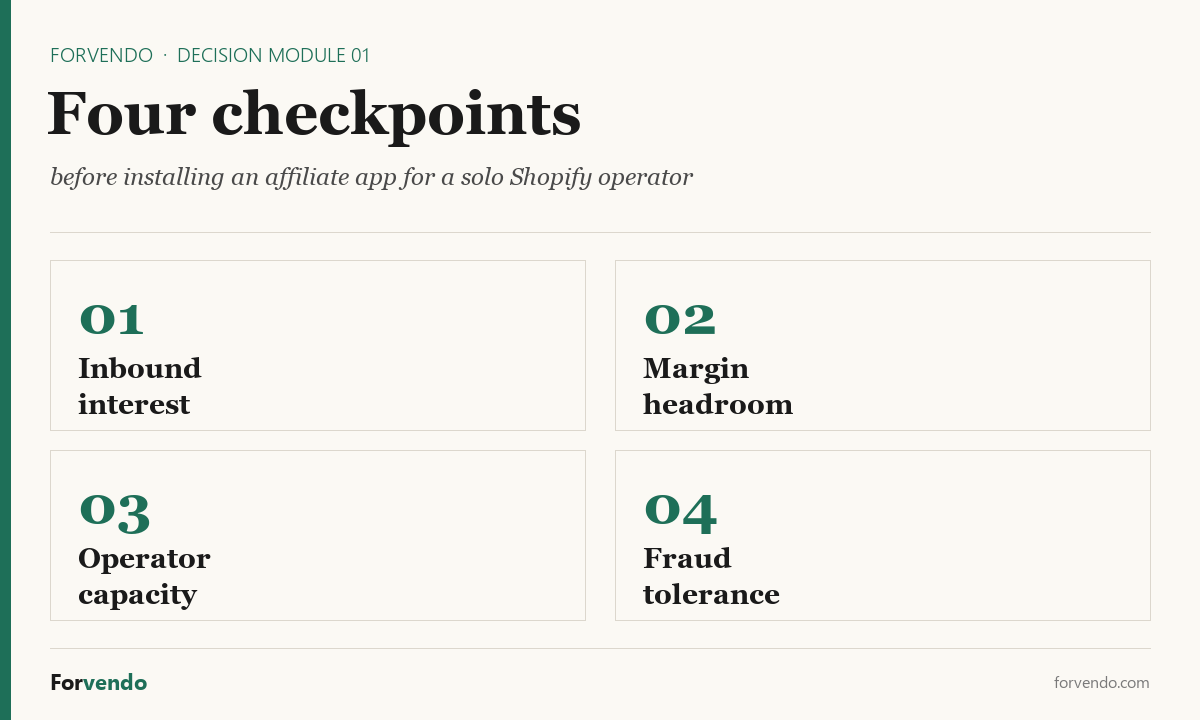
Checkpoint 1 tends to be the most predictive in practice. A store owner being asked for an affiliate program by people who already use the product starts from a different baseline than one inventing demand. With 5 or more credible inbound asks over 90 days, a structured program is generally worth running; with 3–4, a small hand-picked test of 3–5 affiliates can be useful; with 1–2, the asks are typically a signal rather than evidence and an open program rarely justifies the time.
Free download
The Solo Shopify Weekly Operating Checklist
A one-page PDF plus a copyable Google Sheet — the weekly cadence these guides build on. Free; bring your own store data.
Get the free checklist →Checkpoint 2 is a margin safety check, not a target margin for every store. For this article’s modeling, 35% is used as a practical margin safety check, not an industry benchmark or universal rule. The reason it shows up is that every dollar of affiliate revenue is split.
At a 10% affiliate commission plus a 2% platform fee plus rounding, channel cost runs roughly 12–13% of channel revenue; with 15% commission it runs roughly 17–18%. A store with 30% gross margin has 12–18% left after the channel, before any other marketing — workable in narrow product categories but tight.
The margin calculation should include the costs that are easy to forget — refunds, discount codes, shipping subsidies, payment processor fees, and return shipping — not just COGS.
Forvendo decision rule
Do not judge UpPromote by the monthly app fee alone. Judge it by total channel cost: affiliate commission, platform fee, payout work, fraud review, and the time you need to keep the program clean.
If two or more checkpoints point the wrong way, defer the affiliate program and revisit it in 60–90 days.
UpPromote ROI example for a $15K MRR Shopify store
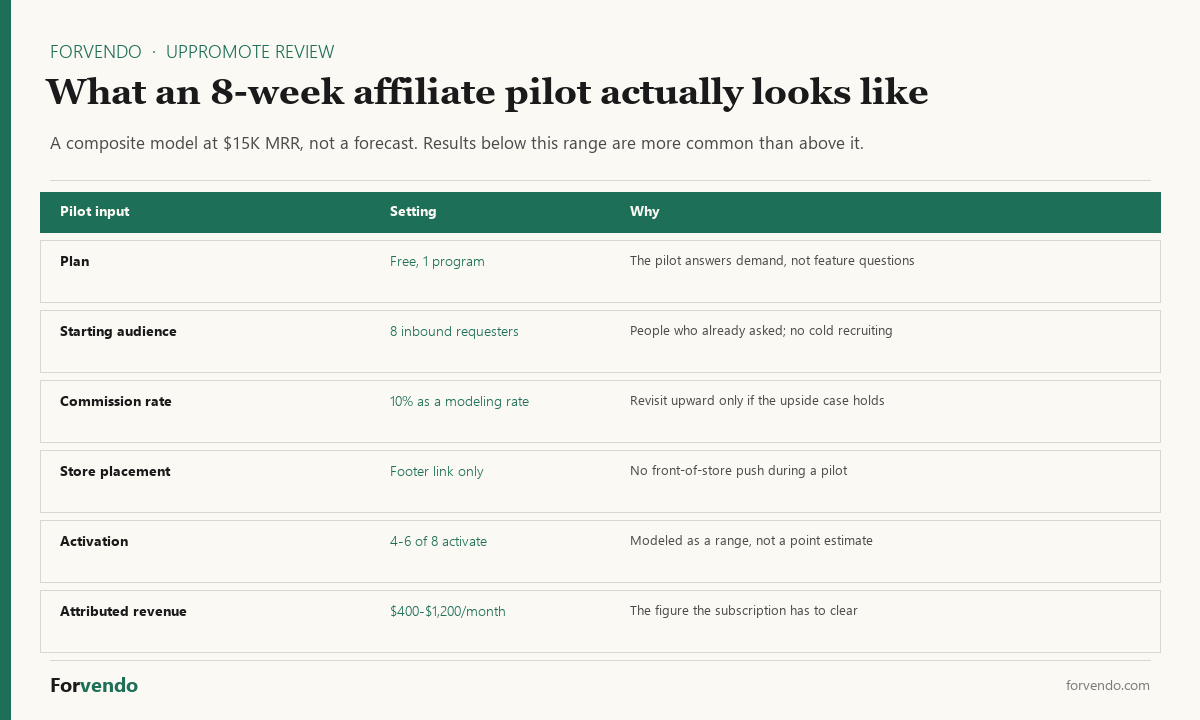
This is a composite model, not a real customer and not a forecast. The numbers reflect an optimistic-but-not-unrealistic pattern for a store where the four checkpoints above are pointing in the right direction. A pilot that produces results below this range is more common than one that exceeds it.
Say you run a single-product apparel store at $15,000 MRR. Gross margin after COGS, shipping, refunds, discount codes, payment processing, and returns is 38%. Eight credible inbound requests have come through Instagram DMs in the last 90 days asking about an affiliate program. You can commit 90 minutes per month to running it.
The first three checkpoints point in the right direction. Checkpoint 4 (product fraud risk) reads as lower than higher-risk categories — apparel is lower-risk than high-ticket, subscription, or reseller-prone categories; the main concern is usually return handling rather than coordinated affiliate fraud. You decide to pilot UpPromote on the Free plan for 8 weeks.
Forvendo newsletter
Operating notes, once a week
One email a week for US-based solo Shopify operators at $5,000–$50,000 MRR: a decision, a checklist, or a teardown. No fluff, unsubscribe anytime.
Join the newsletter →Pilot setup (week 1):
- UpPromote Free installed, 1 program created
- 10% affiliate commission rate as the default modeling rate (you may revisit upward if the 15% upside scenario looks achievable)
- Cookie window, payout threshold, and payout schedule confirmed inside the UpPromote app before launch
- DM the 8 inbound requesters with the affiliate signup link
- Add a footer link “Apply to our affiliate program” — no front-of-store push
Pilot result (week 8) — modeled as a range, not a point forecast:
- 4–6 of 8 inbound requesters activate
- 2–4 of those produce conversions consistently (1–4 each per month)
- Attributed monthly revenue lands in a $400–$1,200/month range
- Affiliate commission paid: $40–$120 (at 10%)
- App cost on Free: $0
- Platform fee on Free: $0
- Margin contribution at 38% gross margin, before affiliate cost: $152–$456
- Net after affiliate commission: roughly $112–$336/month
The upper end of the range needs the inbound asks to convert into productive affiliates; the lower end is what happens when two of the four productive affiliates stop posting after week 4. Both are realistic. Neither is a forecast.
You now consider whether to upgrade to Growth at $29.99 + 2% performance fee. Using the midpoint of the range (~$800 attributed revenue): $800 × 2% = $16 in performance fee plus $29.99 subscription = $46 in platform cost. Margin contribution at the midpoint falls from roughly $224 to roughly $178. The upgrade unlocks unlimited programs and the premium registration form, which you don’t yet need.
The reasonable decision is to stay on Free, run the program for another 60 days, and upgrade only when referral volume crosses the Free plan’s 200 review/month limit or a specific paid feature (premium registration form, store-credit payout) becomes necessary.
Quick ROI test
Affiliate-attributed revenue × affiliate commission rate + platform fee + app fee = monthly channel cost.
If that channel cost leaves too little contribution margin, the affiliate program isn’t ready yet.
Two failure modes that make UpPromote a bad investment
These are the two patterns that lead a solo store owner to spend $30–90/month on a Shopify affiliate program app for 6 months and have nothing to show for it.
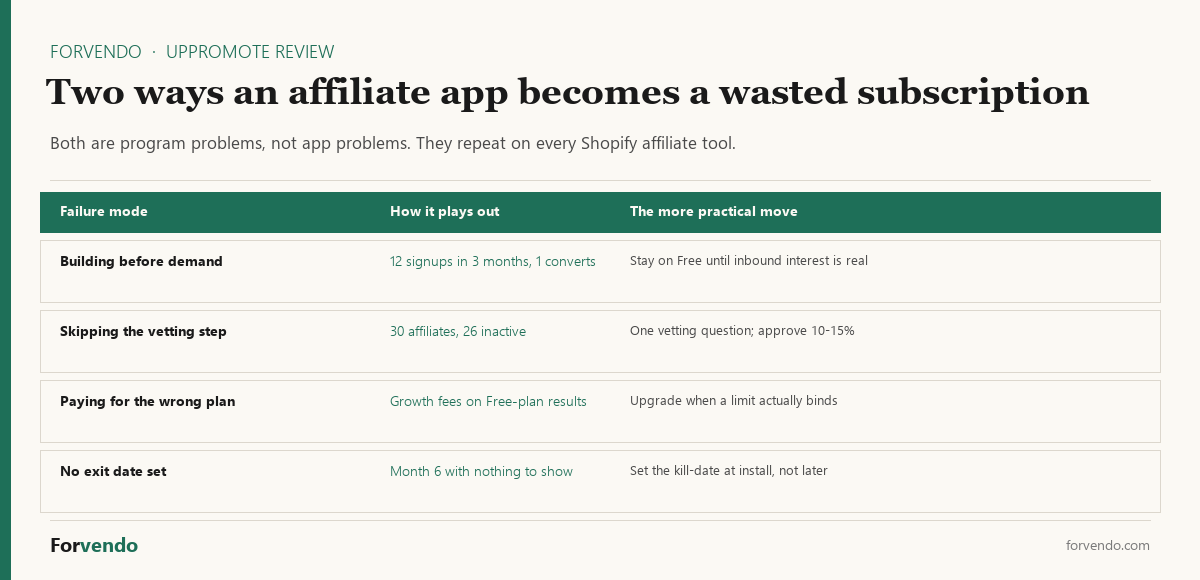
Failure mode 1: building before demand. You install UpPromote on Growth ($29.99 + 2% fee), publish an affiliate signup page, and wait. With no inbound interest and no recruitment outreach, the page accumulates 12 signups in 3 months, 1 converts. Channel revenue is $90 over 3 months against $90 in subscription cost. The app gets uninstalled in month 4. The more practical move was the Free plan and waiting for the inbound checkpoint to be clearly in place, or skipping the program entirely until checkpoint 1 was pointing in the right direction.
Failure mode 2: skipping the vetting step. You approve every applicant. By month 2 there are 30 affiliates, 26 of whom are inactive. The active 4 are the same 4 who would have been productive on the Free plan with 8 hand-picked affiliates. You’ve paid 2 months of Growth ($60) plus performance fees on revenue that would have happened on the Free plan anyway. The right move was 1-question vetting on signup — “where do you currently share product recommendations?” — and approving 10–15% of applicants.
Both failure modes are operational, not app-related. UpPromote doesn’t cause them. They happen on every Shopify affiliate app when the underlying program isn’t ready.
Set against those two patterns, a pilot that answers the demand question cheaply has a fairly specific shape:
One setup step sits outside the app entirely: affiliates promoting your products are expected to disclose the relationship. The FTC’s Disclosures 101 for Social Media Influencers is the plain-language version worth sending with every approval, whichever affiliate app you end up running.
UpPromote vs Refersion vs ReferralCandy
This part of the UpPromote review is a brief positioning view of the three apps a solo Shopify seller usually weighs, not a deep comparison. A dedicated UpPromote vs Refersion comparison and a separate UpPromote vs ReferralCandy comparison are on the editorial schedule for Q3 2026.
In an UpPromote vs Refersion comparison for a Shopify store owner working alone running a first-time pilot, the practical advantage of UpPromote is the combination of a genuinely usable Free plan (1 program, 200 referral reviews/month, link and coupon tracking) and a lower performance fee at the entry paid tier (2% vs 3%). Refersion’s $39 Launch plan unlocks unlimited affiliates and first-party tracking — competitive once monthly attributed revenue is established, but the Refersion free tier is a marketplace listing rather than a working pilot environment.
In an UpPromote vs ReferralCandy comparison, the two products are closer to different categories than they’re to direct substitutes. ReferralCandy’s $39 Basic plan carries a 10.5% success fee on the first three orders from each referred customer and is positioned as a customer-referral / refer-a-friend tool. For a true Shopify affiliate program — where creators and partners outside the existing customer base distribute trackable links — UpPromote or Refersion fit the use case more directly.
None of these signals alone is a decisive argument. Taken together they describe a less-risky path into a channel that often doesn’t pay off until checkpoints 1–4 are clearly in place.
What this UpPromote review does not cover
- Setting up specific affiliate program payout rules (commission %, cookie duration, bonus structures) — that depends on the product margin and is covered in the App Stack Audit Sheet.
- Affiliate program legal terms (FTC disclosure language, contractor classification, 1099 thresholds when an affiliate is paid above the IRS reporting threshold) — these are referenced in the Forvendo W-9 / TIN reconciliation article and require confirmation with a CPA.
- Influencer marketing strategy as distinct from a Shopify affiliate program.
- Multi-store or international affiliate program operations.
- Refersion or ReferralCandy deep reviews — those are scheduled for Q3 2026.
The companion to this UpPromote review is the free Shopify App Stack Audit Sheet 2026, which includes a 5-question test that maps the affiliate-app row to the same four checkpoints above. Use it to revisit the decision quarterly as UpPromote pricing or program terms change.
Frequently asked questions about UpPromote
Is UpPromote free to start?
Yes. The Free plan has 1 program, 200 referral reviews per month, link and coupon tracking, a basic registration form, and basic analytics, at $0/month with no performance fee. For a pilot with 5–10 affiliates, the Free plan is typically sufficient for 60–90 days.
What does UpPromote pricing look like as the program grows?
The Growth plan at $29.99/month adds a 2% performance fee on successful referral sales. On $5,000 of attributed monthly revenue, platform cost is about $130/month. The Professional plan at $89.99/month drops the performance fee to 1.5%, which can pay off above roughly $12,000 of attributed monthly revenue. Confirm current pricing on the official pricing page before subscribing.
Does UpPromote pay recurring commissions to its own partners?
Yes. According to UpPromote’s partner page, the program pays up to 20% lifetime recurring commission on referred paying merchants. That’s one reason Forvendo discloses the affiliate relationship — partner programs that pay lifetime recurring create incentives that readers should be aware of when reading any review.
Should a $5,000 MRR store install UpPromote?
Usually no. At $5,000 MRR with the typical margin profile of a solo store, the capacity required to vet and pay affiliates often pulls time from higher-leverage work like sales tax reconciliation, app stack review, or one-product expansion. This UpPromote review treats the four checkpoints above as the practical filter for that decision rather than the pricing tier itself, and at $5,000 MRR most stores fail checkpoint 1 or checkpoint 2.
How does UpPromote handle fraud and duplicate orders?
UpPromote’s standard fraud detection includes duplicate-IP screening, multi-account detection, and coupon-leak protection (the anti-leak discount feature gates the latter to the Professional plan and above). Solo store owners on the Free or Growth plan rely on your own review of suspicious referral events — the 200 reviews/month limit on Free is a soft pacing tool that helps with this.
When should an operator upgrade from Free to Growth?
Two practical triggers — referral review volume crossing roughly 150 per month (close to the Free cap), or a need for the premium registration form, multiple programs, marketplace listing, or store-credit payment. Upgrading purely for unlimited programs without those concrete needs typically doesn’t pay off.
What commission rate should I pay affiliates?
There’s no universal answer, but a useful starting frame for one-person Shopify stores in 2026:
- Low-margin physical products (heavy COGS, shipping subsidies, narrow markup): roughly 5–8%.
- Typical DTC physical products with normal margin and return profile: roughly 8–12%.
- Higher-margin physical products with strong repeat-purchase rates: roughly 10–15%.
- Digital products, downloadable templates, courses: higher rates may be supportable because cost-to-serve is low.
A 10% commission is a reasonable default modeling rate when first sizing the channel — high enough to be attractive to a small number of motivated affiliates, low enough not to assume margin the store may not have. A 15% rate may work, but it relies on margin, repeat-purchase rate, refund rate, and shipping economics being healthy enough to absorb the larger cut. The number can be revised after the first 60–90 days of pilot data.
Does paying affiliates trigger 1099-NEC?
In many cases, US merchants that directly pay US-based individual affiliates above the applicable IRS reporting threshold may need to collect tax information and issue a Form 1099-NEC. Treatment can vary based on payee status, payment method, processor reporting, and current IRS rules. Confirm the exact requirement with a qualified US tax professional. The Forvendo W-9 / TIN reconciliation article covers the contractor-side records that support this reporting if it’s required.
Is this UpPromote review recommending the app for every Shopify store?
No. This UpPromote review is written for Shopify store owners working alone who need to decide whether an affiliate program is operationally worth running. If there’s no inbound referrer demand, no margin headroom, or no monthly time for affiliate review and payouts, the better decision is usually to defer the app and revisit the channel later.
Forvendo Editorial note. Forvendo publishes educational operating resources for solo ecommerce operators. Articles may cover tax, sales tax, 1099-K reporting, software pricing, platform policies, and other operating topics that change over time.
This content is for general research and operational planning. It is not legal, tax, accounting, financial, or professional advice. Readers should verify details with official sources or qualified professionals before acting on them. Platform rules, tax thresholds, software pricing, and affiliate program terms can change without notice.
Forvendo articles may be drafted with AI assistance and are reviewed by the operator before publication according to our Editorial Policy, which covers sourcing, AI use, update cadence, and corrections. See also About, Disclosure, and Privacy Policy.